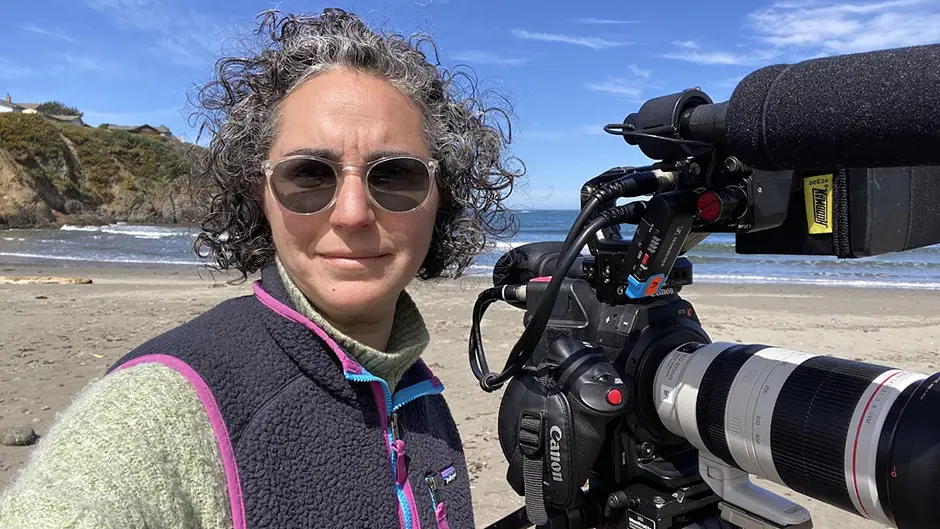
Natasha Benjamin was drawn to the ocean from a young age.
“Growing up, my father would take me snorkeling in Miami and the Florida Keys, and I fell in love with an underwater world,” she said. “Over the span of a few decades, I watched the coral reef ecosystem change before my own eyes—coral started to bleach, then crumble and fall apart.”
Witnessing these changes and the speed and scale at which they were occurring—and guided by the words of ocean explorer Jacques Cousteau, who once said, “you protect what you love”—Benjamin decided to study marine biology as an undergraduate. She then went on to earn a master’s degree in marine policy at the Rosenstiel School of Marine, Atmospheric, and Earth Science in 2001, in hopes of protecting the ocean through policy reform and conservation.
Her thesis project took her out West, where she worked with the Ocean Conservancy and the Institute for Fisheries Resources in San Francisco. She worked closely with small-scale fisherman and conducted a comparative study of fisheries management, examining approaches from both a conservation-focused organization and an industry-supported NGO.
Benjamin fell in love with the Bay Area in the process and never left.
It was there that she learned about kelp forests, which inspired her first film, “Sequoias of the Sea.” It’s a story about the catastrophic 95 percent loss of California’s kelp forests and the community’s response to save it, told through the lens of the fishermen, tribes, and scientists working together to restore their natural home. The film premiered at the International Ocean Film Festival earlier this year, where it won the Environment Award.
“As a surfer, a diver, a marine scientist, and an ocean conservationist, I spend a lot of time in the ocean,” she said. “For the past 10 years, I have witnessed the mass destruction of kelp forests and the ecosystem of the coast of Northern California collapse.”
Kelp forests play a special role in the natural world, protecting biodiversity by creating habitat, food, and shelter for hundreds of species. Kelp also mitigates the effects of climate change by absorbing large amounts of carbon dioxide from the water through a process called carbon sequestration.
Kelp forests are vitally important to the cultures and livelihoods that have evolved around them. The destruction of these forests has negatively affected Northern California fisheries, indigenous tribes, and the coastal economy centered around tourism and recreation.
“In 2013 and 2014, there was a ‘blob’ of warm water that radically altered this ecosystem and caused major ecological shifts, which stressed kelp forests that rely on cold, nutrient-rich waters,” Benjamin said. “As a result of the rising temperatures and shifting marine life, kelp forests began to disappear.”
Benjamin partnered with Ana Blanco, the director of the International Ocean Film Festival in San Francisco, to document this story of climate change in real time through the devastating loss of California’s kelp forests.
“The more I told people about what I saw, the more I found that people had no idea this was happening,” she said. “I turned to film to tell this story because in 25 years of work in ocean conservation, I realized that film is one of the most powerful tools we have to show larger audiences what is happening in the ocean.”
Benjamin and Blanco titled the project “Sequoias of the Sea” to illustrate the scale and importance of kelp forests to ocean life.
“Kelp creates a canopy and ecosystem underwater just like our land-based forests do,” she said. “When we lose a land-based forest to deforestation or fire, people can visually see the loss, which better helps to understand it. When we lose an underwater forest, most of the population will not be able to witness this change unless they are already divers or marine scientists.”
Over the next four years of production, Benjamin documented a community coming together in a crisis and working to find creative solutions to restore the ecosystem on which they live and depend on.
“It gave me hope to see fishermen and scientists working together to find solutions, to see tribal knowledge being incorporated into the scientific community, and in some cases, as a result of community-led efforts, we have even seen kelp forests regrow in areas,” she said.
Coral reefs, which make up one percent of our global coastline, have benefited from increased awareness campaigns, which in turn led to larger collective action, conservation efforts, and, eventually, a tentative rebound in coral health.
Kelp forests make up about a quarter of the world’s coastlines and play a major role in carbon cycling and sequestration. Benjamin hopes her film can bring awareness to this issue and help the kelp.
“Kelp can grow up to one foot a day and up to 100 feet tall, so we have a lot going for us in restoring kelp,” she said. “The film is about helping the kelp, but it’s also a story about a community responding to climate change occurring much faster than the scientific community ever thought possible—losing 95 percent of an ecosystem in just a few years was unheard of until now.”
