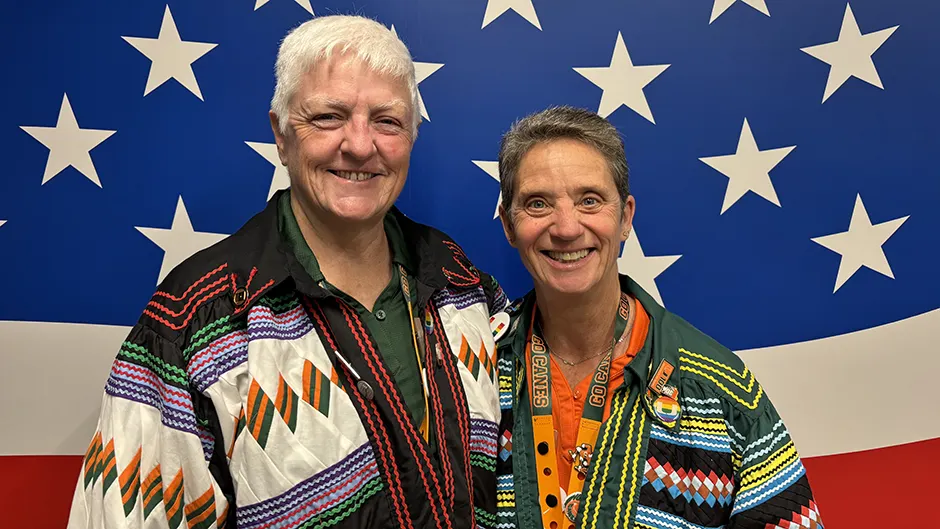
Colonel Alice Kerr knew she wanted to serve in the military when she was six years old.
She grew up listening to stories from her father’s and grandfather’s time in the service, proud of a family military tradition that stretches back to the Civil War.
“I believe that service is an obligation of citizenship,” she said. “But I also believe that service can take many forms—like teaching, working in the medical field, anything done outside of yourself to help others. I chose military service, partly because of my family and partly because I’m a sucker for the pretty uniform and the pomp and circumstance.”
Kerr went on to serve two combat deployments—first in Operation Desert Storm, then in Operation Iraqi Freedom—rising through the ranks to become a colonel.
One moment that stayed with her came during Operation Desert Storm, when she was deployed in Saudi Arabia. As she and her female colleagues explored the area, the local women took notice.
“I think the local women felt empowered watching us female soldiers do things that only men in their country were allowed to do—walking freely in public, wearing the same clothing as the men, carrying guns,” she recalled. “Not long after we arrived, the female teachers in the town organized a protest to push for greater rights for women. It was an eye-opening example of the real impact we had on the people there, a feeling you can’t capture in the history books.”
In 1994, she returned to civilian life, working for the University of Miami and later earning her master’s in liberal studies there. The transition wasn’t easy.
“In the military, an emergency is an emergency because our job is saving lives. In the civilian workforce, things that are considered important are sometimes treated like an emergency, like strategizing the menu or seating chart for a holiday party. This caused me a lot of angst,” she said.
To ease that transition, Kerr joined the reserves. “It gave me an outlet for my military mindset, which in turn helped me to readjust to my civilian life,” she said.
Still, she found it difficult to connect with the people who thanked her for her service.
“It becomes this weird existence for many veterans since we’re still figuring out how to tell our stories and what we want to share, while the people around us want to connect with us but don’t always know what to ask,” she said.
Kerr’s advice: approach them and say, “Hey, I hear you’re a veteran—do you feel comfortable sharing your story? What drew you to the service? Did you volunteer or were you drafted? What led you to re-enlist? What kept you going? What are some of your fondest memories?’ Nothing breaks down barriers like conversation, curiosity, and genuine interest.”
In 2007, Kerr was again called to active duty, deploying to Iraq in early 2008. This time was more difficult, as she was leaving behind a full life she had built alongside her now-wife, Sheryl Borg, herself a double Cane.
“Alice and I have always shared a strong commitment to service—she through the military and I through volunteering,” Borg said. “Four years into our relationship, Alice was plucked out of our lives and sent into a combat zone. I was extremely proud of her, but at the same time, I was terrified every single day.”
In 2009, Kerr returned to work with the Department of Homeland Security, where she served until her retirement. In 2017, she enrolled at the University’s School of Law to become an even stronger advocate for veterans. A few months shy of her graduation in 2020, Borg surprised her with the Colonel Alice A. Kerr Veterans Scholarship Fund.
“One night, Alice mentioned that it’s a shame that there aren’t more student veterans at the U,” Borg recalled. “I started looking into what it would take to create a scholarship in her name, a piece of her legacy that will live forever. Five years later, it has supported law, nursing, and physical therapy students—one recipient even re-entered the service as a nurse after graduation.”
Today, Kerr does pro bono work helping veterans, while the couple continues to give back to both veteran and LGBTQ+ communities. Earlier this year, Kerr and Borg made an additional gift to enlarge and endow the scholarship fund that bears Kerr’s name.
“We really believe in paying it forward, leaving the world a better place than we found it,” Kerr said.
