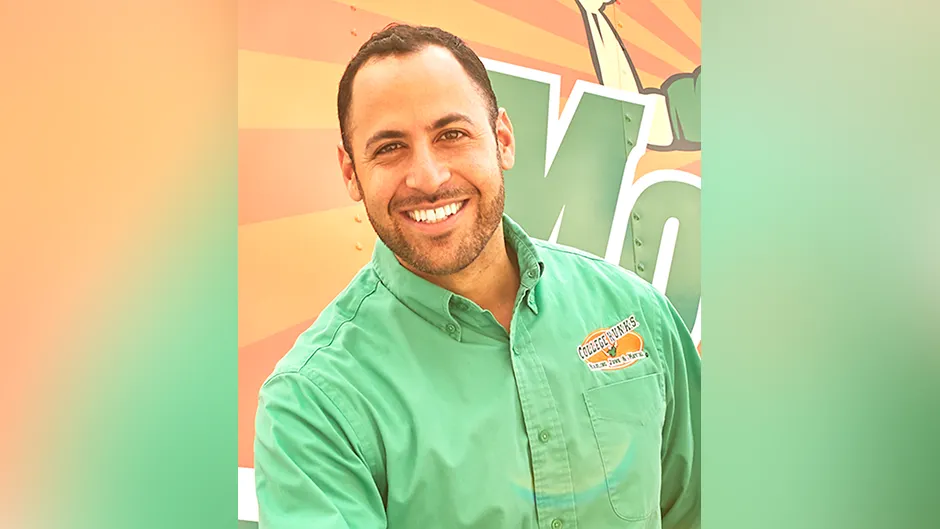
Moving mogul and entrepreneur Omar Soliman recently celebrated 20 years since founding College Hunks Hauling Junk with his partner and childhood friend Nick Friedman. In that time, they’ve grown the business from his mom’s van in Washington, D.C., into a national franchise with millions in annual profit and nearly 10,000 team members.
Here, Soliman reflects on the early days, milestones, and guiding philosophies that proved foundational to his success.
Q: How did you first realize your idea’s potential?
A: In 2004, my friend and I borrowed my mom’s beat-up cargo van to do odd jobs around the neighborhood, mainly hauling junk. She started calling us “the college hunks who haul junk,” which we thought was pretty funny, so we printed out some flyers with the name and posted them around town. That summer, we woke up early, worked late, and hauled junk in my mom’s van with no air conditioning—and by the end of it, we made almost $12,000.
When I returned to the University of Miami that fall, I enrolled in an entrepreneurship class. My professor announced a University-wide business plan competition, so I submitted a plan based on the concept we tested that summer. I became a finalist and presented my business proposal to a panel of professors and judges, eventually winning first place. That’s when I started to think this may be more than a summer gig.
Q: How did you take that idea and grow it into the multimillion-dollar company it is today?
A: In 2005, we bought a truck and committed to making the business a year-round endeavor. I had taken business classes, so I understood the theory, but the day-to-day realities—accounting, marketing, payroll—were completely new to me.
In those early days, Nick and I would drive the van, which had our number plastered on the side. We’d get calls complaining about our driving. After promising to “fire ourselves” a few times, we realized we needed a dedicated sales center to handle incoming calls.
We knew that if we wanted to scale, we needed systems to support that growth. Within a year, we grew from one truck to eight. We franchised our first location in Orlando under the direction of another Cane and continued expanding steadily, selling two to three franchises a year.
In 2008, we appeared on the very first episode of Shark Tank. We were offered $250,000 for 10 percent of the company, valuing us at around $2.5 million. It was a fair offer, but we believed the business would be worth more one day. We were 26 at the time, and I’m glad we trusted that conviction.
Q: What principles have shaped you as an entrepreneur?
A: I often compare building a business to playing a video game. The early levels are simple, but as you progress, the challenges get more complex.
Level one for us was just finding a truck and getting from point A to point B. As we leveled up, we had to juggle multiple trucks, integrate technology, establish a call center, and so on. Whenever we found ourselves stuck, we sought out people who had already overcome similar challenges to help us advance.
We are always trying to learn from people who have succeeded in the areas we’re navigating—through mentors, books, or the people we choose to surround ourselves with.
Operationally, we believe people don’t fail; systems do. That means bringing in people at every stage who are smarter than we are, who have the tenacity to execute big ideas, and who will push back when we’re biting off too much. Most businesses don’t die from starvation—they die from indigestion.
My partner and I also believe deeply in the idea that if you want to go far, go together. Running a business of this size requires a lot of people rowing in the same direction—franchise owners, our board, corporate staff, and the ‘hunks’ out on the field. Many business owners struggle with letting go. Letting go is essential to growth and evolution.
Q: What advice do you have for young entrepreneurs?
A: As an entrepreneur, your job is to be a detective. Seek out people who have succeeded in the ways you hope to succeed. Ask questions. Learn from them. There are so many clues to success out there—people who have already solved the problems you’re facing—but it’s your job to investigate and do your research.
The beauty of being a young entrepreneur is that you have an enormous amount of energy. You can chase goals with intensity, bounce back quickly from failure, and pivot without losing momentum or getting derailed. Speed is a superpower. Fail fast and fail forward.
