During the lab’s early years, World War II spurred interest in ocean studies, making the seas into a vital battlefield, and the Marine Laboratory’s focus turned to underwater acoustics for submarine detection. Sonar devices were deployed off Key Biscayne and Bimini to refine oceanic acoustic signatures.
Postwar, the lab broadened its research. In 1947 Walton Smith and his team achieved a significant breakthrough, identifying the cause of red tide responsible for fish die-offs. This discovery set the stage for ongoing research into harmful algal blooms. The following year, the University consolidated its marine-related curricula into a dedicated Department of Marine Science, awarding its first Master of Science degrees a year later. Early research spanned fisheries, hurricanes, marine physics, coastal zones, and coral reefs, establishing a robust foundation for future specialized studies.
In 1953 the Marine Laboratory continued its expansion with the development of a radar research lab on the Coral Gables Campus that supported hurricane tracking and meteorological research. Courses on weather radars quickly attracted National Weather Service personnel from across
the country, as well as prominent researchers from many disciplines. To accommodate the growth, staff moved to a new main building on Virginia Key, which was completed in 1957.
The lab underwent a significant transformation, reorganizing in 1961 as the Institute of Marine Science with three academic and research divisions, before evolving into the Dorothy and Lewis Rosenstiel School of Marine and Atmospheric Science
in 1969. Walton Smith became its first dean, marking the beginning of a renowned institution dedicated to advancing marine and atmospheric sciences.
The school’s commitment to collaborative research is evident in its long-standing partnership with the National Oceanic and Atmospheric Administration (NOAA) that led to the establishment of the Cooperative Institute for Marine and Atmospheric Studies (CIMAS) in 1977.
The school’s contributions are far reaching—from assisting with research on the Deepwater Horizon oil spill in 2010 using its F.G. Walton Smith research vessel to developing the North American Multi-Model Ensemble, a seasonal weather forecasting system that has provided reliable weekly forecasts to NOAA since 2016.
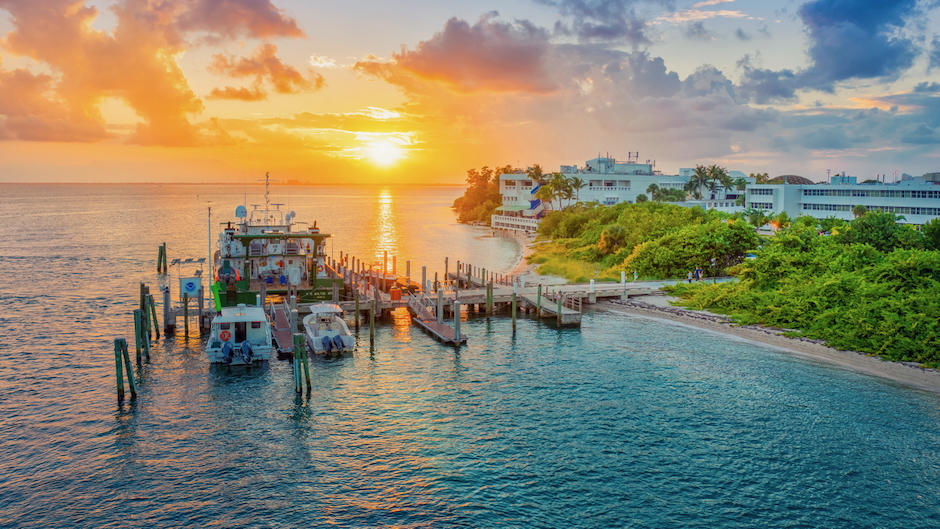
Uniquely situated on Virginia Key between Biscayne Bay and the Atlantic Ocean, the Rosenstiel School boasts cutting-edge facilities—including a unique wind-wave tank capable of simulating Category 5 hurricane-force winds and an aquaculture and coral hatchery facility. It also has a research station at Broad Key, located off the coast of Key Largo, and a teaching research station in the Galápagos Islands.
Today, the Rosenstiel School, which expanded its name in 2022 to better reflect the breadth and depth of its research and teaching, is home to nearly 300 faculty members and scientists across five departments and CIMAS.
Read the full issue of Miami magazine’s centennial edition online.
