Organized by the Master of Real Estate Development + Urbanism (MRED+U) program, the Capstone engages students and faculty from every program in the School of Architecture, including Architecture, Urban Design, Construction Management, and Real Estate. The Capstone is scheduled at the culmination of multiple graduate degree programs and provides an opportunity for students to apply the knowledge they've acquired throughout their studies. "It was interesting to see the collaboration between architects, developers, and construction managers. Seeing solutions arise from conflicts was a great insight into real-world decision-making," said Kevin Logue, Real Estate Development and Urbanism student. Capstone sites are selected to present various challenges and opportunities involving housing affordability, resiliency, historic preservation, transit-oriented development, and more.
The 2022 Capstone focused on the future of the 23-acre Alper Jewish Community Center (JCC) in Miami on The Jay Morton-Levinthal Campus in the heart of Kendall. The Alper JCC provides many opportunities for residents throughout south Miami-Dade County to enjoy recreational, educational, and community activities. The JCC's members and patrons' members include residents of all religions, backgrounds, and ages. Architecture student, Isabella Zayas, adds, "As a Miami native, I used to go to the JCC throughout high school to support my friends' theatre productions and recitals. I've always admired the JCC's strong sense of community and dedication to enriching the lives of its members.”
The Capstone engaged nine faculty members and 55 students from the School of Architecture organized into interdisciplinary teams. The faculty worked with JCC representatives to determine the goals and objectives for the workshop. The first challenge was to evaluate the nonprofit's property and determine which portions could be opportunities to rezone and sell off to the private sector. The sale of underutilized properties would generate funds to allow the JCC to retire debt and have enough left over to improve their existing buildings and grounds and introduce new facilities to support the JCC's programs. "The Capstone provides a real-life, hands-on experience where students and faculty from throughout the School of Architecture collaborate to craft proposals that embody best practices in livable community design and development. In the case of the Alper JCC, the students learned how to elevate and balance the needs of a nonprofit client and prospective for-profit developers and envision a thriving gathering place for the greater Kendall community," said Dr. Charles C. Bohl, Director of Master in Real Estate Development + Urbanism Program.
Another challenge was to evaluate the JCC's existing facilities and programs and plan for the future of the campus. The COVID pandemic adversely impacted community center programs and memberships everywhere, and the Alper JCC was no exception. In response, the JCC was interested in updating facilities and the mix of programs they offer which have focused on education, summer camps, sports, recreational activities, and arts and cultural events. Some of these programs are revenue streams (e.g., summer camps and schools), and others drive memberships (e.g., fitness facilities). Like most communities, the JCC's programs have also been focused on youth and seniors, and they were less successful at attracting the large in-between age groups from the community.
The teams began by looking at the surrounding context to understand the natural and built landscape and the scale and type of development around them to get an idea of what types of residential and commercial uses would be appropriate on portions of the JCC site. The students found that the JCC site was zoned for low-density, single-family use but was surrounded by multistory apartments and townhomes. They also found that the County's future land use map designates the JCC site for medium-density development in the future, consistent with the multistory development already approved and built around the site.
To understand the County planning and zoning process Shailendra Singh, the Miami-Dade County Urban Design Center Supervisor, and a School of Architecture alumni was invited to participate in a session with the students. Mr. Singh answered the student's questions about the rezoning options they were considering for all, or parts of the site and the review and approval process involved. The students learned that the JCC site was large enough to apply for a Planned Area Development (PAD) zone, which allows the flexibility to pursue best practices for livable community design, mixed-use, and public spaces that the students study at the School of Architecture. The PAD strategy allowed each student team to come up with unique scenarios and master plans for the entire 23-area site incorporating a variety of homes, apartments, grocery stores, shops, restaurants, and services, as well as a long-term build-out of the JCC campus facilities. This represented the best strategy for the JCC as it would increase the value of properties sold and provide more revenue to the nonprofit to retire their debt and reinvest in campus facilities. Real estate development scenarios were run for parcels the teams proposed selling and illustrated the financial feasibility under the PAD plan. Each team created an entirely new campus plan for housing existing and new programs with strategies for gradually implementing this over time at a pace to be determined by the JCC. "This year's project was one of the most challenging projects in the Capstone collaborative history among the participating programs. In past projects, the level of detail was subverted to the general idea of the project. In this case, it was impossible to hide from a high level of detail. The very small territorial coverage, its suburban location, the complexity of the existing financial situation, the zoning challenges resolved by the Plan Area Development (PAD) portion of the Miami-Dade County zoning code, and the necessity to measure the pace of development in modest phases created conditions requiring a high level of professionality and commitment on all our students and faculty," added Professor Jaime Correa.
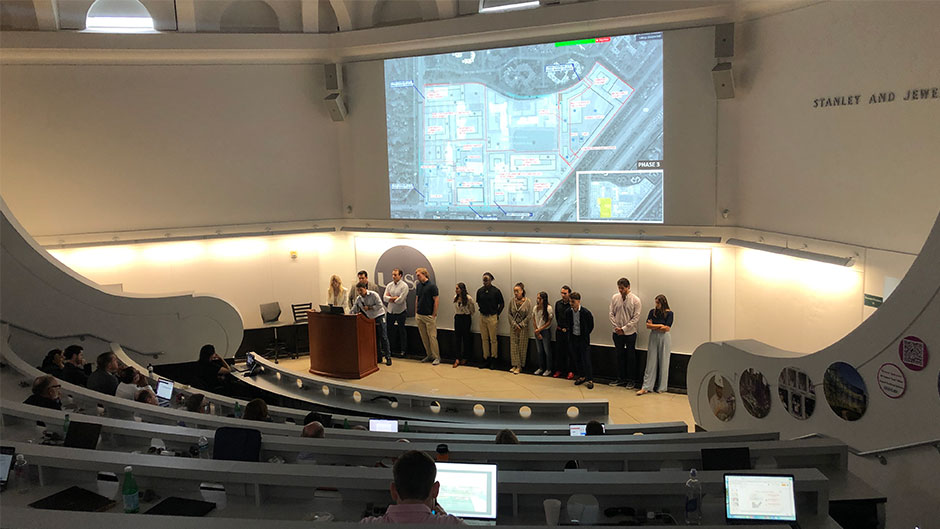
Each team gave a formal presentation of their work and took questions from JCC stakeholders in Glasgow Hall at the School of Architecture at the Capstone Final Review. At the end of each presentation, the students highlighted how their proposals responded to the needs of the JCC, prospective private sector developers, future residents of the site, and the greater Kendall community. Weaving together all these uses would be the walkable streets, parks, and public spaces that would underpin a community gathering place for farmers' markets, community celebrations, and family gatherings that serves the greater Kendall community. "A Jewish Community Center is an opportunity for people of the Jewish faith and people who want to part-take in the community to be together in a creative, beautiful, functional environment. You all are the future leaders in your fields, and based on these presentations, deservedly so," emphasized Jacob Solomon, President, and CEO of the Greater Miami Jewish Federation.
Now, the stakeholders are equipped with four new scenarios filled with innovative ideas for planning, development, and programming concepts. They can choose which portions of the projects will work best for their objectives toward a successful dwelling for the community and a profitable outcome. And these students from different programs gained the experience of working together to accomplish a strategic goal. Professor Yasmine Zeghar added, "I believe the biggest takeaway for each student after this experience was working as a team. It was very challenging for them because they were from different disciplines. However, they managed always to show that they were united, well-coordinated, and very professional."

