
The school’s rich history began in fall 1927 with three courses and a faculty that was supplemented by local talent. A distinguishing feature of the program was the presence of female students.
By the mid-1930s, a number of factors led the University to scale back its operations, with the architecture program being among those affected. The program reemerged in 1950, gaining a foothold in the Department of Architectural Engineering within the School of Engineering and grew into a five-year Bachelor of Architecture program by 1968.
An independent School of Architecture was established in 1983, moving to its current facilities on the Coral Gables Campus—a set of international-style buildings designed in 1947 by Marion Manley.
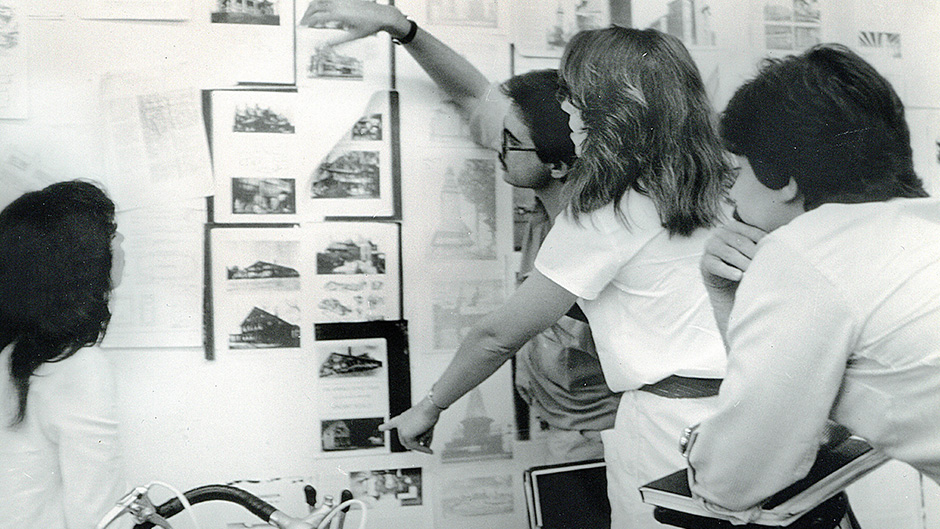
The school founded its first graduate program in 1989. Both the Bachelor of Architecture and the Master of Architecture programs received accreditation from the National Architectural Accrediting Board in 1974 and 1995, respectively.
The opening of the Jorge M. Perez Architecture Center in 2005 added a new hub for learning and discourse. A widening scope included programs in adjacent fields, such as real estate development and construction management, as well as a deepening focus on sustainability, resilience, and technological innovation. The construction of key facilities, such as the Thomas P. Murphy Design Studio Building and the B.E. & W.R. Miller BuildLab, supports the school’s emphasis on project-based learning and emerging construction techniques. Collaborations with industry leaders have led to the adoption of advanced tools, including the first large-format concrete printer in a school of architecture.
The school actively collaborates across disciplines, including partnerships with the Climate Resilience Institute, Center for Global Black Studies, Department of Geography and Sustainable Development, and College of Engineering, to address 21st-century challenges through innovative research and teaching. Its study abroad program has expanded from its renowned Rome Program, launched in 1991, to include courses and semesters for undergraduate and graduate students, and summer programs for high school seniors. More than 50 percent of its students participate in study abroad programs based in Europe, Asia, the Caribbean, and Latin America.

Since its founding, the school has been deeply committed to community engagement and advancing social equity. In 1992 the school mobilized faculty members and students to assist in rebuilding efforts following Hurricane Andrew, which led to the establishment of the Center for Urban and Community Design. The creation of the Social Justice Prize and Teaching Fellowship empowers students and staff and faculty members to actively address critical global issues, fostering a strong sense of belonging and purpose. An emphasis on community-oriented design and environmental stewardship are woven into the curriculum.
Today, the school stands as a leader in urban resilience and technological innovation, preparing its students to address the complex challenges of the future.
Read the full issue of Miami Magazine Centennial Edition online.
