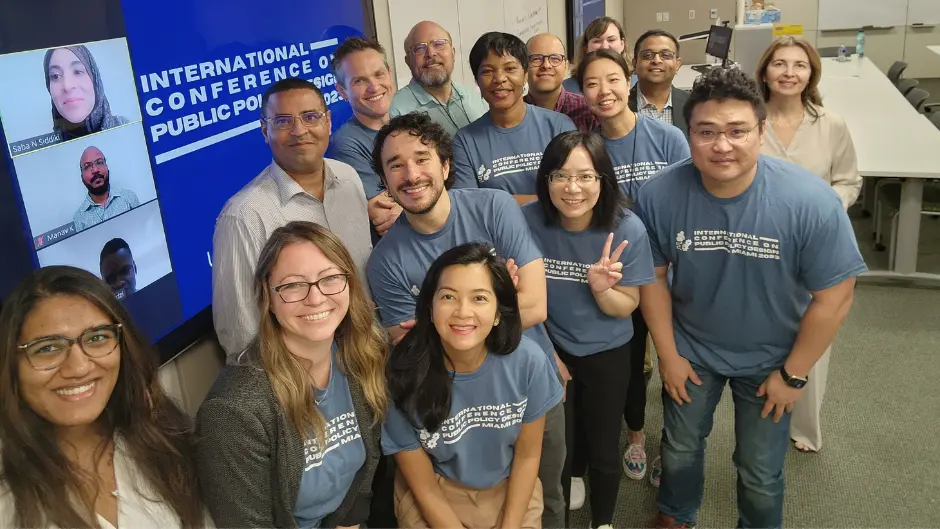
Ask Cali Curley what has changed about the online Master of Public Administration at the University of Miami, and she has plenty to share.
Curley, who is entering her third year as M.P.A. program director this fall, points to the enhanced emphasis on in-demand skills that students can apply immediately in their careers.
"One of the things we do best is build a real tangible skill set that is immediately beneficial to the students and their employers," said Curley, who previously taught at Indiana University/Purdue University.
Curley is proud of the expanded opportunities for online students to engage with faculty, fellow students, and working professionals, both in person and virtually.
 Students will be encouraged to attend professional conferences and events in their own communities, through the newly formed student chapter of the International City/County Management Association (ICMA).
"This will provide our students with excellent resources and on-ramps to network and develop new skills," Curley explained. "By being part of the student chapter, they will be able to connect with the local chapter where they live and attend events close to home."
When asked about new courses launching this fall, Curley really lights up.
One of three new courses is public program evaluation, a subject Curley has taught for more than a decade and a practice she regularly engages in with government and nonprofit organizations.
"This course is my baby," she said, laughing. "We haven't offered it online before, and it is something that elevates the profile of the degree itself. This is theory in action, we apply real-world tools with real-world implications.
"Understanding how to properly evaluate public programs, policies, and organizations is one of those skills that can easily be applied in almost any position."
Since the online M.P.A. is designed for mid-career professionals, mastering program evaluation skills has a distinct benefit, she said.
While many M.P.A. programs emphasize theory, Miami's program stands out, Curley said, for its skills-driven approach and distinct faculty specializations, including:
- Local government leadership: develops the knowledge and skills needed to manage municipalities, engage with diverse communities, and lead with transparency.
- Sustainability and environmental policy: focuses on environmentally responsible governance and sustainable public service strategies.
- Participatory governance: equips leaders to create inclusive decision-making processes that reflect and serve their communities.
Courses range from budget and financial management to ethics in government, business, and nonprofits, equity and diversity, complemented by statistics, human resources management, and organizational dynamics and management.
Graduates of the program pursue careers across the public, nonprofit, and private sectors, including city management, human resources, nonprofit leadership, public policy analysis, and sustainability consulting.
The goal is to weave applied experiences through the program, Curley emphasized.
Students might participate in community engagement projects or run simulations mirroring real-life policy or management challenges. These applied learning opportunities bridge theory and practice, ensuring graduates are prepared to lead from day one.
In addition, the curriculum encourages the ethical use of emerging tools like AI, helping students navigate the evolving technological landscape of public administration.
"We've updated the program in a way that reflects the specific skills and expertise that are most in demand in today's workplaces," she said.
"We have an energetic core faculty group with strong and emerging research profiles," said Curley, who in addition to being director of graduate studies, serves as associate editor for "Public Administration Review," a leading journal in the field.
The faculty bring a combination of academic expertise and real-world experience to the curriculum, with some members advising federal agencies, contributing to environmental policy at the utility level, or serving as thought leaders in public administration.
They uphold rigorous academic standards and also emphasize mentorship, work-life balance, and ethical leadership, Curley said.
"Our faculty aren't just good at what they do, they're good people too," she explained. "They genuinely care about their students, they care about the greater good, and the benefit to society from the kinds of work our students will be doing in the world."
One of the best examples, Curley noted, is the program's associate director, Sharon McIntyre, who was recently named the Jonathan P. West Educator of the Year by the South Florida chapter of the American Society for Public Administration (ASPA).
McIntyre, who Curley said is "all about student engagement," is taking on a new role with the program, helping students build connections through professional development, internships, and networking.
It's no surprise, Curley said, that McIntyre won an award named for West, a beloved former director of the M.P.A. program who died in 2022.
"Dr. West was amazing," Curley said. "He wore every single hat with enthusiasm. I strive to be a bit like him. We all do."
The online Master of Public Administration is accepting applications through Aug. 14. Classes begin on Aug. 18.
