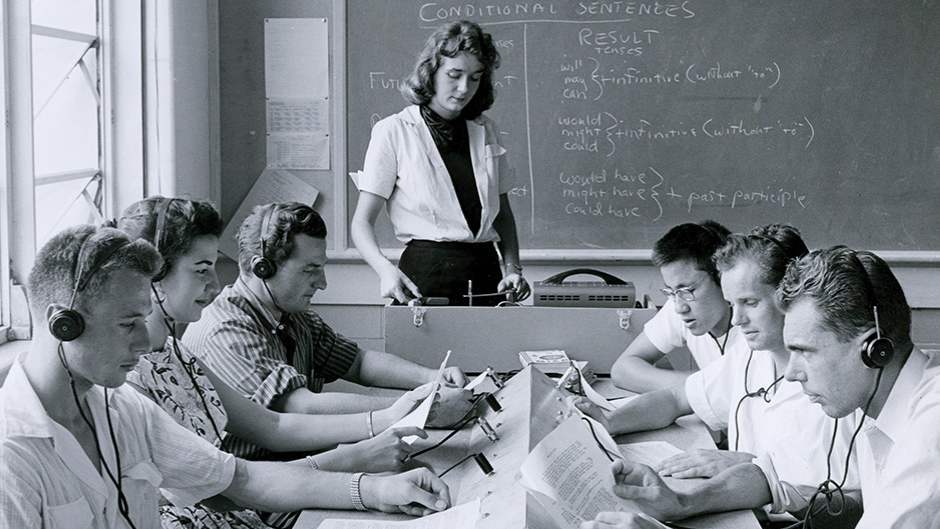
While program names and leadership have changed, the concept of adult education, now commonly known as continuing education, dates back to the University's founding in 1926.
Bowman Foster Ashe, the University's first president, never forgot his early teaching experiences in recreation centers in Pittsburgh, where he grew up. He developed his own concept of adult education, which he saw as a kind of "intellectual recreation."
Ashe envisioned this early adult education program as encompassing lecture series and concerts, drawing upon Miami's winter visitors for its speakers, performers, and audiences. However, it wasn't until the 1960s and the arrival of Dean M. Robert Allen that continuing studies took off with renewed interest, increased enrollment, and new program offerings. Allen revitalized the program, transforming it from a part-time, "hobby-oriented" initiative offered during the summer and evenings into a professional program focused on lifelong learning.
Under Allen's leadership, the School of Continuing Studies launched in 1974 and was quickly recognized as one of the leading centers for continuing education in the nation.
In addition to serving as dean of continuing studies, Allen was also director of the summer sessions program, which was pulled into the continuing education umbrella. Allen had a tremendous interest in international affairs and launched programs with a focus on Latin America, the Caribbean, and the Middle East. Today students from more than 90 countries study through the University's continuing education language programs.
A year after Allen retired, a new building named in his honor opened to house the growing school. Built at a cost of $1.1 million and funded with donations from James L. Knight and more than three dozen other donors, Dean Robert Allen Hall was dedicated in 1985.
The 30,000-square-foot facility had 19 classrooms, an English laboratory, computer lab, and, somewhat unique for the time, the capability to link electronically to the Whitten Learning Center and what was then the University's James L. Knight International Center in downtown Miami.
Growth continued and the school was later renamed the Division of Continuing and International Education to better reflect the inclusion of international language programs that launched in the 1950s and saw explosive growth in the 1970s and 1980s.
The Bachelor of General Studies program, created in 1970 by President Henry King Stanford, was integrated into the expanding continuing education division to provide students with more flexible options for completing their degrees.

In 1984 the University created what would become a flagship program of its continuing education division—the Institute for Retired Professionals, renamed the Osher Lifelong Learning Institute (OLLI).
Today the Division of Continuing and International Education continues on its path to provide programs to students of all ages at every stage of life. From high schoolers experiencing college through pre-college programs to professionals looking to advance their careers with certificate programs, and, most recently, the addition of online education through UOnline, the division seeks to disrupt the continuing education landscape by creating revolutionary learning experiences into the next century.
Read the full issue of Miami Magazine Centennial Edition online.