When Adriana Ramirez took an Advanced Placement biology class her junior year of high school, she was hooked.
“It was amazing. Everything felt like a puzzle that I was putting together,” she said. “And I noticed that the people around me weren’t enjoying it quite as much.”
After graduating from Coral Gables Senior High, Ramirez enrolled at the University of Miami College of Arts and Sciences with a plan to major in biology and go on to medical school. She had moved from Havana, Cuba, to Miami when she was 13, and the idea of staying close to her new home appealed to her.
The University proved to be a good fit for Ramirez, who described it as “the best college experience I could ask for,” but after working as a medical scribe at a local hospital, she began to realize that medicine wasn’t for her. She still loved biology; she just didn’t think she would enjoy the other aspects of working as a doctor.
It wasn’t until her senior year when she took Developmental Biology (BIL 455) with Athula Wikramanayake, a professor in the Department of Biology, and Seminar in Research Problems (BIL 299) with Julia Dallman, an associate professor of biology, that everything started to fall into place.
In the Developmental Biology course, Ramirez was fascinated to learn more about how cell type is determined. Hearing from the alumni invited to speak to the biology seminar about their diverse career paths was similarly illuminating, and Ramirez realized there were myriad opportunities for her outside of medicine. When one of the guest speakers recounted their experience taking a gap year before graduate school to conduct research, Ramirez thought, “Maybe I should do that.”
The summer after she graduated in 2024 with a bachelor’s degree in biology, Ramirez interned with the Miami soccer team Inter Miami CF, analyzing data on the athletes’ performances and recovery times to see how those metrics compared to incidences of injury.
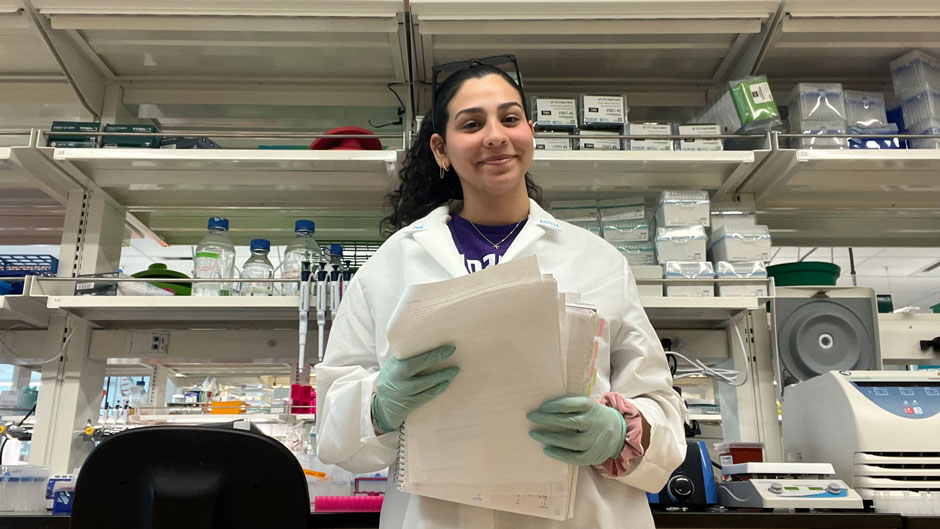
Then, in the fall, Ramirez started a postbaccalaureate researcher position at Washington University in St. Louis, where she has spent the past ten months studying transcription factors—proteins that play a role in gene expression—and working on a research project that involves reprogramming skin cells to become liver cells.
“The whole idea is that after we transform them, we are able to see at different time points what changes within the genome to understand how they change from one fate to another, and what triggers that,” she explained.
Ramirez’s job involves reading numerous research papers, as well as conducting experiments and analyzing data. Sometimes the experiments require her to stay in the lab until late in the evening or come in on a Sunday because the cells she’s working with require attention. She doesn’t mind, though.
“The whole time I’ve been here, it just keeps on getting more fun,” she said.
The experience has solidified Ramirez’s interest in pursuing a career in biology research. In the fall, she will be starting a Ph.D. program in molecular genetics and genomics at Washington University in St. Louis. She isn’t yet sure what area she’ll specialize in, but she’s interested in studying muscle regeneration and cell reprogramming.
Ramirez’s long-term goal is to go into academia. She wants to conduct research, but she’s also drawn to the opportunity to teach and mentor students who, like her, might not initially know which career path to take.
As a first step, Ramirez returned to Dallman’s biology seminar during the Spring 2025 semester, this time as a guest speaker, to share her research experience with students.
“Mentoring has been a big part of how I got here,” she said. “I would like to have my own lab and also teach and be able to mentor people in the process to help them find their passion like I found mine.”