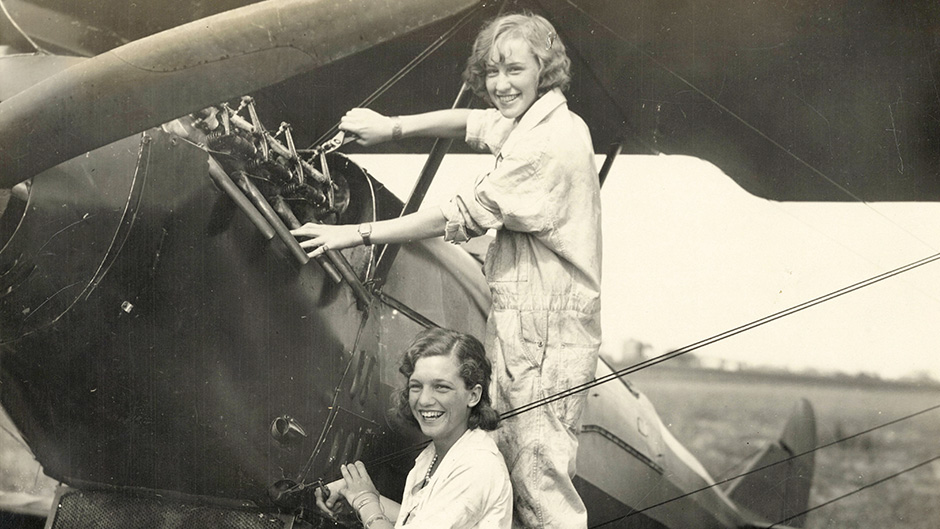
One of these early projects was the Vacuplane, an experimental aircraft developed at the University in the 1930s. With the onset of World War II, the University expanded its engineering-related programs to support the war effort, preparing cadets of the U.S. Army Air Corps and Britain’s Royal Air Force for critical roles in navigation and precision bombing.
Following the war, demand for skilled engineers grew, and in 1947, the School of Engineering was officially established. The school initially enrolled 400 students, the majority of whom were veterans taking advantage of the GI Bill. This postwar period saw a surge in aviation advancements, and by the 1950s, enrollment had tripled. Generous contributions, including a $2 million donation from J. Neville McArthur of McArthur Dairy, supported the construction of a dedicated engineering building.
The space race between the United States and the Soviet Union in the 1960s opened new opportunities in aerospace engineering. Many graduates went on to work on pivotal NASA projects, including the historic Apollo missions and the space shuttle program. In the 1970s, the global energy crisis underscored the need for alternative energy solutions, and the School of Engineering was at the forefront of research into solar energy and hydrogen storage. The decade also marked the expansion of the McArthur Engineering Building with a new wing dedicated to environmental engineering.
Later that decade, the school ventured into healthcare technology with the creation of the Department of Biomedical Engineering. Early pioneers worked on designing artificial organs, helping to keep patients alive while they awaited transplants. This marked a major milestone, highlighting the school’s dedication to improving human life through engineering. As the school expanded, faculty members voted to grant autonomy to the architecture program, which had been housed within the school, officially establishing the College of Engineering and the School of Architecture as separate entities in 1983.
With the dawn of the information age in the 1990s, the college positioned itself as a leader in telecommunications and information technology, playing a key role in advancing satellite communications, microchip technology, and super- computing. Programs in cybersecurity were also launched to keep pace with the tech-driven economy.

In the 21st century, the college established the Johnson & Johnson 3D Printing Center of Excellence, where students, faculty members, and industry professionals could access cutting-edge 3D metal printers to manufacture body parts for orthopedics or engine parts for rockets. By 2021, the college had expanded to six departments, adding programs in chemical and materials engineering and launching new research initiatives in aerosol science, thereby positioning itself as a leader in environmental and atmospheric studies.
The college is expanding its local, national, and global impact, including ventures into space, and is now focusing on strategic initiatives in emerging fields where innovation is needed most, such as health tech, digital tech, nanotech, cleantech, and fintech.
Read the full issue of Miami magazine's Centennial Edition online.
