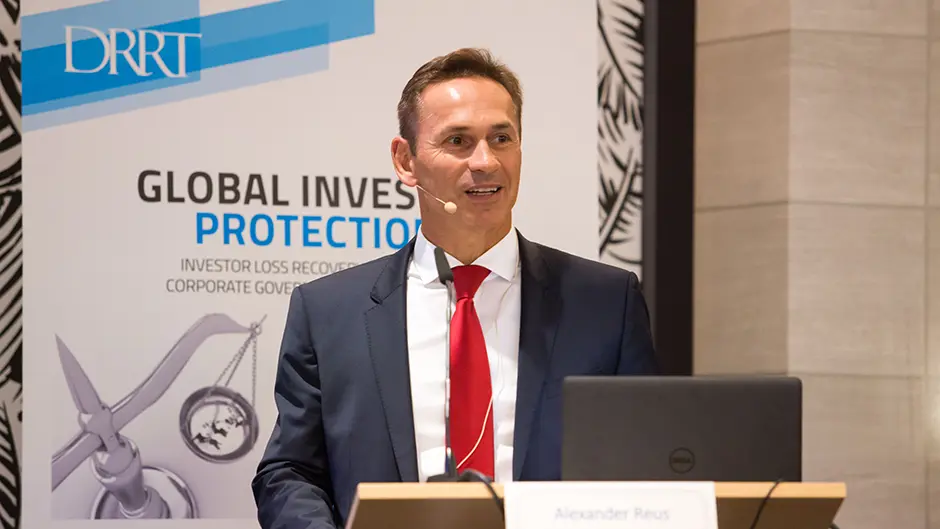
For Alexander Reus, the path from international law student to founder of a global litigation practice was shaped in part by opportunities he nearly did not have. More than 30 years after earning his law degrees at the University of Miami, he is working to make that path more accessible for the next generation of international attorneys.
Reus, who earned both his J.D. and LL.M. from the University of Miami School of Law in 1993, has established the DRRT Strive for Excellence Endowed Law Scholarship. In addition, he has begun offering paid post-master’s internships for students in the School of Law’s international LL.M. program.
The internships reflect his belief that access to professional experience can be just as critical as classroom instruction, particularly for students navigating the U.S. legal system from abroad.
“We set up two programs to provide post-master’s internships in our firm, paid internships,” Reus said.
Originally from Germany, Reus came to the United States for law school after beginning his legal education in Europe. He said the American law school model differed significantly from what he had known, offering a more structured and interactive academic environment.
“Now that I’ve lived and worked in the U.S. for more than 30 years, it’s clear to me that this education was very formative for my career,” he said.
While he described European legal education as more theoretical, Reus said the U.S. system emphasized engagement, smaller classes, and a stronger sense of academic community. He also pointed to the campus experience as a defining feature of his time at the University.
“The campus atmosphere was something I’d never experienced before,” he said, noting that collegiate life and alumni culture are far less prominent at European universities.
That sense of connection ultimately influenced both his decision to remain involved with the University and his choice to direct his philanthropy toward academics. Reus said he intentionally focused his support on the School of Law.
“I’m more academically focused, particularly on the legal field,” he said. “I wanted to ensure that the gift went to the law school.”
After graduating, Reus spent several years clerking and working at U.S. law firms before deciding to build his career in the United States. In 2004, he founded his own firm, which now operates internationally and focuses exclusively on securities litigation representing shareholders in cases involving corporate fraud.
Reus said his firm has helped expand plaintiff-side securities litigation beyond the United States, leading first-of-their-kind or landmark cases in multiple countries across Europe and Asia.
Those global roots are central to his support of the international LL.M. program. Reus recalled how difficult it was to secure professional opportunities as a foreign-trained lawyer.
“I sent around 100 applications and couldn’t get anyone to hire me for an internship,” he said. “Firms would see you as someone studying for just a year, then going home.”
By offering paid internships through his firm, Reus hopes to remove that barrier for current students while strengthening the program’s appeal to international lawyers seeking exposure to U.S. legal practice.
“This is about making the LL.M. program stronger and more appealing to international lawyers,” he said.
Reus also credits the University’s location with shaping his experience. Despite an offer from Cornell, he chose the University of Miami after visiting the campus and connecting with the city. He later decided to remain in Miami permanently.
“I could live and work anywhere, and I chose to stay in Miami,” he said.
His connection to the University has deepened further as his oldest son recently enrolled at the University of Miami Patti and Allan Herbert Business School.
Beyond financial support, Reus remains engaged with students, regularly speaking to incoming LL.M. classes about career planning, networking, and making the most of their time in the United States.
“Giving back isn’t just about money,” he said. “I believe in giving back with time, mentorship, and resources.”
For alumni considering philanthropic involvement, Reus framed giving as both gratitude and responsibility.
“If you’ve been successful after attending the University of Miami, you probably owe some of that success to your time there,” he said. “You should acknowledge that and give back.”
