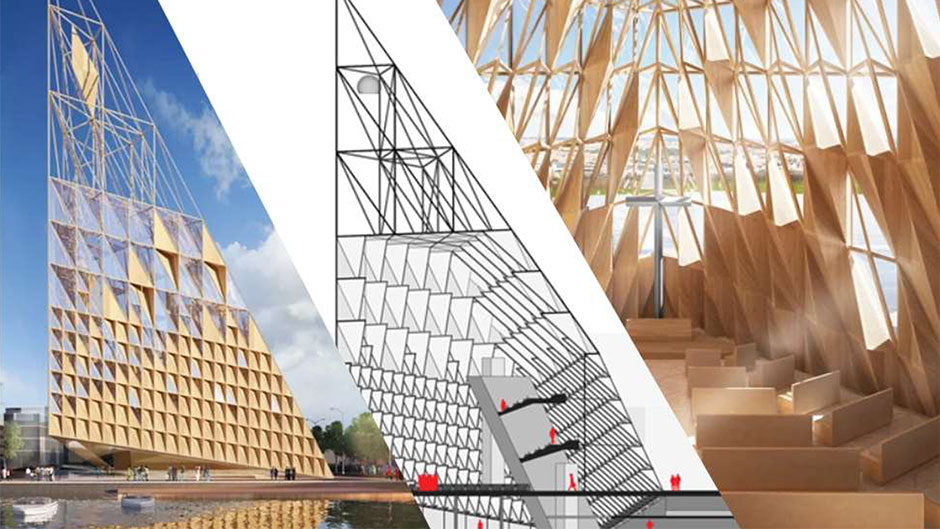
Hector joins William Green, a professor of Religious Studies, and Kim Grinfeder, Director of the Interactive Media Program in the School of Communications, to focus on religion, artificial intelligence, and virtual reality. They taught the course together last year, but this year students were able to fully engage into the metaverse via Oculus 2 virtual reality headsets – which allows the entire class to meet virtually.
“Bill Green and I have been collaborating on a class focused on sacred space the last five years,” Hector said. “Much of, of the greatest architecture is religious and we explore the mutual dependence of architecture and religion with our students “Kim works in the area of XR (extended reality) and his VR/interactive media expertise has expanded the realm of investigation to immaterial reality which strengthens the collaboration.”
Hector, who has been part of SoA long before VR and AI were part of our vocabulary, said that after a short period of adjustment virtual experience is not remote or artificial rather it creates real haptic experience. The course is a part of the University’s QEP towards the implementation of discussion-based learning and that virtual reality allows us to visit and experience cathedrals, mosques, temples and other religious sites, experience them together and discuss their significance and affect interactively in the virtual site.
“The course is truly interdisciplinary both the students and faculty are grounded in different disciplines. We have readings in architecture, readings in religion, development of virtual reality from the communications side to help establish a common framework for our discussions,” Hector said. “We put all this out there – encountering real phenomenon just not in physical space – and the students discuss their perceptions.”
Hector said it is interesting to see the perceptions of space through the lens of architecture, religion and communications students. “The architecture students speak about buildings differently in this class - more personally and experientially - than they do in SoA design courses,” he said. VR allows us to test the boundaries of what makes space real and what makes space sacred.
In the virtual world, 15 students and three faculty members will be in the same space, but obviously not in the same room. Hector said the level of immediacy, collaboration and sharing is incredibly promising as a teaching tool.
The final project is the design a ritual in a sacred space. In the first year of the course, which was conducted more two dimensionally before everyone had VR goggles, one of the projects created a Roman Catholic Confession ritual via AI and another proposed a virtual Hadj. This year, working in cross-disciplinary harmony, the final deliverables promise to be as boundless as the metaverse.
Steve Wright (@stevewright64) created and co-teaches the groundbreaking course on Universal Design at the U-SoA. He is a Pulitzer-nominated, award-winning writer who blogs daily at: http://urbantravelandaccessibility.blogspot.com/
