What do safer runs, sustainable farming, and advanced rehab for amputees have in common? They’re all the focus of student-led startups that each received $100,000 in funding from the University Student Startup Accelerator (USTAAR), established in 2023 through a generous donation from alumni brothers, Angel and Victor Alvarez.
Among the winners: 3rd-i, a personal safety app; Smart Aerosol Technologies, which develops nanoparticle fertilizers; and SimuStride, an augmented-reality rehabilitation system.
An app that makes safety social
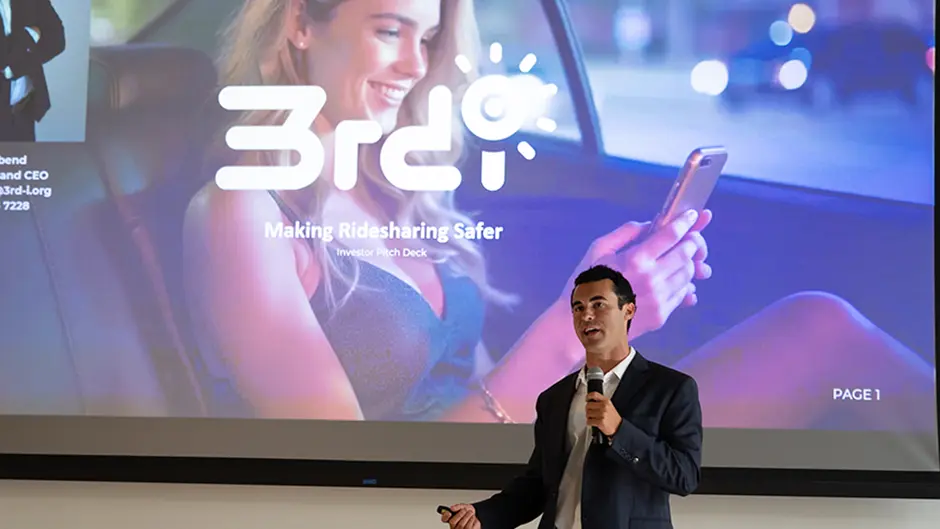
Dillon Abend, B.B.A. ’25, often enjoyed nighttime runs through wooded areas near his New Jersey hometown, but recognized the risks as well. As a safety precaution, he would FaceTime a friend while running, but soon realized that if he were attacked, the friend would not know his location. That gap between feeling connected and being protected sparked an idea.
When he arrived at the University of Miami, Abend began to see safety through a wider lens. Students, like residents in any large urban area, navigate everyday uncertainties—walking alone after dark, passing through unfamiliar areas, or stepping into a car with someone they’ve never met.
Working with dozens of fellow students, as well as survivors and families impacted by safety-related incidents, Abend built 3rd-i, a smartphone app that, as he puts it, “makes safety social.”
3rd-i helps keep users safe by live-streaming their location to trusted friends and loved ones. The app also enables users to connect discreetly to emergency dispatchers, and post anonymously about incidents on a community safety feed.
“Students and riders often text or call a friend to ‘stay safe,’ but there’s no context, no live location, and no reliable way to escalate. 3rd-i makes safety habitual by blending it into everyday social behavior,” Abend explained.
Since receiving the $100,000 grant from USTAAR in 2024, Abend’s startup has been successful in two other business plan competitions and raised more than $1 million in additional funding. 3rd-i has gone live on the Apple App Store to rave reviews from users.
Plans are underway for product launches across more than 50 campuses through more than 120 product ambassadors, and the company has partnered with safety-focused nonprofits.
Precision farming solutions
Shruti Choudhary, an aerosol science doctoral student in the College of Engineering whose grandfather was a farmer in India, aims to revolutionize sustainable agriculture through Smart Aerosol Technologies (SmArT), an agriculture tech startup focused on precision farming solutions. SmArT’s nanoparticle fertilizers not only boost crop yield but also minimize the amount of fertilizer required, reduce water consumption, and are cheaper to transport.
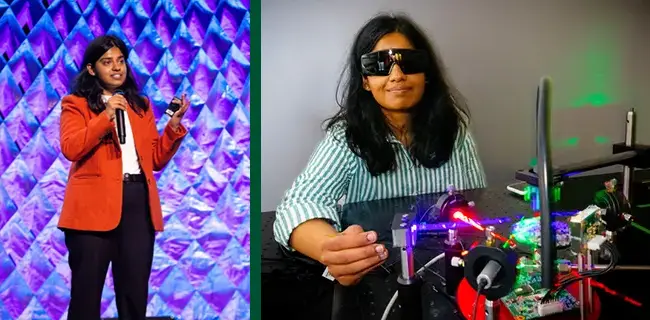
“Farmers worldwide face significant challenges with fertilizer runoff, where 50 to 80 percent of traditional fertilizers are lost to the environment,” Choudhary explained. “On top of that, fertilizer resources are limited, creating mounting pressure to sustainably feed a growing global population.”
In addition to the $100,000 grant from USTAAR, SmArT garnered $125,000 from the eMerge Americas Startup Showcase and was among the top seven at MIT’s Water, Food, & Agriculture Innovation Prize competition. SmArT is starting greenhouse trials later this fall and has partnered with South Florida’s DiMare Homestead for field testing.
Rehabilitation through AR
Ben Broyles, Elissa Cimino, and Aidan Scott-Van Deusen, all B.S.B.E. ’25, collaborated on another USTAAR pitch winner. SimuStride is an augmented reality rehabilitation system for lower-limb amputees, designed to help them regain motor skills and mobility before they receive a prosthetic.
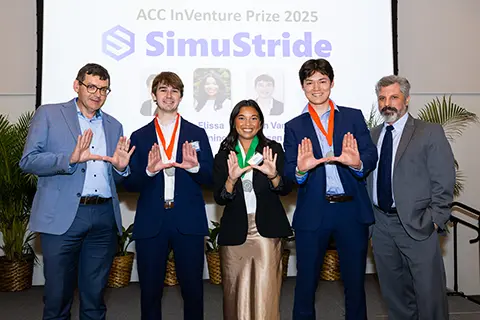
“After amputation, patients often wait months before receiving a prosthetic leg, which can lead to phantom limb pain and the loss of critical motor skills,” Broyles said. “SimuStride bridges that gap by allowing patients to begin rehabilitation with a virtual prosthetic just days after surgery.”
SimuStride incorporates a sleeve worn over the patient’s residual limb that captures the electrical activity of muscles and nerves. Using augmented reality, virtual elements are superimposed into the user’s physical environment, where they will see a virtual prosthesis and can control its movement based on real-time muscle activity.
Broyles, Cimino, and Scott-Van Deusen are preparing a pilot study in collaboration with surgeons at UHealth – University of Miami Health System and are taking steps toward FDA clearance for SimuStride.
In August, the SimuStride team won the National Institutes of Health DEBUT Challenge’s Rehabilitative and Assistive Technologies Prize, which recognized the team’s innovation at a national level and awarded funding to continue development.
From idea to innovation
3rd-i, SmArT, and SimuStride are among nine student-created innovations that have, to date, received $100,000 in startup funding USTAAR. The $100,000 grants, awarded after a “Shark Tank”-style pitch competition, enable winning teams to advance their ideas from concept to prototype, minimum viable product (MVP), and feasibility testing. In preliminary pitch competitions, teams compete for $10,000 grants and the opportunity to advance to the main competition, and all finalists benefit from mentoring throughout the program.
As a successful entrepreneur, Suhrud Rajguru, director of USTAAR, professor of biomedical engineering and otolaryngology, and assistant vice provost for research workforce development, knows from firsthand experience how vital early mentoring and financial support are for fledgling startups.
“Any startup company knows that the first investment, combined with the right mentorship, is the most critical to get you off the ground,” Rajguru said. “The majority of startups fail because they don’t know where to get that. We didn’t have any program to support students with hands-on mentoring and capital at the level of $10,000 to $100,000” before the Alvarez family stepped up, along with an earlier donor, scientist and entrepreneur Jonathan Rothberg, who established the Miami Engineering Rothberg Catalyzer Award.
With two complete USTAAR pitch cycles in the books, Rajguru marvels at the breadth and depth of student ingenuity and expertise on display. “We have student entrepreneurs from different disciplines, undergraduate and graduate, and startups in different industries,” he noted. “In addition to the medical device, social safety app, and nano fertilizer, there have been innovations in real estate appraisal and titling, electric vehicle charging, women’s health, and more.”
USTAAR pitch winners credit the support of Rajguru and other faculty, mentoring teams, and donors that enabled them to improve and test their prototype, refine their business model, enter pitch competitions around the country, and move their concept toward marketability.
“Philanthropy and programs like USTAAR have been pivotal in providing mentorship, credibility with partners, and resources for prototyping, software development, and legal/intellectual property work that a student founder couldn’t easily fund alone,” Abend said. “Most importantly, the University of Miami opened doors to real app users on campus, accelerating feedback and impact.”
“USTAAR prepared me for the pitch competitions, they connected us to the network of mentors who helped with preparing business plans, questioning our financial models, and mentoring us for storytelling,” Choudhary recalled. “Miami has a great ecosystem for startups. … Winning at USTAAR, eMerge, and getting into the top 7 at the MIT WFA pitch competition was when I realized how supportive the University has been to its student entrepreneurs.”
Broyles echoes his fellow USTAAR winners. “USTAAR and the Rothberg Catalyzer Pitch Competition have provided us with funding, mentorship, and visibility to help us drive our startup further,” he said. “Just as importantly, they gave us the confidence to believe that we could turn our ambitious ideas into something real. As student entrepreneurs, this combination of resources and encouragement has made all the difference.”
