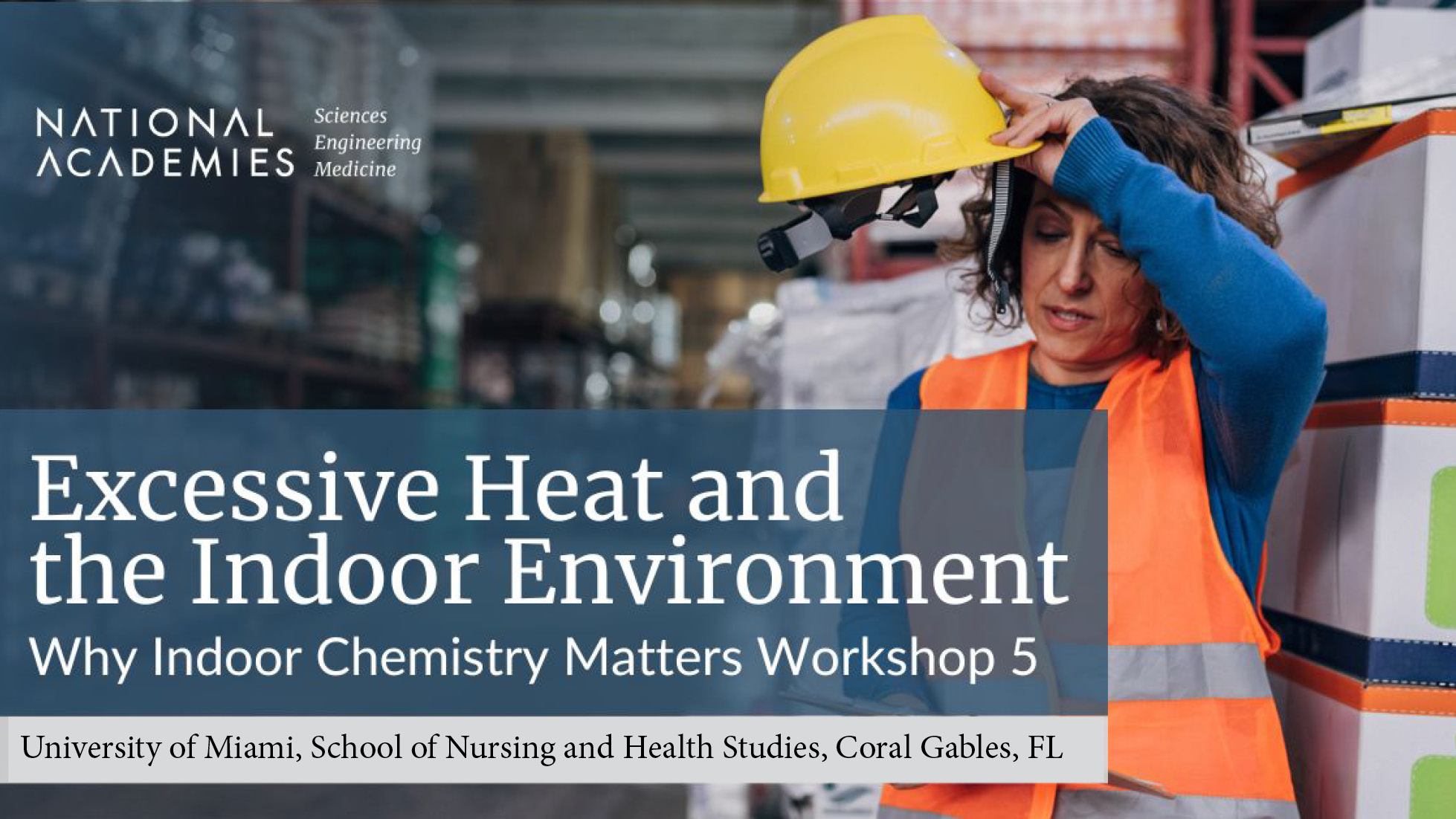
Dean Hudson P. Santos Jr. and other University of Miami scientists took part in “Why Indoor Chemistry Matters,” a daylong hybrid workshop hosted by the National Academies of Sciences, Engineering, and Medicine (NASEM) in the University of Miami School of Nursing and Health Studies S.H.A.R.E. Auditorium. The April 23 event delved into NASEM’s consensus study report, addressing the state-of-the science regarding chemicals in indoor air.
Understanding indoor chemistry is critically important, NASEM states, because people in the United States spend over 90 percent of their time indoors on average, exposed to thousands of chemical compounds from building materials, furnishings, electronics, personal care products, cooking, cleaning, and heating and cooling of homes, among other sources, which can have various adverse effects. These health impacts can range from eye and throat irritations or nausea, to increased risk of neurodevelopmental deficits, cancer, and cardiovascular disease, and ultimately even death. NASEM’s report “identifies gaps in current research and understanding of indoor chemistry and new approaches that can be applied to measure, manage, and limit chemical exposures.”
Dr. Guillermo (Willy) Prado, the University’s Interim Executive Vice President for Academic Affairs and Provost, welcomed an ad hoc committee of scientific experts and leaders to the workshop at the school. It was the fifth workshop in a series of ongoing events supporting NASEM’s consensus study report and was aimed specifically at revealing emerging science on indoor chemistry related to “Excessive Heat and the Indoor Environment,” an apt topic for South Florida-based scientists.
NASEM’s stated objectives included illuminating the experiences of workers exposed to heat and indoor chemicals, exploring the current landscape of interdisciplinary community-engaged research to address heat and indoor chemical pollution issues, and identifying opportunities for future investments to build research capacity and a scientific evidence base to inform action.
Dean Santos was a panelist in session 4, titled “Future Investments in Research.” He discussed “Securing Funding for Climate/Environmental and Health Initiative,” while National Academy of Engineering member Pratim Biswas, dean of the University of Miami College of Engineering, addressed “Indoor Air Quality: From Earth to Outer Space Abodes” in the same session. Dean Santos also serves on the Internal Advisory Committee for the University of Miami Climate Resilience Institute, offering expertise and leadership in areas of research and teaching related to emerging topics and trends in resilience.
School of Nursing and Health Studies alumna Natasha Schaefer Solle, Ph.D. ’15 (nursing science), RN, was a panelist for session 2, titled “Workers Exposed to Heat and Indoor Chemicals.” Dr. Solle, a research associate professor with the Miller School of Medicine, presented on “Heat Exposure in the Fire Service: The Impact of Occupational Heat Stress on Firefighter Health,” a topic she has been studying for the past several years through her work with the Sylvester Comprehensive Cancer Center Firefighter Cancer Initiative.
This workshop covered the following 5 of the NASEM consensus study report’s 15 total recommendations:
- Researchers should further investigate the chemical composition of complex mixtures present indoors in a wide range of residential and nonresidential settings and how these mixtures impact chemical exposure and health.
- All stakeholders should proactively engage across disciplines to further the development of knowledge on the fundamental aspects of complex indoor chemistry and its impact on indoor environmental quality, exposure assessment, and human health.
- Researchers who study toxicology and epidemiology and their funders should prioritize resources toward understanding indoor exposures to contaminants, including those of outdoor origin that undergo subsequent transformations indoors.
- Researchers and practitioners should include communities in the wide range of indoor environments they study and engage these communities in formulating research priorities and recommendations for future indoor air quality standards.
- Researchers and their funders should prioritize understanding the health impacts from exposure to specific classes and mixtures of chemicals in a wide range of indoor settings. Such understanding is needed to inform any future standards, guidelines, or regulatory efforts.
For more information visit https://www.nationalacademies.org/our-work/emerging-science-on-indoor-chemistry.

