
It is a rare experience to be able to attend an in-person lecture and hear directly from a U.S. Supreme Court Justice. As a school focused on empowering students and strengthening community ties, the University of Miami School of Law enabled students to access a trio of opportunities to meet and hear United States Supreme Court Justices in the 2024-25 academic year.
In October, U.S. Supreme Court Associate Justice Ketanji Brown Jackson, who lived on campus as a child while her father attended the School of Law, held a conversation before a standing room only audience. She came to celebrate not only the launch of her new book, "Lovely One," but also what School of Law Interim Dean Patricia Abril called the "extraordinary life" of the University's "hometown pride" before 720 people, approximately 500 of whom were School of Law students.
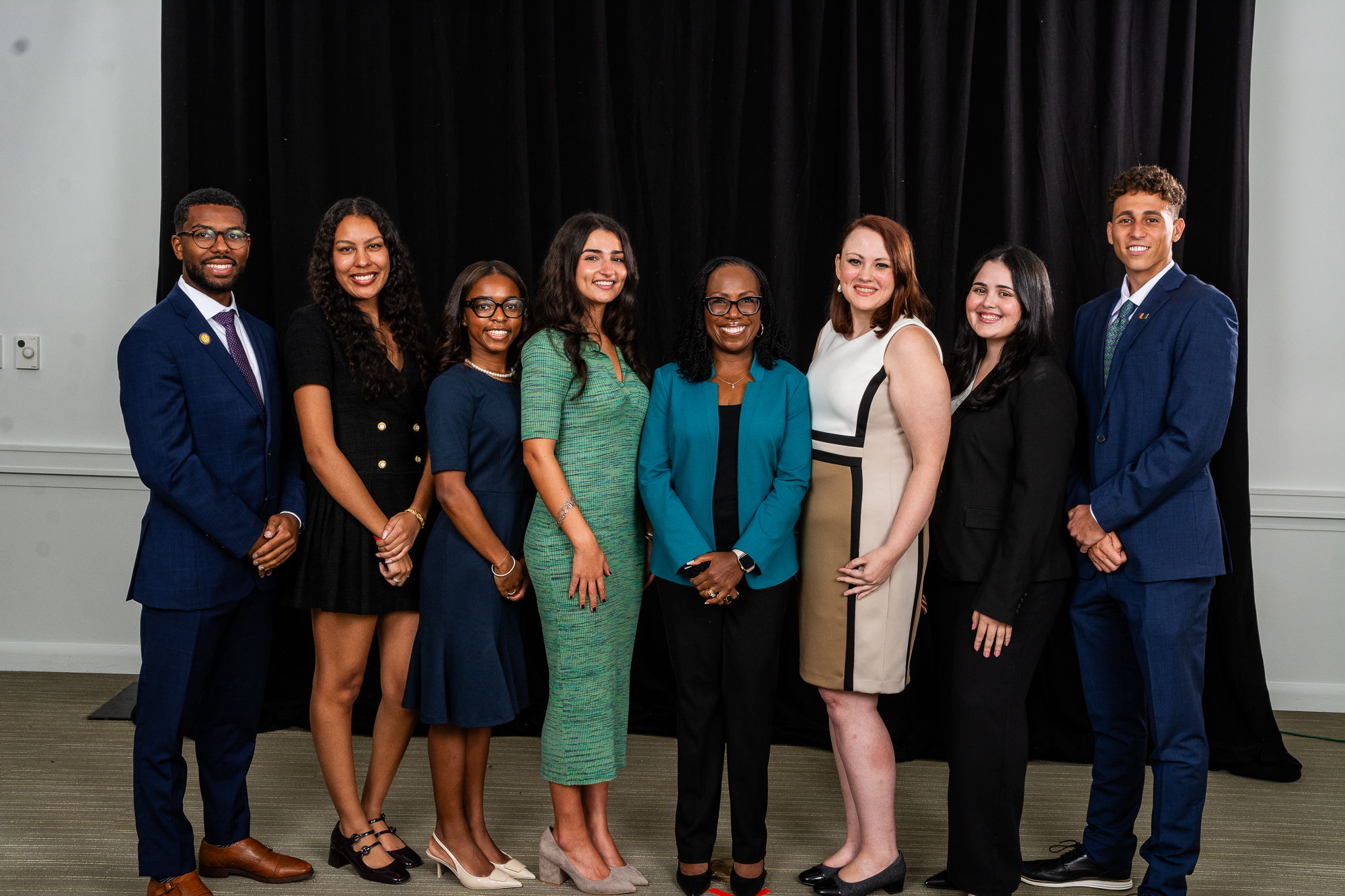
During her talk, Jackson discussed everything from her days as a champion debater at Miami Palmetto Senior High School, her path to the Supreme Court, her challenges as a mother during her journey in the legal profession, and her daughter's autism diagnosis.
"I remember thinking early in my career that, 'Well, you can't always necessarily be the smartest person in any room, but what you can do is commit to being the hardest worker.' It's something that I can control. And it meant getting to places early and staying late," she said.
"I had a favorite poem that I learned about in high school that I put up in every single law firm or office that I ever went to, because it was motivational in this way. It was a stanza from Henry Wadsworth Longfellow's "The Ladder of St. Augustine." And he says, 'The heights by great men reached and kept were not attained by sudden flight, but they, while their companions slept, were toiling upward in the night.' That was the person that I thought I was, professionally," Jackson said.
Then, in February, former Associate Justice Stephen Breyer, using the trademark anecdotes, humor, and hypothetical scenarios for which he is known, brought his case to the University of Miami campus, where he analyzed the different types of constitutional interpretation, recalled some of the Supreme Court cases on which he ruled, and doled out advice to the assembled, including the more than 100 students from the School of Law who attended.

Breyer, who was nominated to the Supreme Court by President Bill Clinton in 1994, told students that, while as lawyers, they will aspire to be as objective as possible, it is inevitable that their personal experiences and identity will influence their decisions on cases.
"You can't help but be influenced by the way you were brought up," Breyer said. "I've lived the life I've led and so have you. And you will, whether you're in your 40s or 50s, be influenced by that. You can't jump out of your own skin. You can try to keep your own experiences out of it, but you'll never succeed in doing it."
"This is exactly what universities and law schools do," said Abril of the Breyer event. "Bringing together members of the community, the judiciary, academia, students, friends, and family to experience three things we all love and champion: books, law, and dialogue. It's magical."
Associate Justice Sonia Sotomayor, the first Hispanic and third woman to serve on the Supreme Court, held a fireside chat event in Miami in February, where she told students, including a dozen School of Law students, "We adults have messed up the world for you." Associate Supreme Court Justice spoke to a crowd of students at Miami Dade College, where she inspired future civic leaders and urged students to drive meaningful change, "If you're relying on the adults to fix it, it ain't gonna happen." She also lectured at the School of Law in 2013.
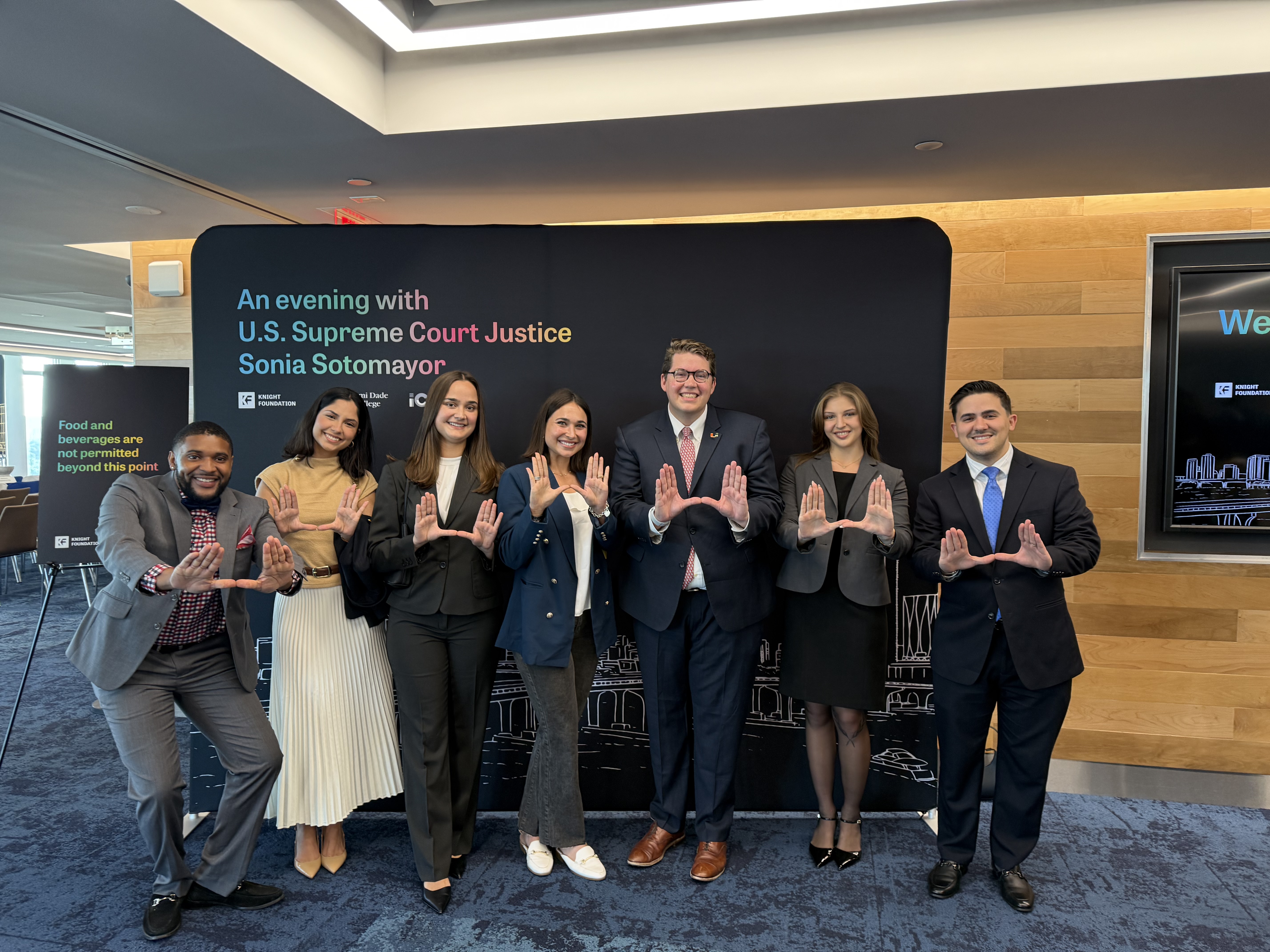
First-year law student Amanda Sarmientos was one of two students in the audience selected to ask Sotomayor a question at the Knight Foundation event. She wondered how the justice made her career decisions.
Sotomayor said she didn't follow the advice of her advisors or friends. Still, she took a chance to work for Robert Morgenthau, the United States Attorney for the Southern District of New York, because she knew it wouldn't be glamorous but that she would learn and become a better lawyer. She talked about how important it was to stay true to yourself. Listen to others' perspectives, but don't let them define your path. Filter out the noise and be determined to make a difference however you want to do that, she said.
She said she never aspired to be a Supreme Court justice. Her greatest dream was to be a trial lawyer. As she pursued that dream, she always tried to take one step forward and to improve her writing and her advocacy skills. One step at a time, she said. "Manage others' expectations by setting your own."
The University of Miami School of Law has a rich and robust history with more than two dozen appearances of United States Supreme Court Justices, starting with Justice Hugo Black in 1951 (and 1952, 1954, and returning in 1962 to deliver the eulogy of Miami Law Dean Wesley Alba Sturges). More than a dozen U.S. Supreme Court Justices have traveled to the School of Law to lecture, teach, inspire, and educate, including Chief Justices William Rehnquist and Warren E. Burger, who first visited as an assistant attorney general. Also, Associate Justice William J. Brennan lectured twice and returned to the School of Law in 1991 and 1992 to teach a seminar after he retired from the court.
"Bringing the esteemed voices of the Supreme Court to our campus is a testament to the University of Miami School of Law's commitment to fostering a rich dialogue on the rule of law and the judiciary's vital role in our society," said Abril. "Our students have the unique opportunity to engage with remarkable justices, who inspire them with their wisdom and experiences. "These interactions reaffirm our mission to cultivate thoughtful, principled legal professionals equipped to navigate the complexities of the law and serve with integrity," she said.