AI acceleration, global deregulation, and geopolitical uncertainty are creating unprecedented decision-making challenges.
University of Miami School of Law professor Marcia Narine Weldon is synthesizing and adding to research at the intersection of business law and technology law to examine how human cognition works when facing unprecedented complexity. This scholarship centers on three interrelated themes: the future of work, the future of the legal and compliance professions, and leadership in an increasingly AI-driven world.
From corporate experience to academic innovation
Narine Weldon directs the law school's Transactional Skills Program and teaches compliance, corporate governance, and sustainability, business and human rights, business associations, and employment law courses in the Master of Legal Studies program. She also teaches in the University of Miami’s Innovation, Technology, and Design program.
She is a former deputy general counsel, chief ethics and compliance officer, chief privacy officer, and human resources executive at a Fortune 500 multinational, bringing decades of executive experience to her teaching and research.
Her current research explores how decision-making is shaped by cognitive limitations, regulatory gaps, and cultural norms, particularly when legal safeguards are absent or limited.
An emerging framework
Supported by a research grant from the School of Law, Narine Weldon is developing a new framework in an academic article tentatively titled "Neuroscience, Behavioral Economics, and AI: An Integrated Framework for Ethical Leadership in a Deregulated and Geopolitically Uncertain World." This research emerges from significant interest from the compliance community, including neuroscience and behavioral insights into frameworks. Further, several students from her compliance class indicated that Narine Weldon's session on neuroscience and behavioral economics was the highlight of the semester.
Her work aims to bridge theory and practice, creating a guide for board members, leaders, policymakers, and educators navigating complexity and change.
Global engagement and impact
In 2025, Narine Weldon presented aspects of this work at four conferences: the Compliance and Ethics Leadership Summit in Boston; Compliance Week's 20th Anniversary Conference in Washington, D.C.; the Congresso de Compliance in São Paulo, the largest compliance conference in Latin America; and the Executive Forum on Strategic Compliance in Accra, Ghana, founded by Tiffany A. Archer of Eunomia Risk Advisory. At all four conferences, Narine Weldon presented with Archer, a lawyer and former chief compliance officer of global firms, who first presented at a University of Miami School of Law Executive Education Compliance Conference in 2019.
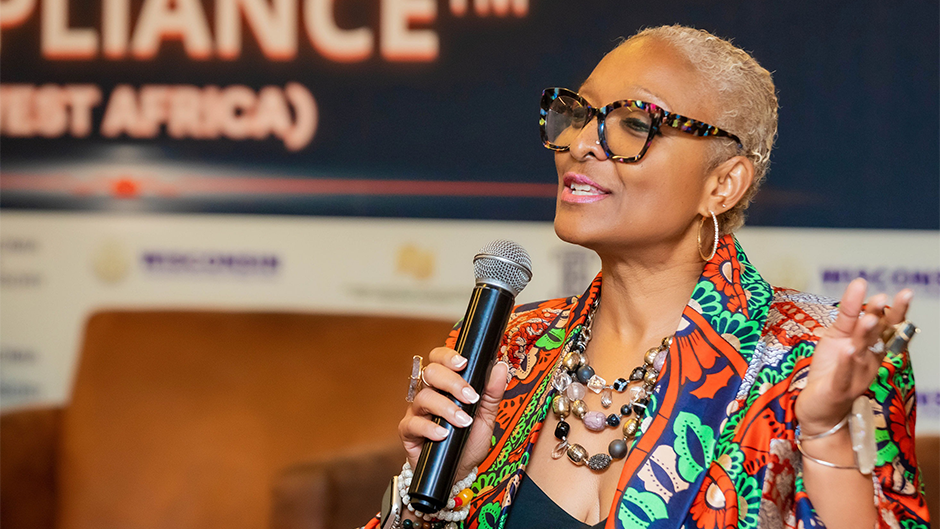
At the Ghana forum, she served as program faculty lead and moderator/panelist examining how global governance and compliance perspectives intersect with African realities.
"From my work across Latin America, the U.S., and now here in Africa, what stands out is the unique opportunity African leaders have to craft governance models that are not only ethical but also culturally intelligent and community-driven,” said Narine Weldon. “The prevailing notion used to be that the U.S. was the world's compliance police officer. That is no longer the case. There is space—and necessity—for African leadership to shape global compliance standards."
A consistent theme emerged throughout these conversations and presentations: traditional frameworks like VUCA (volatility, uncertainty, complexity, and ambiguity) no longer capture the leadership challenges posed by AI acceleration, behavioral risk, and global disruption.
Extending the research
Narine Weldon is writing two book chapters on AI for a law school textbook and will speak this fall at a symposium on how employment law and leadership must change with increasing AI agents in the workplace. The work builds on her 2024 article, "Establishing a Future-Proof Framework for AI Regulation: Balancing Ethics, Transparency, and Innovation."
She is also collaborating with Archer on the book referenced earlier, which will translate their neuroscience, behavioral economics, AI, and cross-cultural leadership framework research into actionable guidance for institutional leaders around the world.
Her work reflects the University's commitment to interdisciplinary inquiry, global engagement, and equipping professionals to lead in an increasingly complex world.
Read more about Miami Law’s business law and technology law areas of study.
