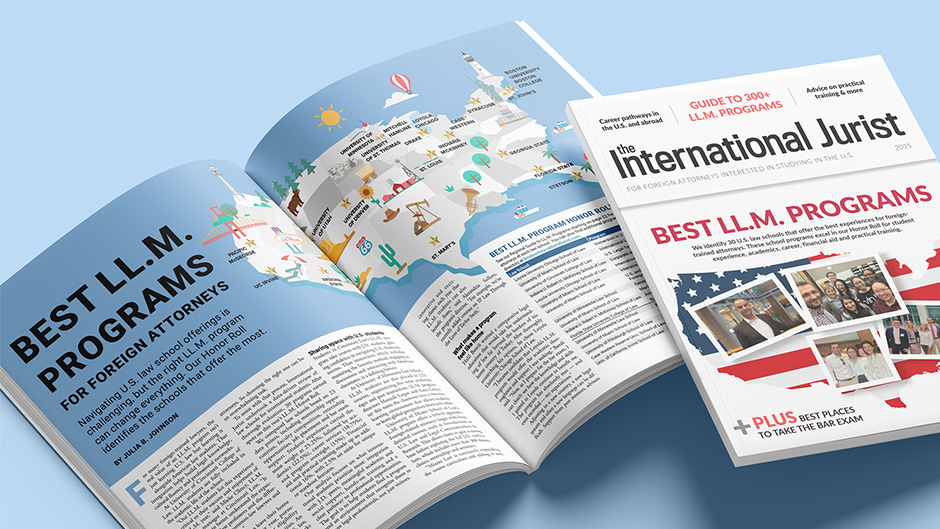
For 70+ years, the University of Miami School of Law has offered LL.M. programs for foreign-trained attorneys and understands that for lawyers looking to practice in the United States, choosing the right LL.M. program is a critical decision that extends beyond academics. According to The International Jurist, the "best" program is contingent on an attorney's specific goals, from gaining eligibility to sit for a U.S. bar exam to specializing in a field like international arbitration or real estate.
A recent data-driven review by the legal education trade publication placed 30 programs on its LL.M. Honor Roll, with the University of Miami School of Law’s LL.M. programs earning top marks for their comprehensive approach to integrating international students. The magazine awarded the following grades to Miami Law’s LL.M. programs:
- U.S. and Transnational Law for Foreign-Trained Lawyers: A+
- International Law: A+
- Intensive Legal English + LL.M.: A+
- International Arbitration: A
- Real Property Development: B+
Integration with American Law Students
One of the top reasons to attend an LL.M. program is the program's success in integrating LL.M. candidates with American law students. The approach helps build not only legal knowledge but also the cultural fluency and professional networks essential for a career in the U.S. The School of Law emphasizes this integration and continually updates its curriculum. “Miami Law is constantly expanding the course curriculum and adding new, innovative, and exciting classes each year that LL.M. students can also benefit from,” said Alexandria Sellers, the program’s former director. “For example, we’ve recently added courses on intellectual property law, such as IP Law Through the Lens of Taylor Swift.”
Beyond the Classroom – Practicum Options
The transition to a new country presents unique challenges, making individualized support crucial. Fernanda Legaspe, who transitioned from the LL.M. program at Miami Law into a J.D./LL.M. joint degree, called the school’s one-on-one guidance pivotal. “Adjusting to life and learning in a new country can be challenging, but Miami Law provided several resources that made this transition much smoother,” she said. Career advisers helped her prepare for interviews and understand how to build professional connections in the U.S.
Hands-on experience is another vital component. Miami Law’s practicum programs for LL.M. students transform the city’s international legal market into a real-world classroom, allowing students to gain experience in local firms while earning academic credit. Legaspe described the practicum as a turning point. “This program allows international students to secure their first professional legal experience in the United States while earning academic credits,” she said. “It was incredibly valuable not only in terms of practical learning but also in opening doors to the local legal community.” Other experiential options include clinics in human rights and immigration, and the International Moot Court Program.
A Pathway to a U.S. Career
Staying in the U.S. after graduation is a complex goal that requires significant institutional support. The School of Law leverages its location and industry connections to create opportunities. Legaspe noted that career events were instrumental in building her network. “Big Law firms come to campus every semester, providing students with direct access to some of the most prestigious employers in the country,” she said. She credits the school's support with helping her translate her international background into a U.S. context. As Legaspe put it, “Career support isn’t just about helping you write a U.S.-style résumé. It’s about opening doors.”
The International Jurist analysis focused on what international students prioritize most: integration with J.D. peers, hands-on training, and a clear path to professional opportunities. The magazine’s evaluation was based on 23 data points, with student experience carrying the most weight (25.25%), followed by academics (22.5%) and career services (18.75%).
For prospective students navigating this landscape, Legaspe offered simple advice: “Take time to research each program carefully. Choose one that fits both your academic interests and your personal values.”
Read more about Miami Law’s LL.M. Programs.
