Fishing communities in the Pacific Island nation of the Federated States of Micronesia face an uncertain future. Warming ocean temperatures are disrupting the migration patterns of fish in local waters, putting their livelihoods in peril.
Compounding the crisis, hotter days and nights and stronger typhoons threaten everything from human health and drinking water to transportation and infrastructure.
As such, attending global summits where nations gather to measure their progress and plan policies toward combating challenges is often important to small island developing states like FSM. But limited resources have placed constraints on the number of delegates the country can send to such talks.
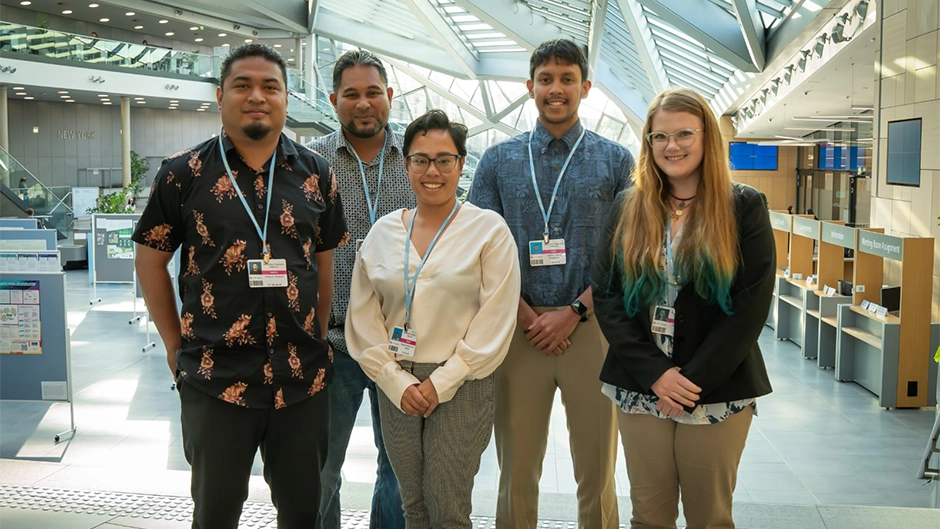
The University of Miami School of Law’s Environmental Law Program recently lent a helping hand, sending two of its legal eagles to the 62nd United Nations Framework Convention on Climate Change in Bonn, Germany, where they attended several high-level discussions and meetings of particular interest to FSM officials.
“Small island developing states have always been fighting in the corner for more ambitious climate actions,” said Valerie Fajardo, a fellow in the School of Law’s Environmental Law Program, who, along with law school alumna Delaney Reynolds, J.D. ’24, attended the 10-day summit. “They’re cautiously optimistic about what the Paris agreement can do, and they are always pushing for more ambitious plans from all parties, even as they try to fulfill their own end of the obligations.”
Higher ocean temperatures, Fajardo noted, impact the Federated States of Micronesia particularly hard, damaging the country’s coral reefs and fisheries. “Those losses are happening now,” she said. “At some point, they can recover, but they don’t always recover. And even when they do, they’re not the same. So, the question of economics is always very much on the minds of the country’s leadership.”
Prior to the start of the 10-day summit, held June 16-26, Fajardo and Reynolds attended coordination meetings with the Alliance of Small Island States and reported on the negotiations to FSM officials.
During the actual conference, the two sat in on meetings focusing on adaptation finance, the resources used to help countries adjust to the effects of climate variability, and what’s known as the global stocktake, or the process by which nations assess the progress they have made in meeting climate goals.
“Delaney took the lead on drafting daily reports to the ground team, and she also attended side events on ocean-related topics and climate litigation,” said Jessica Owley, professor of law and director of the Environmental Law Program. “Valerie provided legal guidance and drafted interventions for the global stocktake negotiators.”
Fajardo also met with a delegation from the low-lying archipelago of Tuvalu to explore potential partnerships beyond the upcoming COP30 UN climate conference.
She and Reynolds are now preparing policy documents that will be used by FSM officials who will convene at COP30 in Brazil.
Climate challenges are “an existential problem inasmuch as they are an economic problem for nations like the Federated States of Micronesia,” Fajardo said. “They are low emitters, contributing so little to global greenhouse gas emissions. Being a relatively small contributor to the problem, there’s little they can do to move the needle, which is why they push so hard for more ambitious actions.”
Born and raised in the Philippines, Fajardo saw her native country devastated by Typhoon Haiyan in 2013, volunteering for relief efforts in the aftermath of the disaster. Shortly after, she decided to earn a law degree and a master’s in environmental law and policy.
She views her work helping to assist the Federated States of Micronesia as an important step in multilateralism. “Try as they might, it is difficult for small island nations to achieve a big impact in climate policies when they work alone,” Fajardo said. “Our work helps make it possible.”
Read more about Miami Law’s environmental law area of study.