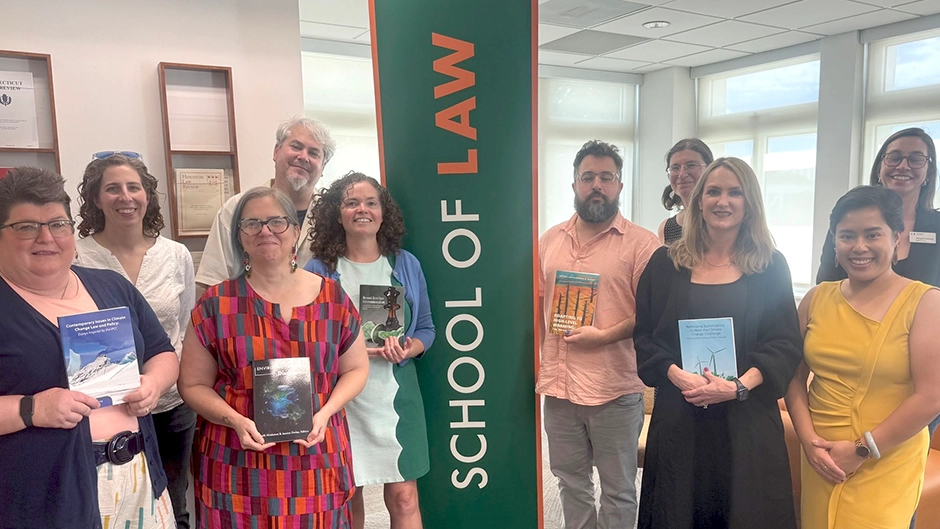
Leading environmental and legal scholars from across the nation gathered at the University of Miami Oct. 17 and 18, 2025, for "The Good Life in the Anthropocene," an interdisciplinary workshop focused on pathways to human flourishing amid growing global crises. Hosted by the University of Miami School of Law's Environmental Law Program, the event brought together chapter authors for a forthcoming book to discuss consumption, waste, and justice in the current geological age defined by humanity's dominant influence on the planet.
The workshop is the latest endeavor of the Environmental Law Collaborative, a think-tank-style group of law academics co-founded in 2012 by Jessica Owley, a law professor at the University of Miami School of Law and director of the Environmental Law Program. The ELC meets every two years to tackle a "thorny environmental issue," a process that culminates in a collection of essays published as a book. The current book project stems from conversations held in 2023 centered on consumption, excess, and planetary limits.
“The workshop went well,” said Owley. “By coming together to discuss these issues as a group, we were able to do some creative thinking on critical issues. We are all trying to figure out how the law can support a society that can be resilient in the face of climate change and biodiversity loss. But we also want to think about how we can go beyond survival and create a thriving future for all.”
Over the course of two days, authors presented their draft chapters for feedback in intensive sessions designed to foster in-depth discussion. The workshop’s central theme was the complex relationship between consumption patterns, waste, and the triple planetary crises of climate change, biodiversity loss, and pollution. Participants explored how legal, social, and policy innovations could address challenges of scarcity, conflict, and environmental injustice.
The sessions, held at the law school on Friday and the Frost Institute of Chemistry and Molecular Science on Saturday, featured a wide range of topics. Discussions included an examination of how the judicial focus on private property rights can restrict access to "the good life," presented by Sarah Fox of Marquette University Law School and Owley. Other presentations explored the concept of "Climate Havens" by Keith Hirokawa and Cinnamon Carlarne of Albany Law School, designing tax interventions to address luxury culture by Anastasia Telesetsky of Cal Poly, and a fictional story titled "Museum of Joy" by Josh Galperin at the Pace University Elisabeth Haub School of Law. Several scholars also joined the sessions remotely.
The book is being edited by a team that includes Owley, Hirokawa, Galperin, and Karrigan Bork of the University of California, Davis, School of Law. The workshop aimed to advance the book project by enabling the authors to collaborate on ideas before final publication. To ensure a rich dialogue, participants were asked to review all draft chapters in advance.
Support for this workshop came from several University of Miami entities, including a grant from the School of Law Intellectual Life program, the Climate Resilience Institute, the Rosenstiel School's Department of Environmental Science & Policy, and the Abbess Center for Ecosystem Science & Policy.
Read more about Miami Law’s environmental law area of study.
