Business law scholars at the University of Miami School of Law have launched the Law & Finance Workshop, an exciting new initiative designed to facilitate more frequent discussion, foster community, and provide critical mentorship for scholars working in this complex field.
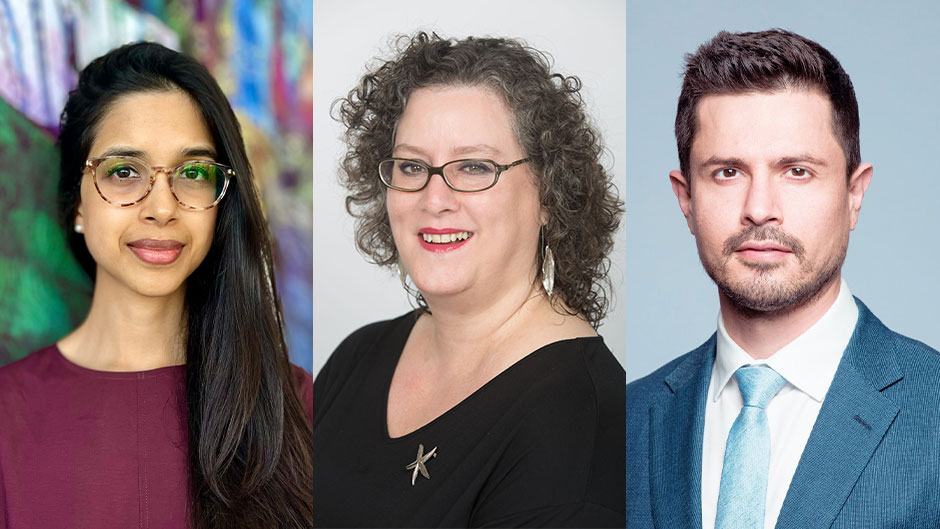
The workshop was created by associate professor Nikita Aggarwal in 2024 and is co-organized by Aggarwal and Professors Caroline Bradley and George Georgiev. They have quickly assembled a strong lineup of papers and presenters for the workshop’s inaugural schedule, solidifying it as a premier forum for cutting-edge research at the intersection of law, business, and finance.
A platform for digital-age scholarship, scholarly community, and mentorship
The 2025–26 Miami Law & Finance Workshop schedule promises a year of rigorous intellectual exchange. All workshops are held on Fridays from 1 p.m. to 2 p.m. ET via Zoom, leveraging digital technology to maximize accessibility. The primary aim of the workshop is to "facilitate more frequent and convenient discussion of legal scholarship in the field of law and finance," said Aggarwal, an expert in consumer finance and technology law.
The move to a digital-first, monthly format represents an important evolution in academic collaboration. "The traditional model of annual, in-person conferences, while still very valuable, was designed for a pre-digital age," Aggarwal said. She views the Law and Finance Workshop as complementing and adding to the value of existing conferences by offering a continuous, accessible forum for scholarly development. "As the COVID pandemic highlighted, video conferencing tools like Zoom allow us to discuss scholarly works-in-progress digitally. This has many advantages, including much lower costs of organization and participation, broader access, and earlier and more frequent feedback on research."
Beyond facilitating scholarly discourse, a second key aim of the workshop is to foster community among scholars working in law and finance. "It can be hard for junior scholars, in particular, to find mentors and build relationships with more established scholars," Aggarwal said. She sees the workshop as a powerful, low-barrier way to bridge that gap. “Just by putting people in the same virtual room for an hour once a month, we enable more connections among scholars and more opportunities for mentorship.”
Navigating rapid change and looking ahead
Working in the field of law and finance, which encompasses financial regulation, corporate law/finance, and bankruptcy, presents a unique challenge: ensuring the submitted scholarship remains relevant in a rapidly changing environment. “Rapid technological change and increasing political volatility mean that legal scholarship—including but not only in the field of law and finance—can more quickly become less relevant, even obsolete,” Aggarwal said.
When selecting papers, the organizers must evaluate their potential shelf-life. “We review and select submitted abstracts based primarily on our evaluation of their quality and likely contribution to the prior literature. The papers are presented relatively soon after selection, which helps to mitigate concerns about obsolescence," Aggarwal said. She also recognizes that rapid technological progress, particularly in AI, may complicate the selection task going forward, but she is confident in the current selection process.
While the workshop isn't tracking formal performance metrics, Aggarwal said that "useful markers of 'success' include the volume and quality of submissions, attendance, discussion, and post-workshop feedback." She is pleased with the initial reception, saying, "The workshop is fairly young, but so far, all metrics are trending upward!"
Looking to the future, the core digital, monthly format is here to stay, as it successfully reduces costs and broadens access. However, Aggarwal envisions expansion through "adjacent events, such as virtual and in-person workshops focused on different disciplines and audiences" to better serve the field’s various sub-communities.
By embracing digital technology, prioritizing meaningful feedback, and cultivating a supportive academic community, the Miami Law and Finance Workshop is quickly becoming an essential engine for advancing scholarship in this vital area of law.
The registration form for the fall workshops is now open, with the final workshop taking place on November 21. The registration form for the spring 2026 workshops will be circulated later in the year.
Read more about Miami Law’s Business Law area of study.