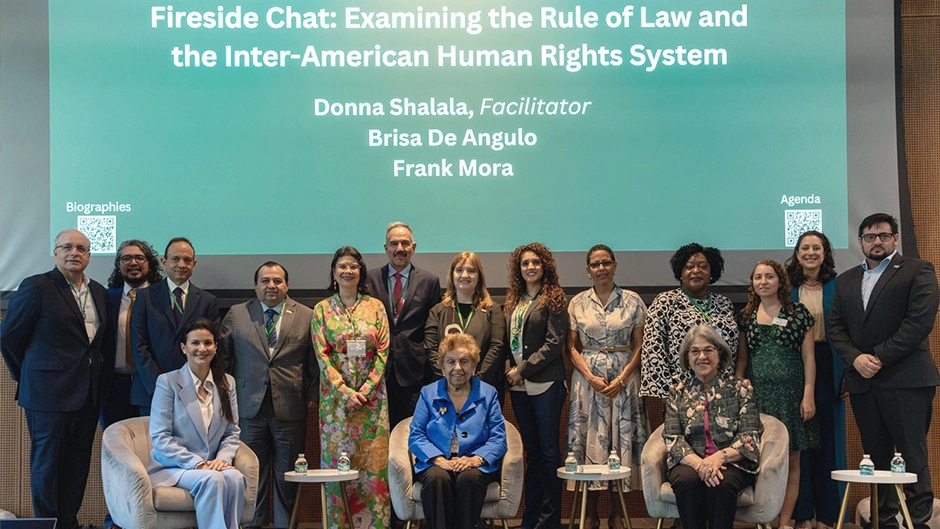
If geography is destiny, then Miami was the inevitable stage for the convergence of legal and interdisciplinary minds that took place recently. Ideally situated at the crossroads of the Americas, the city pulsates with the complex human rights problems of Latin America and the Caribbean—problems that are often felt here as intensely as they are abroad.
From Nov. 16 through 21, 2025, the University of Miami School of Law transformed into the epicenter of these critical conversations as it hosted the “Human Rights in the Americas Symposium: An Examination of Past, Present, and Future.” The weeklong event at the University’s Lakeside Village was not merely a series of lectures; it was a comprehensive gathering featuring official hearings by the Inter-American Commission on Human Rights, one of the principal human rights organs within the Organization of American States.
For professor and organizer Caroline Bettinger-López, the founder and director of the Human Rights Clinic, the timing could not have been more urgent. Yet, amid the heavy topics of authoritarianism and instability, she found a thread of optimism.
“A week like this is a reminder that connection is possible,” Bettinger-López said during her opening remarks. “That gathering in community, across disciplines and experiences, strengthens us and fuels our collective capacity for justice.”
A kickoff with gravitas
The week began on a Sunday evening in the law school’s Gail D. Serota, J.D. 79 Reading Room—a space usually reserved for quiet study, but which was filled with the hum of high-level diplomacy. The opening reception featured a keynote address by Ken Roth, the former executive director of Human Rights Watch and current visiting professor at Princeton.
Roth delivered the 13th annual Louis Henkin Lecture on Human Rights, discussing his book, “Righting Wrongs,” before settling into a fireside chat with Pedro José Vaca Villarreal, the Special Rapporteur for Freedom of Expression for the IACHR. For the faculty, the lecture was a nod to their own history. “We are committed to carrying forward his commitment to the transformative power of human rights,” said Bettinger-López.
Beyond the briefs
While the IACHR hearings—conducted by seven independent members—formed the spine of the symposium, the event was fleshed out by a series of thematic panels designed to tackle the messy, interconnected reality of modern human rights work.
On Monday morning, interim law dean Patricia Sanchez Abril, opened the conference, saying, “As the daughter of Cuban immigrants, I know firsthand how the promise of human rights and democratic freedom resonates deeply in Miami. Hosting the 194th period of sessions of the Inter-American Commission on Human Rights is both an honor and a testament to our law school's dedication to advancing justice and human dignity, and the outstanding leadership of the faculty and students in our human rights program.
“In a time when society is increasingly divided, this week offers an opportunity to come together, reflect, and bridge divides through conversation and collaboration,” Abril said.
The conference further highlighted human rights issues in the context of migration. Professor Rebecca Sharpless, director of the Immigration Clinic, joined a panel with IACHR Commissioner Andrea Pochak to dissect the perilous state of human mobility.
“It was an honor to join commissioner Pochak and fellow panelists to examine the present political moment for immigrants—and to warn against dehumanizing and dangerous enforcement tactics that threaten the safety and dignity of people and their families,” said Sharpless.
The conference’s scope was aggressively interdisciplinary. “The symposium united practitioners, scholars, students, and community members to tackle urgent issues including the rule of law, access to housing, environmental protection, and gender justice,” said Tamar Ezer, acting co-director of the Human Rights Clinic and faculty director of the Human Rights Program. For instance, Miami Law professor Charles C. Jalloh, the Richard A. Hausler Chair in Law, participated in a panel exploring the environment and human rights, moderated by senior lecturer Ileana Porras.
Art Imitating life
Perhaps most poignantly, the symposium acknowledged that legal briefs cannot capture the full human experience. An art exhibit focused on the right to housing ran concurrently with the legal proceedings. The pieces were produced by Red Line Service, a collective of Chicago artists with lived experience of being unhoused. As a partner organization of the School of Law’s Human Rights Clinic, their work illustrated the seven dimensions of the international human right to housing, grounding abstract legal concepts in concrete, visual reality.
Legacy in the stacks
The University of Miami School of Law has long maintained a relationship with the IACHR, with its faculty deeply engaged in scholarship that mirrors the Commission's priorities. To ensure the week's lightning was captured in a bottle, the University of Miami International and Comparative Law Review will be publishing a synopsis report of the thematic sessions—drafted by students and faculty from the School of Law and the University of Southern California Gould School of Law. Students also participated in other ways, such as appearing as “solicitantes” or applicants in IACHR hearings.
In a region where diasporic communities have settled upon South Florida's shores for decades, bringing their stories and struggles with them, the symposium was more than an academic exercise. It was a reaffirmation of Miami’s place at the table—or rather, as the table itself—where the future of human rights in the Americas is being written.
Read about Miami Law’s Human Rights Law area of study.
