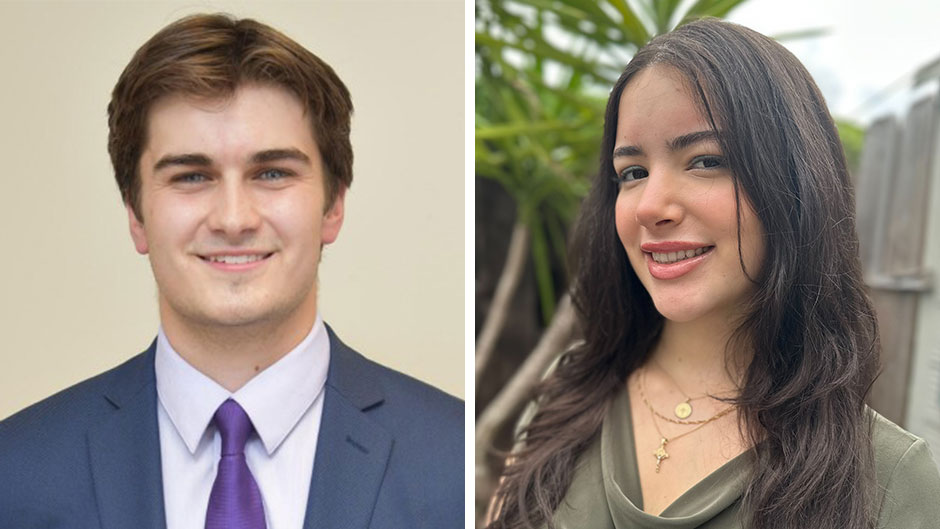
Two University of Miami School of Law first-year students had the opportunity to engage in high-level federal advocacy with legislators in Washington, D.C. Joining a cohort of over 60 law students nationwide, they participated in the International Refugee Assistance Project’s Advocacy Week, meeting with more than 30 congressional offices to discuss critical issues in immigration, foreign policy, and human rights law. The School of Law is one of 28 chapters of IRAP, which has trained more than 1,200 law students by providing hands-on legal experience, education in legal ethics, and a strong foundation in international law and society.
From direct service to policy impact
For Andrew Navarro, a 1L Miami Public Interest Scholar, Advocacy Week was a natural extension of his pre-law career. Having worked with Catholic Charities and the Manhattan Area Resettlement Team, Navarro has seen firsthand how legal assistance helps displaced families rebuild their lives.
"Participating in IRAP Advocacy Week allowed me to bridge the gap between grassroots service and policy-level advocacy," said Navarro. "Seeing law students nationwide commit to these issues—at a moment when humanitarian resettlement is often sidelined in national discourse—was incredibly inspiring. It has solidified my goal of pursuing a career in human rights and humanitarian response."
Keilly Miranda Torres, also a 1L, found the experience vital for professional networking and awareness. "Meeting with congressional staff was a great opportunity to highlight the legal challenges facing displaced communities…It was reassuring to engage with representatives who remain committed to these issues, even when they aren't in the headlines," she said.
Engaging with federal policymakers
The initiative provided students with a direct seat at the table with federal policymakers. Throughout the week, the Miami Law delegation urged Congressional representatives to support measures ensuring fair processing for those seeking entry to the United States, as well as the maintenance of protections for Afghan allies who assisted U.S. missions abroad. They also advocated for the No Ban Act, which seeks to limit executive authority regarding entry restrictions, and called for the restoration of protections for individuals from conflict-affected regions like Syria.
Building the next generation of advocates
Miranda Torres and Navarro are both involved in Miami Law’s HOPE Public Interest Resource Center which is dedicated to fostering a pro bono ethic and providing all law students with pathways to advocacy.
For students interested in the intersection of law and public policy, IRAP’s Advocacy Week serves as a masterclass in legislative engagement. It demonstrates how early involvement in advocacy can build the essential skills required for a career in the public interest.
Read more about Miami Law’s social justice and public interest area of study.
