A new report by the Human Rights Clinic at the University of Miami School of Law and the National Homelessness Law Center details an alarming surge in laws and policies across the U.S. that criminalize homelessness.
The report, “The Criminalization of Homelessness and Mental Health Conditions in the United States,” focuses on one particularly distressing avenue for this criminalization: the widespread expansion of civil involuntary treatment and commitment. This legal mechanism, which allows individuals to be confined in psychiatric hospitals, is increasingly being used to target unhoused individuals.
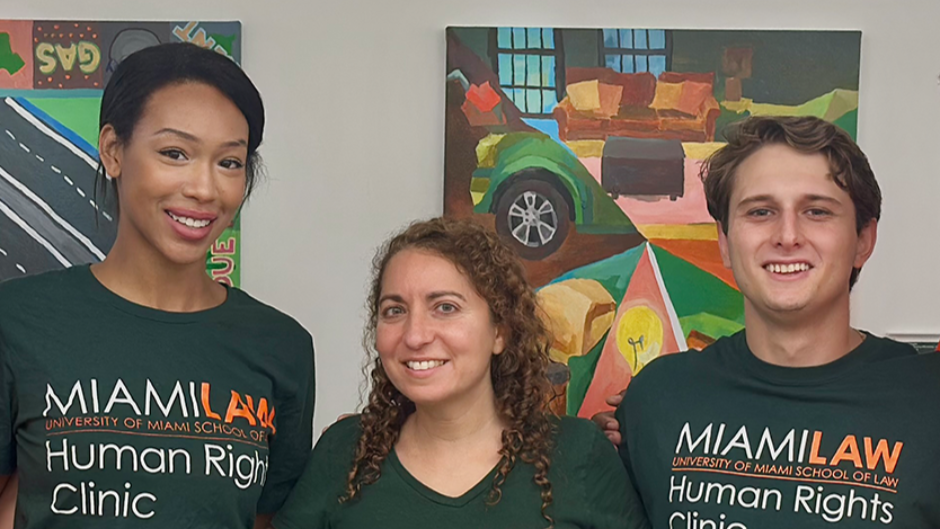
The report was drafted by former clinic fellow Abigail Wettstein, J.D. ’25, and former clinic interns Tiana Rose Montague, J.D. ’25, and Nicholas Tricarico, J.D. ’25, from the Human Rights Clinic, under the supervision of the clinic's acting co-director, Tamar Ezer. It also received critical support and guidance from the National Homelessness Law Center, Disability Rights California, the National Disability Rights Network, and Documenta.
A troubling trend
The study finds that this trend involves leveraging a person’s status of homelessness as evidence of potential danger to themselves or others, which is then used as a criterion for involuntary commitment. The authors note that individuals may be subjected to this process even in the absence of any overtly dangerous behavior. These policies affect a large population, impacting the estimated 771,480 Americans experiencing homelessness on any given night.
The report’s release follows recent government directives that explicitly target unhoused persons and those with mental health conditions for arrest or institutionalization. These actions prioritize funding for cities that adopt maximally flexible civil commitment standards and enforce camping and loitering bans.
The report’s authors describe these policies as retrogression towards disproven and harmful approaches that would ultimately exacerbate homelessness, mental health, and substance use crises.
Report findings and case studies
The report is divided into four main sections, beginning with a historical background on the treatment of mental health conditions in the U.S. and the overlap between the criminalization of mental health and homelessness.
The second section focuses on current policies that enable forced institutionalization, featuring in-depth case studies from California, Florida, and New York. A third section provides a human rights analysis, highlighting how these policies violate international human rights standards.
Human rights-based alternatives
The report's final section is dedicated to answering the question, what should we do instead? It outlines several evidence-based, human rights-focused alternatives to provide mental health support to unhoused individuals.
Key recommendations include:
- Investing in permanent supportive housing and voluntary community-based treatment options to make crises less likely in the first place.
- Implementing harm reduction models to address substance dependence.
- Replacing traditional law enforcement with trained health and social service providers as first responders to mental health crises.
The Human Rights Clinic, part of Miami Law’s Human Rights Program, promotes social and economic justice globally and in the U.S. Students gain firsthand experience in cutting-edge human rights litigation and advocacy at the local, national, regional, and international levels.
Read more about Miami Law’s Human Rights Law area of study.