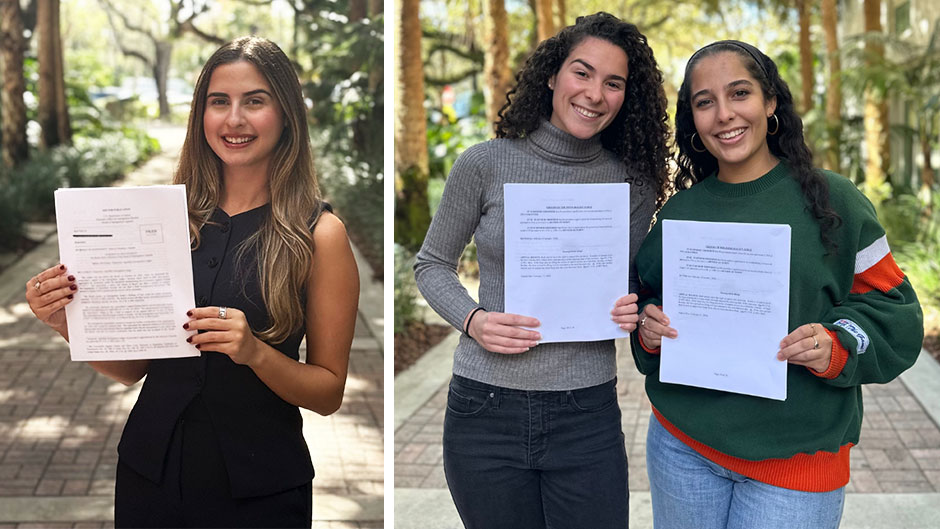
The Immigration Clinic at the University of Miami School of Law is celebrating two significant victories to start 2026, highlighting the real-world legal training students receive while representing vulnerable clients in complex asylum cases.
In a rare win before the Board of Immigration Appeals, the clinic secured remand of a Convention Against Torture case that had been denied by an immigration judge. As the highest administrative body for interpreting and applying U.S. immigration law, the BIA operates within the Department of Justice. Although the Board typically upholds CAT denials, it remanded this case to the immigration judge for a decision that complies with legal standards. Clinic Fellow Maria Alonso, who worked on the appeal, called the remand "a huge victory."
The clinic also won asylum for a woman from Honduras following an intense day-long bench trial at Krome Immigration Court. The case required extensive preparation, including witness testimony, expert evidence, and comprehensive country conditions reports.
From authoring appellate brief to arguing in court in Puerto Rico
Alonso prepared her CAT case from initial intake at Baker County Detention Center in Macclenny, FL through the merits stage and appeal before the BIA. Due to overcrowding at the Baker facility, Alonso argued the case in person before an immigration judge in Puerto Rico—an unusual circumstance that gave her invaluable courtroom experience.
"I conducted fact development, legal research, and strategy planning…Managing the case end-to-end for a detained client required sustained advocacy and careful attention to both the factual record and evolving legal standards," Alonso explained. She also authored the appellate brief that ultimately resulted in the remand to the BIA, “validating our legal arguments and record development.”
Beyond the experience, Alonso acknowledges the impact this experience has had on her legal training. “I learned how to communicate complex legal concepts to clients with little familiarity with immigration law,” she said. “Perhaps most importantly, it taught me professional responsibility and ownership over a case from start to finish. The clinic prepared me to enter practice ready to manage cases independently and advocate effectively and strategically for clients.”
Using legal Spanish and preparing for 8-hour immigration court hearing
In the other case, 2L Rocio Lopez represented a Honduran transgender woman who had entered the United States as a minor. "We worked with her in Spanish, spending hours listening, and drafting her declaration to ensure her story was accurately and respectfully portrayed," said Lopez.
Lopez conducted legal and country conditions research, drafted direct examination questions and legal arguments, and helped prepare for the full-day merits hearing before Krome Immigration Court. "The Clinic strengthened my legal research skills, my ability to take in and apply feedback, and writing skills while teaching me how to advocate in a way that preserves a client's dignity," she said.
The merits hearing—which functions like a bench trial, where the immigration judge hears testimony, reviews evidence and legal arguments, and issues a decision —resulted in a successful grant of asylum for Lopez’s client.
In addition to legal skills, Lopez augmented her already fluent Spanish. “While I was already fluent in conversational Spanish, this experience strengthened my ability to communicate legal concepts in Spanish and pushed me out of my comfort zone,” she said. “It better prepared me for a future career working with Spanish-speaking clients.”
Lopez worked alongside immigration clinic fellows, student intern Andrea Lopez, and supervising attorney and Immigration Clinic Associate Director Andrea Jacoski throughout the case.
Building future immigration attorneys
Both students say the clinic experience will shape their future legal careers and credit the clinic's faculty—Jacoski and Clinic Director Rebecca Sharpless—with preparing them for independent practice and emphasizing student leadership and case strategy. "Instead of giving me answers, they guided me on how to find them myself, which prepared me for practice and pushed me to become a problem solver," said Alonso.
For Lopez, who plans to pursue a career in immigration law, the case "reaffirmed my passion for this work and showed me the meaningful impact that client-centered advocacy can have. I will carry this experience with me wherever I practice in the future as a driving force and a reminder of why I am committed to this work."
Alonso emphasized the practical skills that translate across legal practice: "The clinic gave me hands-on training in client counseling, evidence development, legal writing, and oral advocacy, which are core skills for any attorney."
More on studying immigration law at Miami Law.