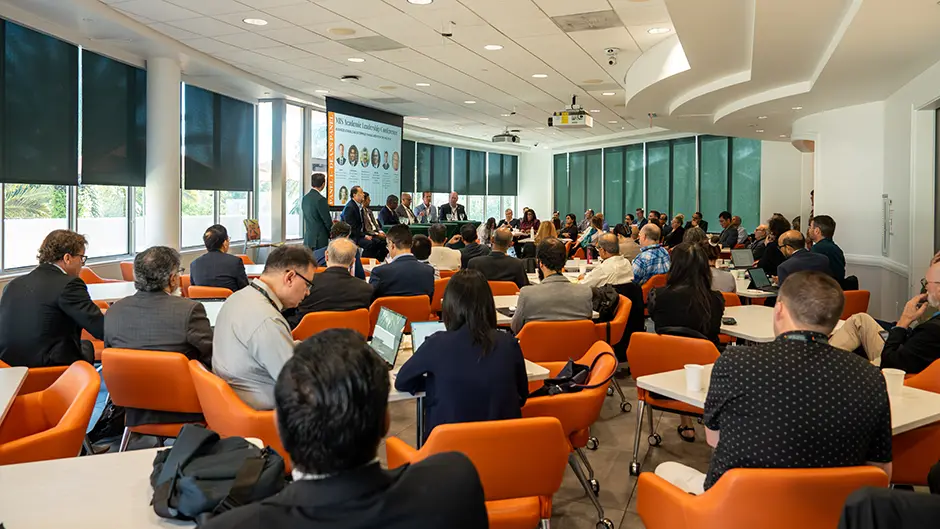
The University of Miami Patti and Allan Herbert Business School hosted the MIS Academic Leadership Conference from Nov. 13-15, bringing together the nation’s top academic leaders in management information systems to address a defining challenge: How should business schools lead in the age of artificial intelligence?
The invitation-only conference, themed “AI as an Emerging Imperative for Business School Leaders,” brought more than ten deans to campus for two dedicated panels that advanced the dialogue on leadership and the future of AI in academia. Faculty gathered to explore AI’s impact on business education and identify priorities for curriculum and leadership development.
“We were honored to convene this pivotal conversation on our campus,” said Paul A. Pavlou, dean of Miami Herbert Business School. “MIS departments are not just responding to the rise of AI; they are leading the transformation of business schools and even entire universities. By reimagining curricula, research, and industry partnerships, we can redefine how higher education prepares leaders to drive and shape an AI-powered global economy.”
The discussions explored ways MIS and business technology departments can contribute to shaping institutional strategy as AI reshapes business practice. Attendees addressed pressing questions about curricular innovation, interdisciplinary collaboration, and the leadership capabilities required to navigate this transformation.
Robert Plant, associate professor and department chair of business technology at Miami Herbert, emphasized the transformative nature of the discussions. “This conference underscored the need for business schools to be creative and excel in preparing students for an AI-driven world. Our discussions highlighted concrete strategies that institutions can adopt now to ensure students are equipped to lead in an AI-powered economy,” said Plant.
Academic leaders from universities across the country shared actionable strategies for integrating AI into their programs, pointing toward evidence-based approaches that balance technical rigor with the intuitive, agile decision-making increasingly required in AI-augmented business environments.
Kevin Hong, associate dean for research at Miami Herbert, and Angelika Dimoka, executive DBA director and professor of business technology, facilitated an environment where leaders could candidly exchange strategies and challenges. Sessions were moderated by Miami Herbert faculty, including Ola Henfridsson, associate dean for online programs and professor of business technology; Nina Huang, professor of business technology; and Niam Yaraghi, associate professor of business technology, who guided discussions on curriculum transformation, research priorities, and institutional leadership.
“What made this gathering so valuable was the willingness of leaders to share not just their successes, but their challenges,” Dimoka said. “We're all navigating uncharted territory. Having a conference to think collectively about the complex work of shaping our field is where true breakthroughs emerge.”
The conference concluded with participants committing to actionable next steps: redesigning core curricula to integrate AI literacy, developing faculty training programs that bridge technical and pedagogical skills, and building cross-institutional partnerships to tackle the societal implications of AI in business.
“As universities confront the realities of AI, the question is no longer whether we adapt, but who will lead the transformation,” said Pavlou. “Higher education must prepare future leaders for an AI-powered world. The institutions that move first will shape the future of higher education, industry, and society. We are committed to being among those leading institutions.”