More than 100 graduate students from the University of Miami transformed classroom theory into executive-level practice during the 2025 Miami Leadership Challenge, held Oct. 24–25. The annual event, hosted by the Johnson A. Edosomwan Leadership Institute at the University of Miami Patti and Allan Herbert Business School, features a rigorous 24-hour crisis simulation designed to strengthen real-world leadership, communication, and strategic problem-solving skills.
“This event is all about developing the skills that matter most in leadership—problem-solving under pressure, executive presence, and the ability to communicate effectively when the stakes are high,” said Marina McCarthy, assistant professor of professional practice and director of the Leadership Institute. “We curate a scenario that’s as close to real crisis management as possible.”
Teams of five, drawn primarily from business and law, had to build a strategy, manage stakeholder communications, and respond to curveballs in real time: urgent emails, inbound calls from concerned partners, video statement requests, and an evolving risk picture that demanded fast, defensible decisions.
The teams presented their solutions to panels of C-suite executives from South Florida businesses, who pressed teams on financial implications, operational feasibility, and communication strategy.
"The simulation drives real-world examples that happen every day," said Dimple Jethani, chief information officer at Aramark Destinations, who served on one of the executive panels. "It's not if a crisis is going to happen, it's when—and this experience teaches them what preparation looks like."
After formal presentations, the executives shifted from evaluation to coaching, giving pointed feedback and career-minded advice that students can apply immediately.
“For most of these students, it would take years—sometimes an entire career—to sit across the table from executives at this level,” McCarthy said. “Here, they’re not only presenting to them, but getting personalized feedback and building relationships that can open doors long after the competition ends.”
Three finalist teams advanced to Saturday’s press conferences, facing actual journalists in the competition’s most intense round.
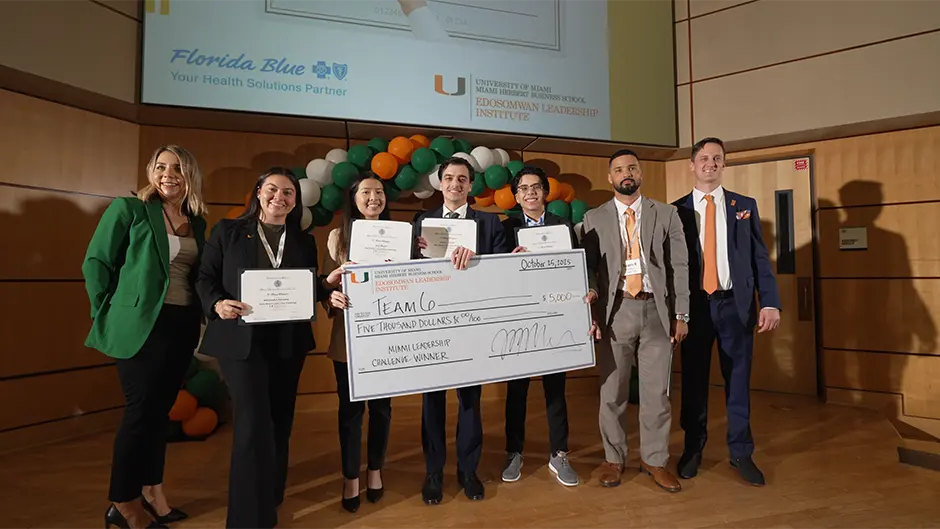
Team 6, comprised of students Nicole Diaz, Alexandra Fonseca, Joie Meyer, Luis Sibilly, and Conner Vasile, took home first place and the $5,000 prize co-sponsored by Florida Blue.
"This was truly an amazing experience that showed me the value of a great team," said Joie Meyer, a Master of Science in Business Analytics student. "While we all came from different programs and didn't know each other at the start, we quickly learned each other's skill sets and—even when pushed to our boundaries—came together to tackle the crisis effectively."
The two-day format allows students to develop skills rarely taught in traditional classrooms: managing competing priorities under time pressure, collaborating effectively when stakes are high and maintaining composure when plans go sideways. "Think of it as a flight simulator for leadership: full-weight pressure, zero operational risk," said Don Donelson, a senior lecturer who designed the simulation and served as commander-in-chief of the command center.