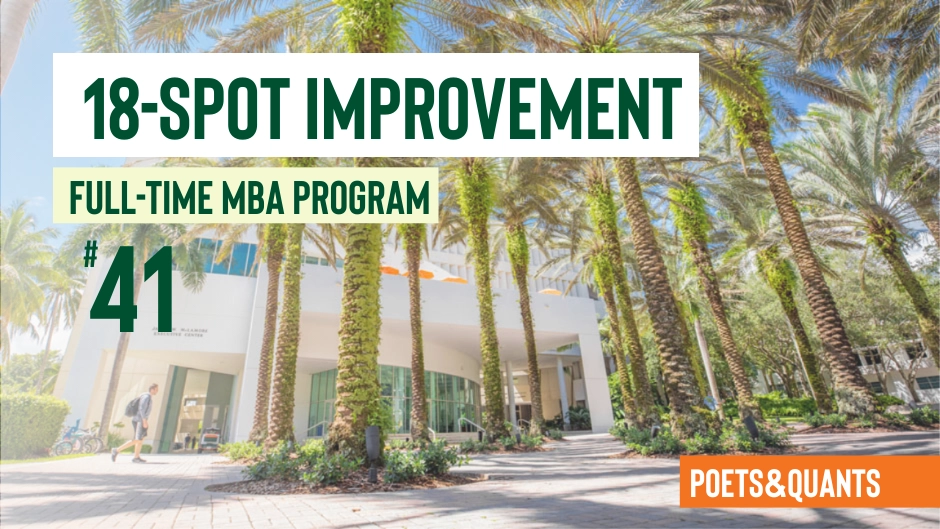
The University of Miami Patti and Allan Herbert Business School rose 18 places in the newly released 2025–26 Poets & Quants composite ranking of full-time M.B.A. programs, moving from No. 59 last year to No. 41 nationally.
According to Poets&Quants, this year’s results reflect a changing landscape, as institutions modernize curricula, integrate AI, and strive to add career value for their graduates in a changing economy.
This ranking is Miami Herbert’s strongest result ever, pointing to sustained improvement. The school has steadily advanced across the key areas evaluated by the ranking, including academic outcomes, career metrics, and student experience.
“We are thrilled by the 18-spot rise and remain committed to providing our students with a transformational educational experience that prepares them for lifetime career success,” said Paul A. Pavlou, dean of Miami Herbert. “This achievement directly advances our Moonshot strategic plan and our overarching goal of becoming a top 20 business school.”
Miami Herbert’s positioning within the Top 50 comes at a time when prospective students are sharply focused on post-graduation outcomes, applied learning opportunities, and access to global networks. The school continues to strengthen each of these areas through AI-infused curricula, transformative research, deep industry engagement, and laser focus on career success.
The school’s world-class faculty contribute to this momentum through research that advances knowledge and informs industry practice. Their work in top academic journals, combined with professional experience across key industry sectors, supports an immersed learning environment that integrates analytical rigor with real-world applicability.
The Full-Time M.B.A. program emphasizes experiential learning while leveraging Miami’s geographic location as an international business hub. Graduates pursue careers across consulting, finance, technology, and other sectors in the United States and abroad.
This ranking is based on a composite methodology that combines results from several major M.B.A. rankings, creating a single overall standing derived from multiple independent evaluations rather than a single survey or data source.
