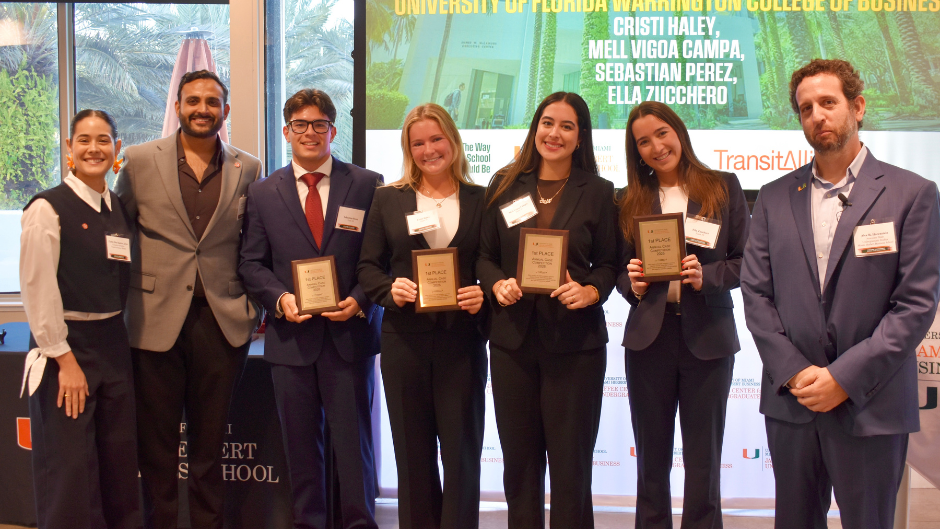
Undergraduate students from across the country applied their business knowledge, communication, problem-solving, critical thinking, and teamwork skills at the 2026 Miami Herbert Business School National Annual Case Competition, where teams were challenged to address real-world business issues while making a positive impact in the community. This year’s competition centered on developing innovative solutions for Transit Alliance Miami, a nonprofit organization dedicated to advocating for a Miami built for people, not cars.
A team from the University of Florida Warrington College of Business, consisting of Cristi Haley, Mell Vigoa Campa, Sebastian Perez, and Ella Zucchero, claimed the $3,500 first-place prize for their creative solution pinpointing three strategic segments: “better buses, better blocks, and better bikes.” Prioritizing five local neighborhoods, Liberty City, Little Havana, Little Haiti, Allapattah, and Overtown, the team proposed upgrades to buses, improvements to areas adjacent to transit with murals and other pedestrian approaches, and adoption of bike stations for multimodal transit solutions.
“Through this experience, we addressed a real-world challenge for Transit Alliance Miami and had to think quickly and deliver our idea concisely and promptly. This is a very valuable skill that our team will take away from this experience, said Haley, Campa, Perez, and Zucchero.
The University of Miami team, including Kaleab Bekele, Malakiyah Fairclough, and Brian Bros, secured third place. Their proposal concentrated on growing partnerships and diversifying revenues while developing a student access transit program.
“This was an exceptional experience made possible by the business school,” said Bekele, Fairclough, and Bros. “The school demonstrated great care and attention to detail in organizing the program, and it actively encouraged broad student participation. Throughout the competition, we developed valuable, lifelong skills that will serve us well in our careers.”
The competition consisted of two phases, Case I and Case II. In Case I, teams evaluated the organization’s strategic plan, selected one of its pillars, and proposed creative ways to meet the goals under the pillar. Each team submitted a formal proposal and interviewed with judges who provided feedback on the feasibility of the proposals. In the final phase, Case II, students were tasked with developing a detailed execution plan, including a five-year financial pro-forma project and a go-to-market strategy for one of the ideas they had proposed during Case I. On the morning of competition day, at exactly 9:15 am, each team was handed a sealed envelope that contained their task for the next three hours. Within three hours, each team prepared a response to deliver in a ten-minute presentation, followed by a rigorous question-and-answer session in which judges evaluated the depth and feasibility of their recommendations.
"All the ideas presented during Case I and Case II were innovative and well-informed,” said Cathy Dos Santos, executive director of Transit Alliance Miami. “We are very impressed and appreciate the time and effort that the University of Miami and all the participating students put into this experience that will enable us in Transit Alliance to continue our impact in the community."
In its third year, Miami Herbert’s Annual Case Competition continues to reflect the business school’s mission to prepare students for lifelong career success, as students learn through the Miami Method, a hands-on approach to learning.
More than 200 students have participated in this competition since its inception. This year, a record number of team registrations brought exceptional student talent from across the nation to Miami. Teams were comprised of business students from schools across the country including, Auburn University Harbert College of Business, Florida State University Herbert Werthein College of Business, Nova Southeastern University H. Wayne Huizenga College of Business and Entrepreneurship, North Carolina Agricultural & Technical, Boston College Carroll School of Management, Cornell University Charles H. Dyson School of Applied Economics and Management, Tulane University A. B. Freeman School of Business, University of Florida Warrington College of Business, and Miami Dade College Wolfson Campus Miguel B. Fernandez Family School of Global Business, Trade & Transportation.
“This competition reflects the school’s strategic vision in action by advancing the Miami advantage, deepening experiential learning, and preparing students for lifelong career success,” said Paul A. Pavlou, dean of Miami Herbert. “It also strengthens our commitment to community impact through meaningful engagement with the nonprofit sector and mission-driven industry partnerships.”
A panel of distinguished judges, including director of development Julie Angulo of ScholarMatch, director of development Tara Auclair of SSJ Health Foundation, founder and the competition’s inagural client Kat Barrow Horth of Comic Kids, 2025’s client Alex Beckham of The Way Forward Foundation, executive director Cathy Dos Santos of Transit Alliance Miami, competition sponsor, Dean’s Advisory Council member and University of Miami alumnus Charles Durnham, alumnus Aaron Jaffee, alumnus Matthew Jaffee, alumnus and Chief of Staff Brandon Mitchell of Staff for Partnership for Miami, and Transit Alliance Miami board member Shaan Patel, provided invaluable insights to all student participants.

From left to right: Julie Angulo, Shaan Patel, Cathy Dos Santos, Kat Barrow-Horth, Tara Auclair, Alex Beckham, Charles Durnham, Brandon Mitchell, and Alex Horenstein.
Since its inception in 2024, the National Annual Case Competition has awarded more than $21,000 in prize money to business student participants.
For more information on next year’s competition, visit: Miami Herbert Undergraduate Case Competition.
