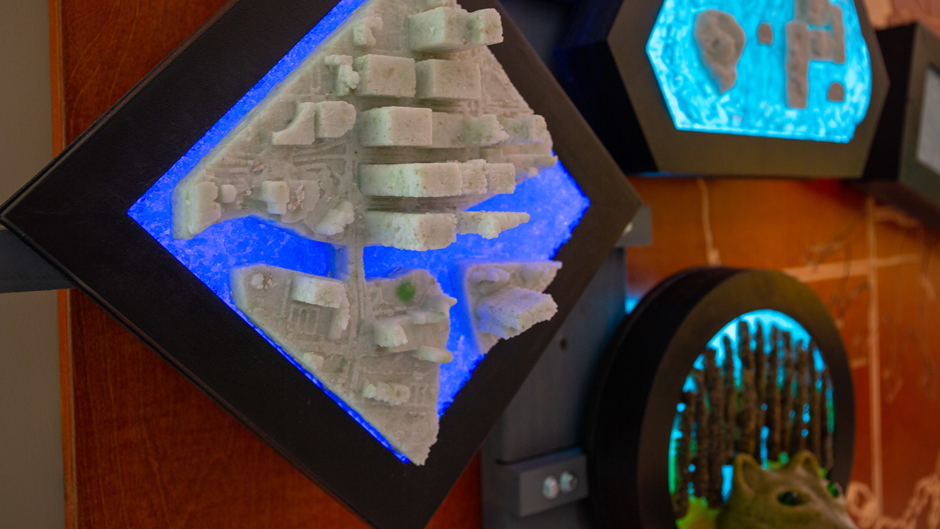
A new multimedia glass sculpture permanently installed in the lobby of the Leonard and Jayne Abess Center for Ecosystem Science and Policy offers a powerful reminder of South Florida’s fragile biodiversity. Designed by students in Jenna Efrein’s cast glass processes class in the Department of Art and Art History at the University of Miami College of Arts and Sciences, the piece is as much a scientific narrative as it is a work of art.
Crafted using recycled glass bottles, the sculpture brings together imagery of marine life, including endangered species, and environmental threats.
“I work particularly with recycled bottle glass in my own artwork,” said Efrein, a senior lecturer in glass, who was approached a year ago to create an installation for the space. “Rather than doing it myself, I thought, ‘Why not make it a project for my students?’”
Efrein guided her class through extensive research using the mission of the Abess Center, which is located in the Ungar Building, as inspiration. Each student selected a topic related to the Abess Center’s work on socio-ecological challenges—from species extinction to water pollution to climate change. They interpreted their findings in nine visual pieces shaped like different road signs, which, Efrein explained, “all indicate something specific, whether it’s regulation, caution, or direction.”

Among the contributors were students studying abroad in Rome during the spring semester, including Ashley Ward, who created a glass panther on a base shaped like a yield sign to symbolize endangered species in Florida, and Lorenzo Marzilli, whose piece exploring the environmental cost of limestone extraction was crafted in the shape of a slow-moving vehicle sign.
On campus, student Daniel Kurland modeled Brickell and Brickell Key to spotlight the tension between urban development and rising sea levels, using the shape of a construction zone sign. “I wanted to highlight the relationship between the built environment and the water around it,” he said. His piece, created from Corona bottles, draws attention to the flood risks in one of Miami’s most iconic neighborhoods. He also highlighted the sacred native land that cannot be built upon with a green dot of water bottle glass.
Ashley Delisser, whose work sits at the bottom of the sculpture in the shape of a stop sign, crafted a seagrass bed with a glass manatee to represent marine starvation caused by pollution and the overuse of freshwater. “We used Don Julio for the manatee and Miller Lite for the dead seagrass,” she explained.
Breanna Gomez, who focused on endangered species, created an alligator snapping turtle from recycled beer bottles, Topo Chico bottles, and several other glass bottles. Set in a yield sign shape, the turtle symbolizes the need for environmental protection.
“I first sculpted it out of clay and then cast it in glass,” Gomez explained.

John Stoffer III focused on the human impact of climate change and used the shape of a regulatory sign. His piece portrays a worker in the sugarcane industry under harsh sunlight, alongside the words “agua sombra descansos” (water, shade, rest). “It’s about heat protection for outdoor workers and how client change affects labor conditions,” he said.
Another student, Callista Sims, created weather maps from hurricane models to depict how natural disasters fuel environmental degradation. Her glass panels, shaped like directional road signs that rotate, overlay a map depicting pressure zones and radar data across southern Florida.
At the base of the installation, Efrein added coral reefs, sea turtles, and starfish, using molds taken from already dead coral structures to avoid ecological harm. “These are all endangered species,” she explained, noting that the class worked collaboratively to create wax molds and hand-sculpted aquatic life.
Whether shaped by a CNC machine borrowed from the School of Architecture or sculpted from salvaged bottles and other glass, every piece in the installation tells a story. Through striking imagery, student voices, and scientific grounding, the installation offers both a wake-up call and a celebration of South Florida’s unique natural world.