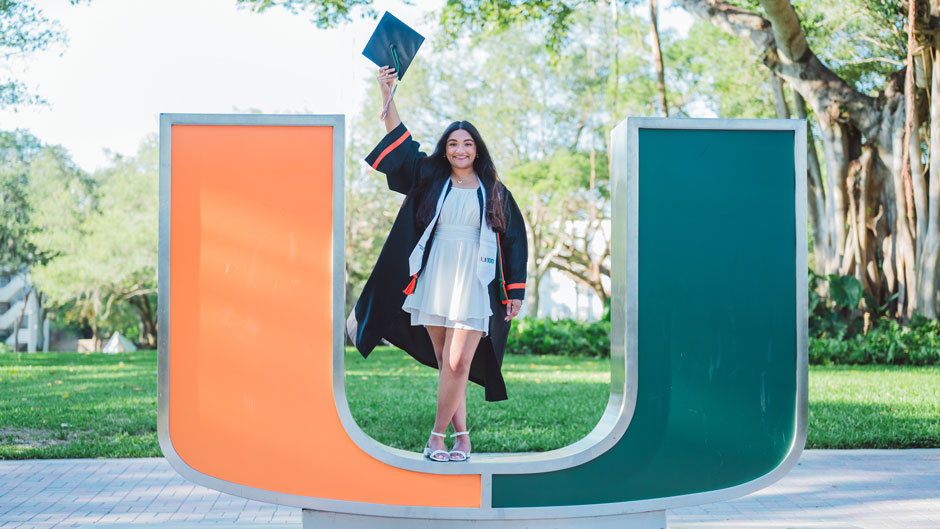
As she was looking for an elective to take during her senior year at the University of Miami, Sejal Yadalla remembered a fellow pre-medical student saying that learning Latin had helped them understand medical terminology.
“I was like, ‘Why not?’” recalled Yadalla, who graduated from the College of Arts and Sciences in May with a biology degree. “I was a little scared because I wasn’t sure how difficult it was going to be, but that’s how I ended up in the class.”
Grasping the fundamentals of Latin proved challenging at first, and Yadalla initially doubted whether she would be able to learn the language. But she soon began to enjoy her Latin class and found that her new language skills were not just useful in helping her to decipher medical terminology. They also helped her develop a stronger grasp of English grammar and make sense of unfamiliar terms in English, which has many words with Latin roots.
“I had heard that Latin is heavily integrated into everything in medicine, and that’s definitely true,” she said. “But I think more broadly, when I’m reading something in English and I don't know a word, I can sort of deduce the meaning.”
Yadalla also enjoyed the reprieve Latin offered from her high-stress pre-medical classes, in which students were often hyper-focused on getting good grades. Learning a new language, she discovered, was more about trying and failing.
“Latin classes are one place that you can really be a student and not be afraid to make mistakes,” she said. “In Latin, you can focus on what you’re learning and why you love to learn it, and I think that’s what was so amazing about this class.”
Yadalla wound up enjoying Latin so much when she took it in the fall semester of her senior year that she signed up for the next level in the spring. She took both courses with Charles Bartlett, a lecturer in the Department of Classics, who Yadalla described as “an incredible instructor.”
“Latin is a so-called dead language, right? You’d never really expect to see it or use it that much in your everyday life,” she said. “But Dr. Bartlett is somebody who just completely brought it to life in the classroom.”
This fall, Yadalla will begin her medical training at the Miller School of Medicine, where she was granted early admission through the Medical Scholars Program. She hasn’t yet decided on a medical specialty, but she hopes to follow the example of her mother, an obstetrician/gynecologist who has spent her career treating patients in rural and low-income areas, by working in underserved communities.
In the meantime, Yadalla plans to continue studying Latin on her own. She even brought her Latin textbook home with her this summer.
“I think it’s always going to influence my writing,” she said. “I thought Latin was a dead language, but it turned out to be the beating heart of everything that I’ve ever read and written.”