When Shai Cohen first began to use artificial intelligence (AI) tools in his classes in February 2023, he wasn’t sure what to expect. The students in his “Jews and Judaism in the Iberian Peninsula” class at the University of Miami were learning about the forced conversions to which Jewish families were subjected during two periods in the history of Spain and Portugal, and Cohen invited them to use ChatGPT prompts to create an individual narrative about this topic.
When the students shared the AI-generated stories in class, Cohen was amazed by the level of detail. The narratives, generated from a simple prompt, seemed to be personalized based on each students’ character. Cohen quickly saw the potential of generative AI tools to enrich historical and cultural studies.
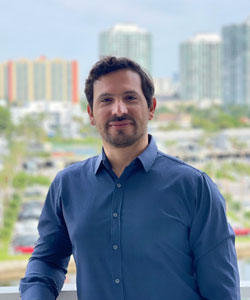
“I said, ‘Here we have something that is simply mind-blowing,’” recalled Cohen, a lecturer of Spanish, Hebrew, and Sephardic studies in the Michele Bowman Underwood Department of Modern Languages and Literatures at the College of Arts and Sciences.
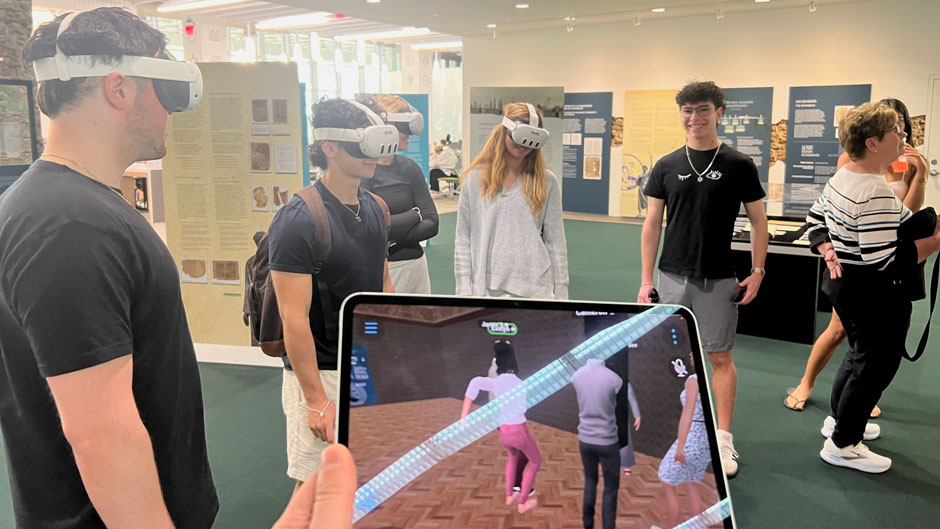
Since then, Cohen has embraced generative AI tools. For “The Golden Age of the Jews of Al-Andalus,” a traveling exhibition he helped bring to the University, Cohen conceived and curated a virtual reality and AI component, which was created with the assistance of Thomas Merrick and Bryson Rudolph from UMVerse. Visitors to the exhibition at the Otto G. Richter Library, which is open until June 15, can explore a digital reconstruction of a medieval synagogue and interact with an avatar of Maimonides, the renowned Sephardic rabbi and philosopher. Cohen has also organized a workshop on using AI in the classroom for faculty members in his department.
This spring, Cohen taught a new course entitled “Sephardi & ChatGPT: Preservation of Cultural Heritage and AI” (SPA 310) that explores how AI tools can be used to preserve, research, and share the culture and history of Sephardic communities—Jewish communities that trace their roots to Spain and Portugal.
Over the course of the semester, Cohen’s class experimented with various tools, creating AI-generated podcasts and 3D-printed artifacts, as well as digital story maps tracing the migration routes of Sephardic families forced to leave the Iberian Peninsula. Some of these maps will be added to the Sephardi Spaces project, an online database of migration routes that Cohen launched with support from the Sue and Leonard Miller Center for Contemporary Judaic Studies, the George Feldenkreis Program in Judaic Studies, and his department. Students also experimented with a Maimonides chatbot Cohen built using the philosopher’s books and letters.
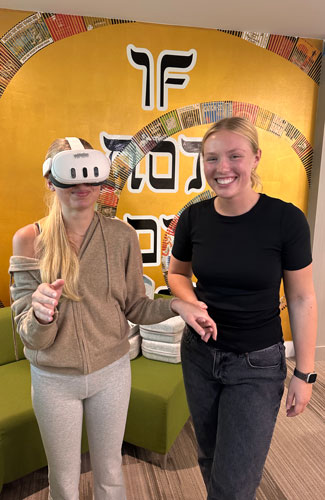
“You could ask questions and obtain guidance as if you were talking to Maimonides himself, which was really cool,” said Kyle Araujo, a graduating senior who took Cohen’s class in the spring.
The “Sephardi & ChatGPT” class also included a community engagement component. The students divided into groups, and each group brought virtual reality headsets to a different Jewish community in Miami for a community engagement activity. For example, one group worked with University of Miami Hillel, a Jewish student group on campus, so participants could explore the Al-Andalus exhibition and speak with the Maimonides avatar. Another group brought the virtual reality headsets to a local Jewish school, and a third group partnered with a Sephardic temple in the town of Surfside.
Araujo said the “Sephardi & ChatGPT” class changed the way he thinks about digital tools and their potential to enhance cultural understanding.
“Before, I just used AI for simple things like email, but through this class, I realized that it can be used for an almost scary number of things in our daily lives,” he said. “I think AI helps with bringing cultures together and bringing traditions alive.”
Cohen said his digital humanities work has shown him that AI tools can help people reach a deeper understanding of the universality of human experience. In his own life, Cohen has experienced many different cultures. He grew up in a Sephardi family in Israel with a grandmother who spoke Haketia, the Judeo-Spanish of Morocco; spent four years traveling around the world as a young adult; went to college in France; completed his Ph.D. in Spain; and moved to Miami in 2022. He said he has found that humans often struggle to grasp the commonalities people from different cultures share.
“AI can understand much better than the average human being the layers of so much universality in human nature and reconcile all of them together,” Cohen said. “When thoughtfully applied, it can become a catalyst for recovering overlooked histories and re-engaging communities with their cultural legacies. Rather than replacing humanistic study, these tools invite new forms of dialogue between tradition and technology.”
