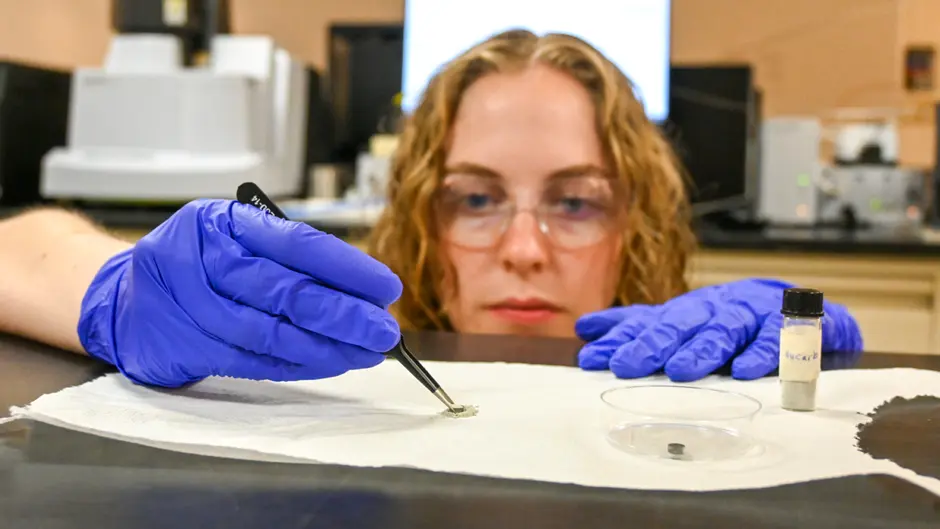
Meaghan Shaw, Jocelyn Kruger, Alec Garcia-Caceres, and Devyn Lea, all undergraduates from across the country, are spending their summer testing whether adding algae and animal waste to concrete can offer a more sustainable way to strengthen buildings.
“Concrete and cement produce a lot of carbon emissions, so we are trying to replace that with organic materials, like this biochar, or burned animal and plant waste, to make concrete more durable,” said Shaw, who is visiting the University of Miami this summer from the University of Hartford.
Nearby at the James L. Knight Physics Building, Susana Cuadra, a junior from Rice University, is working on a temperature sensor that could be part of the newest lobster eye x-ray telescope that NASA hopes to launch into space next year.
Other students visiting the University this summer are delving into topics like the sleep and movement of fruit flies; improving water quality in Miami Beach canals; whether existing telescopes can detect light from the cosmic microwave background; and creating better filters for wastewater. These are all research projects happening at the University this summer, but for these students visiting on-campus labs, it is also fascinating, hands-on experience in their chosen field.
“I’m very excited by this research, and this summer, I’ve gotten the chance to learn coding and simulation skills,” said Cuadra, adding that she hopes she can see the launch next summer in Houston or someday work for NASA. “I was in a rocketry club at Rice, but this is much more than that could offer.”
Students are working on these projects thanks to a National Science Foundation grant called Research Experiences for Undergraduates (REU) that enables them to live on the Coral Gables Campus for two months. While the program is not new, academic departments must apply for these grants that help fund the students’ time and housing at the University. This summer, the Department of Physics at the College of Arts and Sciences and the Department of Civil and Architectural Engineering at the College of Engineering are hosting a total of 17 REU students from institutions across the nation.
While Ali Ghahremaninezhad is overseeing nine REU students working on coastal infrastructure engineering projects, physics professor Olga Korotkova is helping to mentor eight students working in her department with assistant professor of physics, Vivek Prakash. All of the faculty members are grateful for the students’ help to advance their research and said the REU experience also helps them attract future graduate students.
“We don’t have enough American students pursuing doctoral degrees in science, technology, engineering, and math, so this program provides a pipeline of incredible students, who may become graduate students, and allows them to see what they like and if they want to continue in this field,” said Ghahremaninezhad. “These REUs help us to publish research, and often, they become quality Ph.D. students.”
Two years ago, Jasmine Rodriguez was an undergraduate studying at Syracuse University, when she grew interested in sustainable construction research and then did an REU in Ghahremaninezhad’s Advanced Infrastructure Materials Research Lab. Rodriguez had such a positive experience that she returned to the University to complete her doctorate. She is now working with this summer’s REU students.
“The fact that I could find this lab was great because I really like the research we are doing, and the REU helped me do it,” Rodriguez said.
Besides the firsthand research experience, the young students also appreciate the opportunity to learn about being a graduate student from their mentors. And all of them had a chance to present their research at a poster session.
Andrew Irwin, a physics major from Bates College, is working with engineering professor Helena Solo-Gabriele to test whether UV radiation can help decontaminate street surfaces of bacteria spread through animal waste. Since the bacteria later ends up in canals, Irwin said that adding this UV light to street sweeper trucks may help to lower water contamination levels in Miami Beach canals.
“I would like to apply physics to environmental issues, and this project allows me to use those skills I’ve learned in class,” he said. “Also, this project is allowing me to do something where there are concrete results that people can see and that could potentially help them.”
Benjamin Dable, a senior biophysics major from University of Missouri–St. Louis, is studying the sleep patterns of fruit flies in the lab of physics associate professor Sheyum Syed. Since fruit flies are often used as a model system for genetics, the insects offer clues to further understand human biology. Toward that goal, Dable is running daily experiments with fruit flies to determine how they recover from sleep deprivation. Using that data, he is working to build a computer model of their sleep patterns, so it can be used for future experiments.
“In the future, I’d like to make computer models of biological systems, and this is a great stepping stone for that,” he said.
Ideally, many of the students will collect new data from the experience, offering them a chance to pen an academic journal article and share their knowledge with others.
Carolyn Garcia, a neuroscience major from Florida State University, is working in physics associate professor Mason Klein’s lab to understand how the interplay of salt and temperature impacts the movement of larval fruit flies. Unraveling this connection may help explain other brain-sensory connections, Klein said.
“It’s interesting to think about how and why these insects move, especially since they have a similar brain to humans,” Garcia said. “I have also gotten the chance to do some neural imaging of their brains this summer, which was really fascinating.”
Korotkova, who works to unravel the properties of light, is elated that with the help of her REU student Glenn Ochsner from Miami University in Ohio, they will be publishing a new paper on how different properties of light couple with each other. Ochsner said it is her first time getting published.
“I’ve learned a lot about the logistics of publishing a paper, and I want to go to graduate school in this area, so the UM program was great,” she added.
