
The United Nations Human Rights Council (UNHRC) recently devoted a session to a largely overlooked chapter of Middle Eastern history: the forced displacement of nearly 1 million Jews from Arab countries and Iran after 1948.
Henry Green, a professor in the Department of Religious Studies at the University of Miami College of Arts and Sciences, was invited to speak at the UNHRC session in Geneva. He placed the issue in the broader context of human rights.
“This presentation does not diminish the plight of Palestinians who were displaced during the 1948 War,” Green told delegates at the Sept. 8 session. “But, like many of you in this room who are refugees, I am a child of a Ukrainian who was displaced as well.”
“In 1948, close to 1 million Jews lived across ten Arab countries and Iran,” he added. “Today, fewer than 12,000 remain. What followed was not a mere exodus, but the erasure of Jewish communities.”
Green and the other speakers at the session presented new research estimating that Jewish refugees lost more than $263 billion in confiscated homes, businesses, and communal property. Delegates heard testimony and historical evidence documenting how entire communities that were once central to the cultural and economic fabric of cities like Baghdad, Cairo, and Tripoli vanished within a generation. Most of the Jewish refugees found safe haven in Israel. Others ended up in France, the United Kingdom, the United States, and Canada.
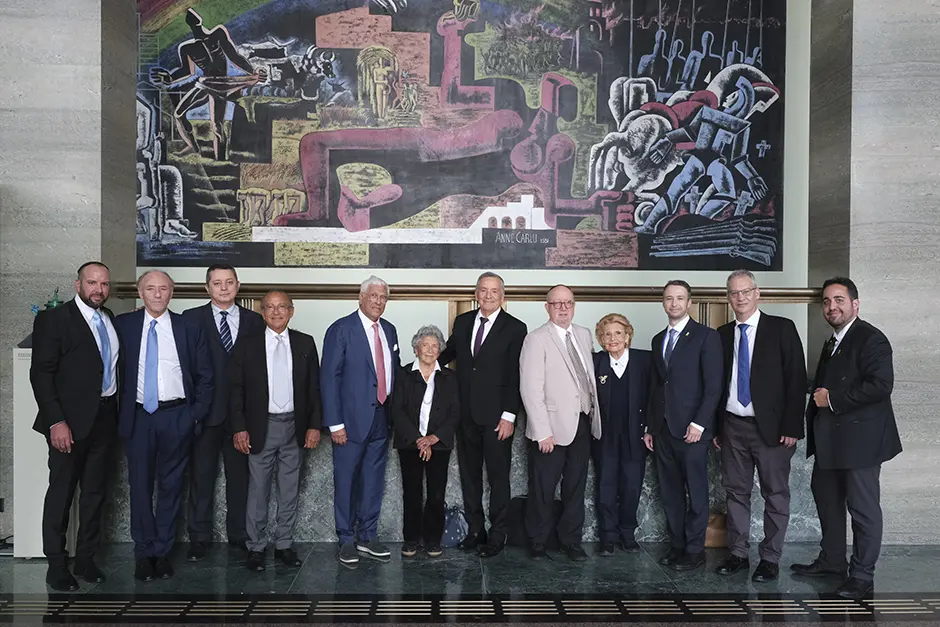
Levana Zamir, 87, who was expelled from Egypt in the late 1940s, was one of the speakers who shared testimony with the UNHRC. She described her experience, underscoring the human cost behind the statistics.
“I was expelled from Egypt with my parents and my six brothers in 1949, after all our property was confiscated,” she said in Arabic. “The only reason: because we were Jews.”
Green emphasized that the call for the recognition of Jewish refugees from the Middle East was not meant to pit one community’s suffering against another’s.
“The legitimate call to secure rights and redress for Jews who were forced to flee Arab countries is not a campaign against Palestinian refugees,” he said. “It is an initiative to ensure that the plight of Jewish refugees from Arab countries be placed on the international political agenda as a quest for truth and justice, and that their rights be secured as a matter of law and equity.”
The meeting, which was streamed globally, marked one of the most prominent stages yet for this issue at the UN. For advocates, it was also a sign that the international community is beginning to acknowledge testimonies of Jewish refugees from Arab lands alongside those of Palestinians.
Green is a leading scholar of Sephardi communities and has conducted extensive research on the exodus of Jews from Arab countries after World War II, publishing a book on the topic entitled “Sephardi Voices: The Untold Expulsion of Jews from Arab Lands.” He is the founding director of the Jewish Museum of Florida and serves as executive director of Sephardi Voices, an international digital archive dedicated to recording, documenting, and preserving the testimonies of Sephardi Jews.
