The Caribbean is facing numerous crises: heatwaves, increasingly damaging hurricanes, and political and social unrest on some island nations, just to name a few examples.
That’s why, when the University of Miami hosted the 43rd West Indian Literature Conference from Oct. 8–11, the conference organizers chose to focus on how contemporary writers are grappling with these situations.
The conference, entitled “The Time of the ‘Bruggadung’: States of EmUrgency,” brought together roughly 150 scholars, writers, artists, and educators from across the Caribbean and around the world to discuss different aspects of Caribbean literature. The conference title comes from the Bajan Creole term “bruggadung,” which refers to both the sound of a bang and a time of disaster, reckoning, or transformation.
One of the keynote events, “Juracán - Huracán - Hurricane Stories: From the ‘l’ of the Storms,” held at the Pérez Art Museum Miami on Oct. 9, was open to the public and explored writings on hurricanes dating as far back as Zora Neale Hurston’s 1937 novel “Their Eyes Were Watching God,” up to writings on Hurricane Dorian in 2019. The event began with readings from poems, stories, and other hurricane-related texts performed by Kei Miller, Travis Weekes, and Njelle Hamilton.
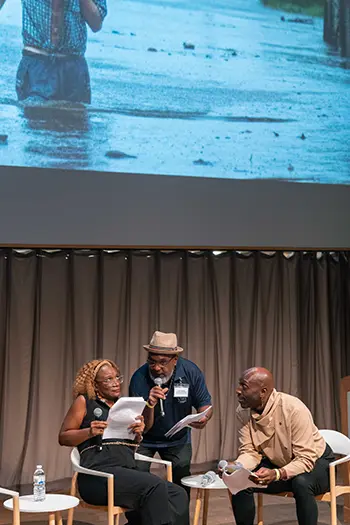
“We thought it was worth reflecting on these experiences as one aspect of the ‘bruggadung,’” said Patricia Saunders, the conference chair and a professor in the Department of English and Creative Writing in the College of Arts and Sciences. “The ‘bruggadung’ as we know is as much about the environment—social, political, cultural—and, obviously, if you’re in the Caribbean, weather-related.”
The “Hurricane Stories” event featured Angelique Nixon, Erica Moiah James, and Tiphanie Yanique, three scholars and writers who have published op-eds about recent hurricanes in the Caribbean. Their op-eds, which appeared in Stabroek News and The New York Times, dealt with disaster responses in the Bahamas and the U.S. Virgin Islands, as well as how islands that contribute little to climate change are bearing the brunt of its impacts.
“For me, I was grieving home in the aftermath of Dorian,” said Nixon, a senior lecturer at the Institute for Gender and Development Studies at the University of the West Indies, St. Augustine, who wrote a series of op-eds about Hurricane Dorian hitting her native Bahamas in 2019. “I watched Dorian being outside but inside, and all I could do was write from a place of deep sorrow and despair. All I could do was share my grief through words and activism.”
The panelists also discussed how writing can help communities heal after the storms have passed.
Yanique, a professor of English and Creative Writing at Emory University, recounted how residents in the U.S. Virgin Islands, where she grew up, have used poetry to recover from the double whammy of Hurricane Irma and Hurricane Maria hitting the islands within a two-week period in 2017. She described how residents invented a new poetic form called the “hurriku,” which is similar to a haiku, but with the number of syllables dictated by figures related to the 2017 hurricanes.
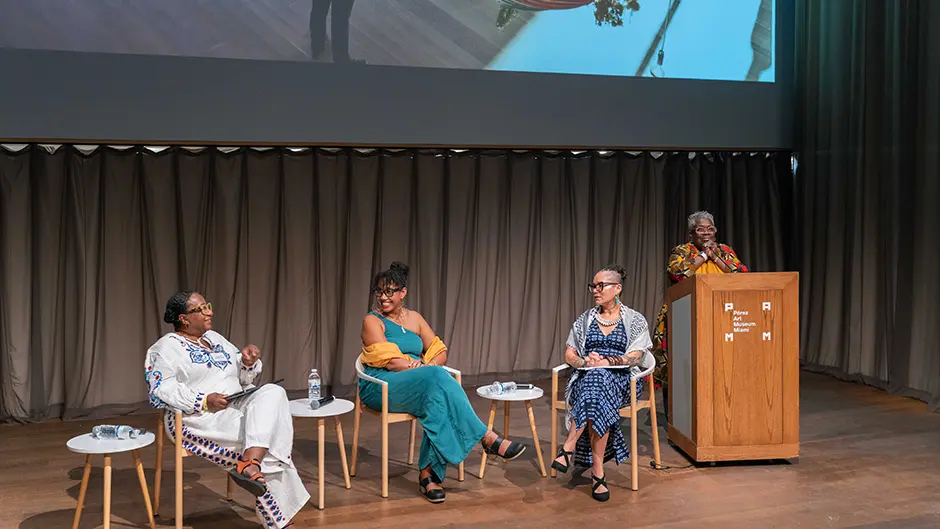
“People were sharing the ‘hurrikus’ over the radio because you could call into the radio and that was the way that you communicated with each other. This became a sort of community poetic project that we used to do reparative work,” Yanique said. “I can’t say we will be all the way repaired because I think the land will hold this destruction and so will our bodies, but we can heal, and I think the poetry can help us.”
James, an associate professor in the Department of Art and Art History at the College of Arts and Sciences, also talked about the value of gardening as a way to reconnect with nature, especially for younger generations.
“Growing up in the Bahamas, I was always a gardener … And I think one of the things I have held onto in Miami is that aspect of the Caribbean,” she said. “We’re becoming estranged, I think, from ourselves and history and the land and landscape. We need to reconnect the next generation to the land, teach them how to restore it.”
The 43rd West Indian Literature Conference was sponsored by various entities at the University of Miami, including the College of Arts and Sciences, the Center for Global Black Studies, and the Institute for Advanced Study of the Americas, as well as by the Pérez Art Museum Miami and its Caribbean Cultural Institute, funded by the Mellon Foundation.