Students in Charles Bartlett’s Ancient Medicine course explore how societal beliefs and religion influenced medical care in ancient Greece and Rome—and how they continue to shape medicine today.
“What’s exciting about studying ancient medicine is that it gives you a critical distance from which you can say, ‘Let me look at how philosophy and religion actually impact medicine,’” explained Bartlett, a research assistant professor in the Department of Classics at the University of Miami College of Arts and Sciences. “It gives you a freedom to interrogate some of these longstanding and undeniable connections.”
“What I’m teaching is not going to be very useful for the MCAT,” he added, “but it can give you investigative tools and an awareness of how medicine fits into the rest of society, which is not always emphasized sufficiently in a student’s medical education.”
The Ancient Medicine course bridges history, philosophy, and science, exploring the origins of Western medicine through the lens of ancient Greece and Rome. It covers a timeline that stretches from Homer’s “Iliad,” which describes some of the final events of the Trojan War just after 1200 B.C.E., to the Roman Empire in the third century C.E.
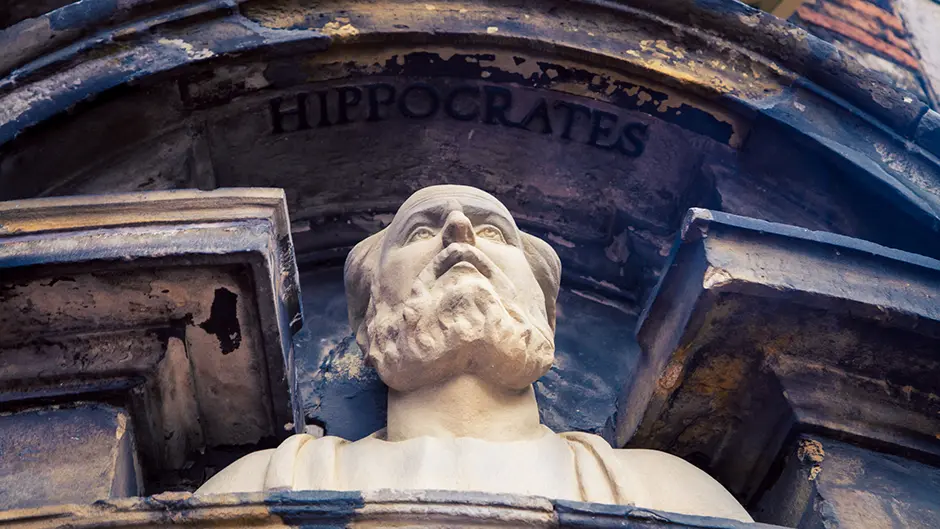
Students examine medical writings such as those contained in the Hippocratic Corpus and the works of Galen, two foundational collections that defined ancient medical thought. The class investigates how physicians in antiquity viewed the human body, disease, and healing, as well as how those ideas evolved within broader cultural frameworks of religion, philosophy, and politics.

“We trace not only the development of the profession of physicians in antiquity, but also the intellectual universe in which they worked,” Bartlett explained. “We look at the ways in which religion, politics, ideas of magic, and other cultural elements shaped the development of medical ideas and medical practices in antiquity.”
He also noted how enduring many of these ancient ideas proved to be. “We tend to think of medicine as an incredibly innovative field, and, of course, it is,” he said. “But there are ancient paradigms or ancient understandings of the ways in which bodies are composed, of how substances move within bodies, and of how people can be restored to health—paradigms or understandings that we now regard as totally wrong—that held on for an incredibly long time in the history of medicine.”
Throughout the semester, students explore key themes such as medicine and society, religion and medicine, conceptions of the body, and the development of the medical profession. Though grounded in antiquity, these discussions encourage students to reflect on how modern medicine is still influenced by cultural forces today.
“Dr. Bartlett’s passion, experience, and teaching provide students with an incredibly unique perspective about medicine through the study of classics,” said Giselle Torres, a senior majoring in health science who previously took the course. “The course discusses and analyzes specific readings that allow us to investigate the ancient world. Through [the professor’s] enthusiasm and warm demeanor, this class allows for critical thinking about science beyond your typical STEM curriculum.”
By comparing ancient and modern approaches, Bartlett hopes students gain a deeper awareness of how beliefs, ethics, and environments influence scientific progress. He emphasizes the value of curiosity and open-minded exploration in his classroom.
“I find that students here are extremely curious,” he said. “Once people are willing to adopt that mindset of exploration and an interest in drawing connections, it makes what we do a lot more exciting.”
Before joining the University of Miami in the fall of 2021, Bartlett completed his Ph.D. in classics at Harvard University and taught at Harvard and at Duke University. His research examines the ancient economy and ancient empires, as well as how the Roman legal system has shaped the intellectual, institutional, and cultural landscape of Europe in the centuries since antiquity.
Bartlett views the humanities as an essential part of education, one that teaches students to think deeply about life’s biggest questions. “We give you tools to ask questions that you should try to answer for yourself, but that will never be perfectly answered by society or by any one person,” he said. “Questions like: How should society be structured? What is love? What is human connection?”
Whether teaching Ancient Medicine or other courses in economic, legal, and political history, Bartlett encourages students to think critically about how the past continues to inform the present. “When you look at these ancient texts, you are not just studying a narrow subject,” he said. “These conversations help us to understand our place in the world, and that’s what makes teaching at UM so rewarding.”