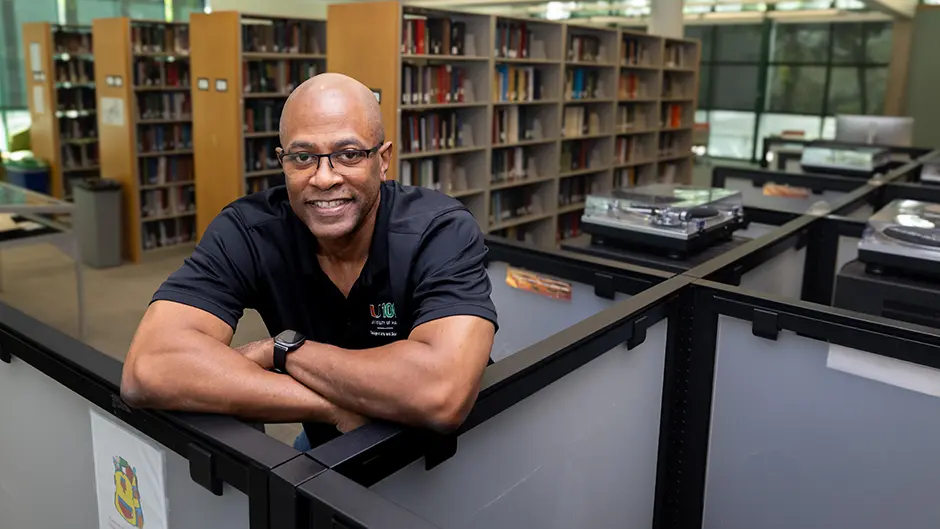
When Martin Peeples completed his military service—including a Gulf War deployment—as a paratrooper in the 82nd Airborne Division, he hoped to find another meaningful job. But he quickly learned that without a college degree, his options were limited.
“I was infantry when I came out of the military, and there are not a whole lot of positions out in the corporate world that really appreciate that kind of experience,” he said, adding that he encountered a lot of “shut doors.”
Although Peeples wanted to attend college, the cost of a four-year university program was out of reach. Absent a degree, what followed was “a hodgepodge” of different manual labor jobs and office managerial positions involving bookkeeping.
Roughly a decade after leaving the military, Peeples moved from Chicago to South Florida, where he eventually met his wife, Adrianne Rondon, who works at the University of Miami as a senior program coordinator in the Department of Psychology. When Peeples learned that the University offers employees tuition remission, he was determined to find a job on campus.
In 2014, Peeples was hired as an evening supervisor at the Marta and Austin Weeks Music Library and enrolled in the Division of Continuing and International Education to take prerequisite courses. He then applied and was accepted to the College of Arts and Sciences.
“I always felt I had the wherewithal to complete school, so once I had the opportunity, I was all in,” Peeples said.
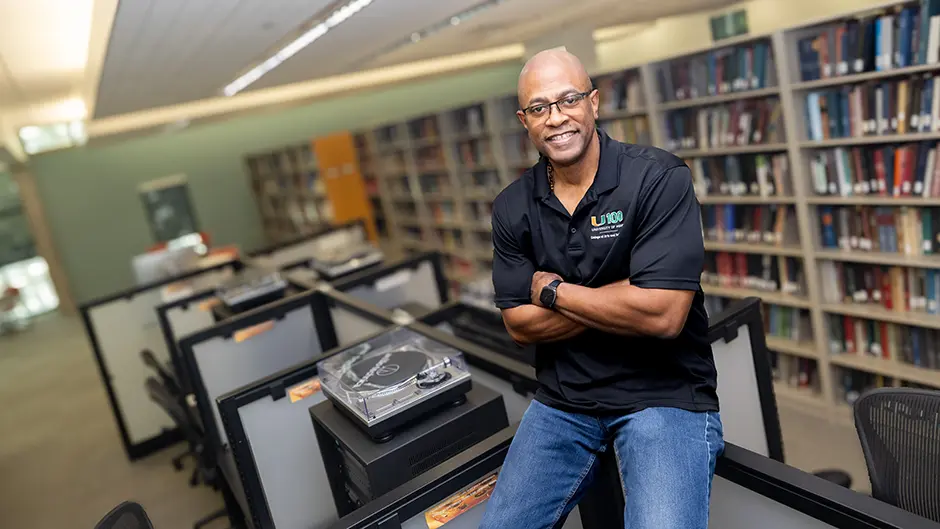
Peeples had been fascinated by human behavior since his military days, when he observed how people from different backgrounds worked together as a unit in high-stress environments like war. This experience made choosing psychology as a major an easy decision.
A class called Mindfulness, Attention, and the Brain taught by Amishi Jha, a professor in the Department of Psychology whose research includes studying the impacts of mindfulness-based training on members of the military, helped Peeples connect the dots between his military career and his coursework.
As Peeples continued to work full-time while completing his bachelor’s degree, juggling demanding courses with his professional and personal obligations, he found time management to be one of the biggest challenges. But he felt fortunate to have understanding bosses at the Marta and Austin Weeks Music Library who were supportive of his academic goals.
“My advice for other nontraditional students is to guard your mental health and find a healthy balance between work, academia, and your personal life,” he said.
Now, after 10 years as a working student, Peeples is graduating on Dec. 11, 2025, with a bachelor’s degree in psychology and a double minor in sociology and strategic communication. He hopes to become a mental health counselor and is in the process of applying for the Master’s in Mental Health Counseling program at the University’s School of Education and Human Development. But regardless of whether he is accepted into the program, Peeples feels hopeful about his future.
“Now, I’m not limited to these shut doors. The doors are now slightly cracked open for me,” he said. “I finally feel like I found where I’m supposed to be.”