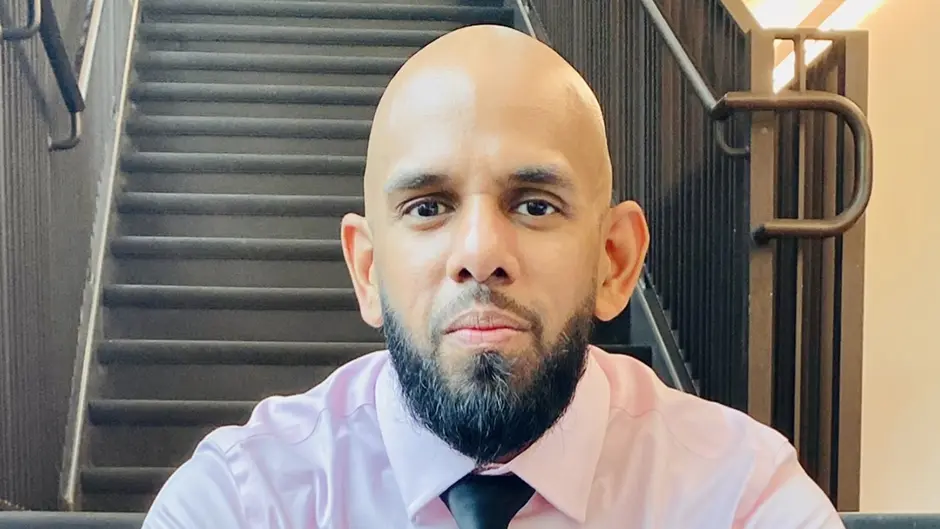
Stephen Narain wrote the first paragraph of his novel as a 19-year-old college student at Harvard University. Then he spent the next 20 years chipping away at it while earning a Master of Fine Arts degree and teaching literature and writing in Iowa, Florida, and New York.
“It’s a coming-of-age novel and a coming-of-artist novel, so as I changed as a person, what I would find is there would be these moments of intense magnetism [drawing me to the book] during those times in my life when I experienced incredible transitions,” said Narain, who is now in the first year of the Ph.D. in English program at the University of Miami College of Arts and Sciences. “As I grew up and matured and took my hits, I think the novel evolved.”
Once Narain finished writing the book, however, he faced numerous rejections from mainstream publishers, an experience he described as “very, very humbling.”
Then, in December, Narain received life-changing news: his novel, “The Church of Mastery,” was awarded the Restless Books 2025 Kellman Prize for Immigrant Literature, a prestigious annual award for first-generation immigrant writers. The prize includes publication by the independent publisher Restless Books, a $10,000 advance, and a writing residency.
“I feel very happy, very relieved,” said Narain, who is now 39.
“The Church of Mastery” tells the story of William (Billy Boy) Jones, who immigrates from a fictional Caribbean island to the United States in the late 1950s and travels through the Deep South with a group of artists. While dealing with segregation and adapting to a new country, Jones struggles to safeguard his inner life as a poet.
“Stephen’s narrative about the immigrant experience gives us a glimpse into a new imagining of what it means to make a home in the world, particularly when that world is changing so rapidly,” said Patricia Saunders, Narain’s advisor and a professor in the Department of English and Creative Writing. “But more importantly, it also highlights the importance of literature and art in reminding us not only of who we are, but also of who we wish to become.”
Some elements of the novel were inspired by Narain’s own journey growing up in the Bahamas as the son of Guyanese immigrants and moving to Miami as a teenager. After graduating from Harvard and the Iowa Writers’ Workshop, he taught at the University of Iowa, Valencia College in Orlando, Florida, and a youth advocacy center in New York called The Door. Along the way, he continued to work on his novel, a process that included conducting copious amounts of research on the Civil Rights Movement and segregation in the Deep South. He also published fiction and essays in Small Axe: A Platform for Caribbean Criticism, the Los Angeles Review of Books, and Wasafiri magazine.
Narain said his decision to pursue a Ph.D. in English with a Caribbean studies concentration felt like “a natural next step.”
“A lot of my work is really interested in the political and historical context of the Caribbean, from the colonial era to the present. So, a lot of what I’m trying to do is make sure that my fiction is not only rooted in character, but also grounded in facts,” he said. “The Caribbean studies program here is phenomenal. It’s so interdisciplinary, it has figures at the top of their field, and it’s really collaborative.”
Narain said he was also drawn to the Ph.D. program at the University because the faculty value both critical and creative work and don’t encourage students to pick one over the other.
Saunders echoed this sentiment. “Stephen’s arrival at the University of Miami made perfect sense to the Department of English and Creative Writing because our faculty boasts an array of writers and scholars who are, as I like to call it, ‘ambi-literary-dextrous’—writing, thinking, and teaching across multiple genres and disciplines,” she said. “When we interviewed Stephen, it was clear that he would be right at home in a department where writing about the immigrant experience in America has been (and continues to be) a mainstay of expression for scholars and creative writers alike.”
Narain already has an idea for a second novel, but for now, he is focused on his Ph.D. program and on preparing “The Church of Mastery” for publication.
He said that in addition to feeling grateful for the award, he feels an overwhelming sense of relief that his novel will soon be published.
“I knew that William’s spirit was in the book,” he said, referring to the novel’s protagonist. “I couldn’t let him just wither away.”
