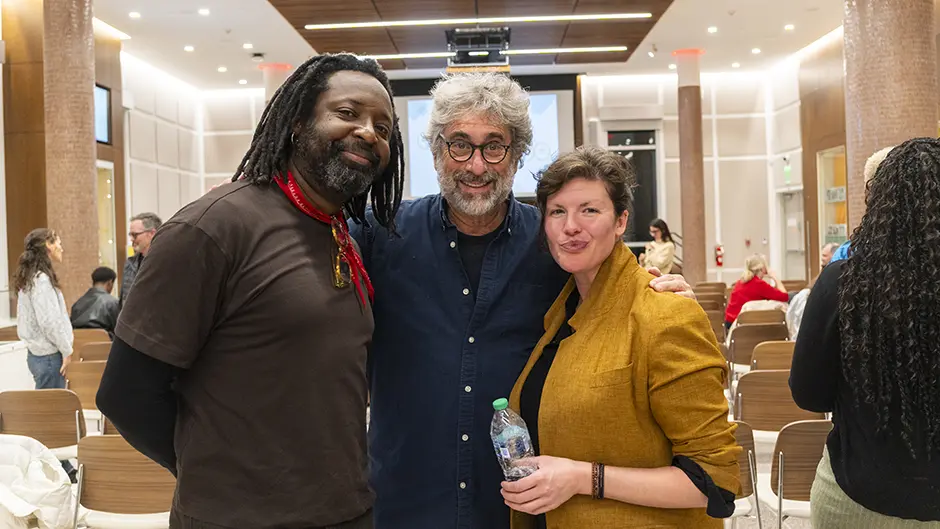
As a sophomore, Laura Garcia, a student studying psychology and creative writing at the University of Miami College of Arts and Sciences, came up with an idea for an event celebrating multiculturalism in literature.
With support and guidance from Jaswinder Bolina, chair of the Department of English and Creative Writing, the Sigma Tau Delta Honor Society, and University of Miami Libraries Special Collections, over the next year Garcia developed an ambitious concept for a Writer’s Night event that would bring together prominent poets and novelists.
On Feb. 3, that event debuted in remarkable fashion with readings by National Book Award finalist Marlon James, U.S. poet laureate Arthur Sze, and faculty members M. Evelina Galang and Kimberly Reyes, who are both award-winning writers.
“Now this event has come to life,” Garcia said in her introductory remarks. “It was just a small seed, and now it has flourished into what we get to share today.”
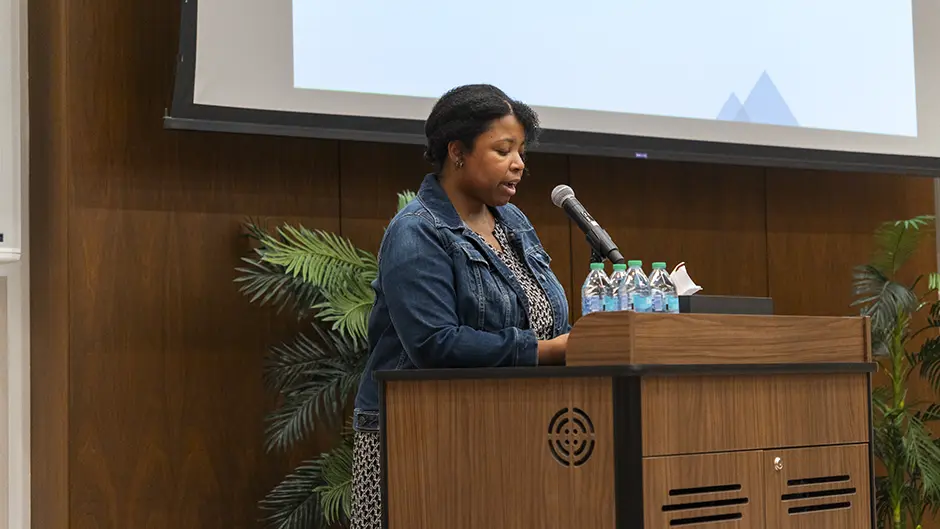
The event, held at the Kislak Center at the University of Miami, took the audience on a wide-ranging literary journey that included poetry inspired by pop culture and the natural world, fiction and nonfiction writing about Filipina “comfort women,” and a preview of James’ forthcoming novel.
Reyes, an assistant professor in the Department of English and Creative Writing, kicked off the readings by sharing poems from her three poetry collections. In a nod to the recent cold snap in South Florida, she began with a poem about bees in the cold and went on to read poems that deal with Taylor Swift, a health scare, and a playground accident, among other topics.
Reyes, a former music and entertainment journalist, said she often incorporates pop culture references into her poetry.
“I just have to tell you you’re going to sit through a poem about Taylor Swift, so I have to introduce it a little bit,” she said before reading the poem “Red.” “I have a very fraught relationship with Taylor Swift, which this book explores in detail. This book is really about the personal being political, the political being personal, and if we should be separating the art from the artist.”
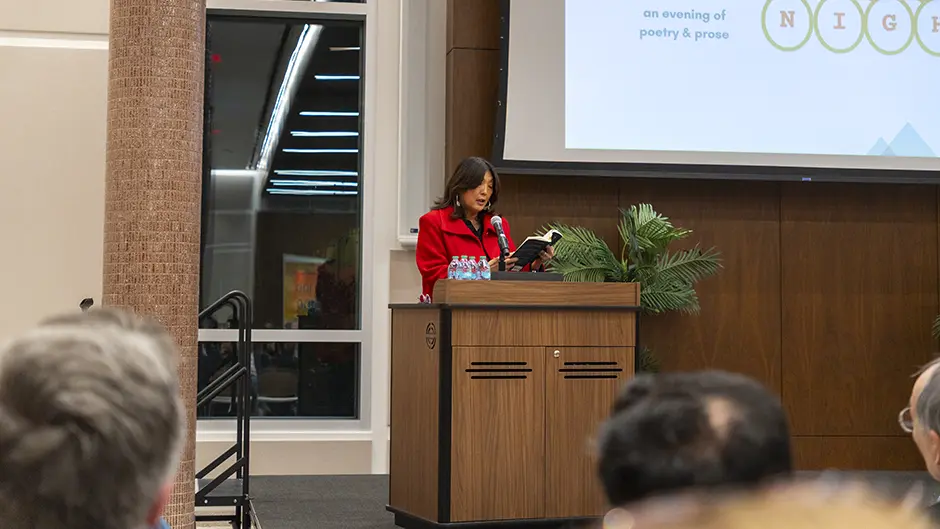
Galang, a creative writing professor and former director of the University’s Creative Writing Program, talked about her experience interviewing Filipina “comfort women”—women who were sexually abused by the Japanese military during World War II. She read from two books that grapple with that history, her nonfiction book “Lolas’ House: Filipino Women Living with War” and her short story collection “When the Hibiscus Falls.”
“Those testimonies that I was working with, they stayed with me,” Galang explained. “I found that they were seeping into my fiction. They were coming out in my stories.”
James’ reading was what he described as a “sneak preview” of his forthcoming novel “The Disappearers,” which will be published in September.
“In this novel, a group of gay men decide to put on a play, a gay play in Jamaica,” he said. “Midway through rehearsals, they’re attacked, they’re brutally gay-bashed. All end up in the hospital, all in serious condition. Three days into the hospital, two of the men vanish without a trace.”
James read a section about one of the men, who turns to religion after the attack and tries to suppress his sexuality.
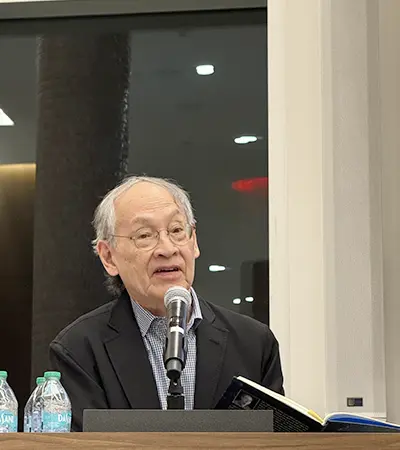
Sze read last and shared poems from several of his 12 poetry collections. The selection included poems inspired by the natural world, particularly the landscapes of New Mexico, where Sze lives, as well as poems that touch on historical events in China. He also read a poem from ancient China that he translated into English.
Translating poetry is one of the areas Sze plans to focus on during his tenure as the 25th U.S. poet laureate, but he told the audience that translation wasn’t something he initially set out to do as a writer.
“My path as a translator just happened over time,” he explained. “I didn’t really foresee that becoming so important.”
The event organizers said they hope to continue Writer’s Night with future prose and poetry readings.
“Tonight marks the beginning of a program I believe will endure for many iterations to come,” said Daniel Arbino, the Jay I. Kislak Chair and Curator at University Libraries.
