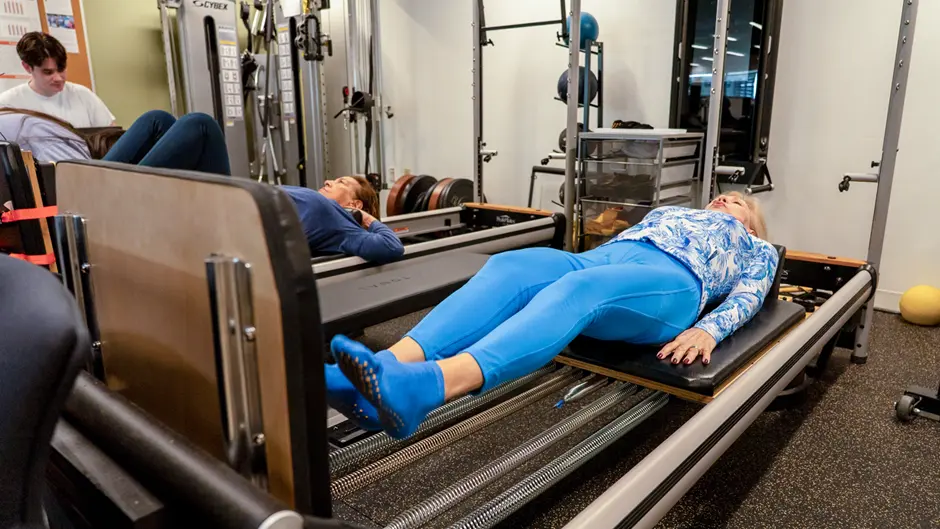
Gisele Armour was beginning to feel the effects of aging.
“Getting older is not easy,” she said. “I feel a lot stiffer, a lot weaker.”
This decline prompted the 67-year-old to join a University of Miami study called: “The Comparative Effects of Plyometric and Power Training on Structural Neuromuscular and Functional Adaptations in Older Adults.”
The study is the thesis of third-year graduate student Rachel Gastaldo, who is studying exercise physiology in the Department of Kinesiology and Sport Sciences at the School of Education and Human Development. Armour was one of 38 participants who came to the Max Orovitz Laboratory twice a week to take part in exercises that were meant to help them with the physical declines associated with old age.
“We are looking at how much power a person has as well as functional and neurological differences,” said Gastaldo. “As we age, we tend to lose muscle mass, and so strength and power start to decrease; but equally as important, we lose the elastic band-type qualities of our muscles and tendons that allow us to store energy that can reduce the metabolic cost of performing our daily activities.”
Power training can help older adults regain some of the functions that they lost, she said, but that’s only part of the story. Her study proposed to put subjects through power training, but also, with one group, add plyometric exercises, which include explosive movements to rapidly stretch and contract muscles. This training is designed to make the muscles and tendons act like springs storing and releasing energy with every movement.
It is no mere coincidence that when we use the expression “put a spring in your step,” it actually refers to our youth when our tissues effectively stored and released elastic energy making every movement easier and more economical, she said.
Prior to the training, all participants were subjected to ultrasound imaging of the leg muscles and tendons to assess muscle and tendon thickness, quality, and stiffness. They also did a series of squat jumps on force plates to determine lower limb power and the stored elastic energy ability of their muscles and tendons. Finally, Gastaldo and other graduate students also tested the amount of oxygen subjects used as they walked on a treadmill at different speeds so that they could compute their metabolic cost of walking.
Then the participants were divided into two groups. The first group engaged in power training using Keiser pneumatic resistance machines, which included leg press, ankle plantar flexion, and chest press, as well as overhead press and triceps extension. All exercises were performed at high speed.
The second group performed all the power training exercises, but once per week they performed plyometric jumping exercises on a horizontal plated reformer (a Pilates machine). These squat jumps and ankle jumps were substituted for the usual leg press and plantar flexion exercises to improve subjects’ abilities to store and use elastic energy.
Although the findings of the study will not be finalized, Gastaldo believes that the results will favor the group that was engaged in power training with plyometric exercises.
“What we want to do is make life easier for them so that everyday things like walking, getting up from a chair, or climbing stairs will require you to use less energy, and you won’t breathe so hard during these activities,” she said.
For Armour, participating in the study has been a game changer.
“This study has really helped me to follow through and commit to something, and it has motivated me to continue exercising,” she said. “This program has really helped me with strength, especially in picking up my groceries and picking up things.”
Rosa Hervis, 66, has participated in several studies at the lab, and she keeps coming back because she values the “quality of the training.”
“The exercises are very specific for people our age and they are very safe,” she said. “They don’t push you beyond your limit.”
This time around she really liked the Pilates machine, which she felt added strength to her legs and calves.
“When I started this study, I hardly had any muscles, and now I have developed muscles in my arms and in my thighs,” she said. “When I walk, my pace is much stronger and my balance is better.”
“To our surprise,” said Gastaldo, “no one wanted to be in the plyometric group when the study started. Now everyone is waiting for the next study so that they can also experience the fun and benefit of plyometric jump training.”