
Colin Martin, a graduate student at the University of Miami’s Frost School of Music, is a year away from earning his doctorate in composition. But he’s already making a splash out in the world, composing an original score for a full-length ballet version of “The Great Gatsby.”
In honor of the 100th anniversary of F. Scott Fitzgerald’s classic novel, the New Mexico Ballet Company premiered the work on April 19 in Albuquerque. The company’s artistic director, Kelly Ruggiero, choreographed the piece, with the New Mexico Philharmonic performing Martin’s score.
And what was it like to witness?
“Awesome and kind of overwhelming,” says Martin. “Hearing anything you write come to life is a sublime and transcendent experience for any composer. I had a rough idea what it would sound like from electronic playback. But it’s always completely different with real people, real instruments, dancers, costumes, choreography, scenery, and props. Seeing the whole thing was an amazing feeling.”
Originally from Albuquerque, Martin earned his bachelor’s degree from Middlebury College, followed by a Master's of Music at the San Francisco Conservatory of Music. He is on course to complete his composition doctorate at the Frost School in 2026.
Martin came to score “The Great Gatsby” because he previously worked with the New Mexico Philharmonic, which premiered his first major orchestral composition in 2019. Commissioned by the Philharmonic, it was a symphony celebrating American composer Leonard Bernstein’s centennial. While Martin has written music for modern dance before, this was his first crack at scoring ballet.
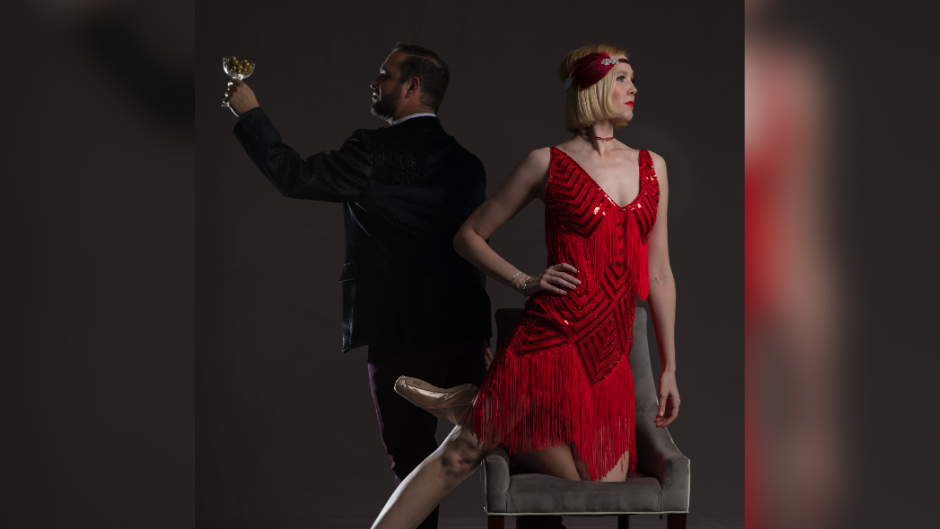
“With ballet, there’s a lot to consider,” Martin says. “It’s for dance, so there’s rhythm and movement, visualizing what dancers will do to the music. But in the end, it’s musical storytelling. Many of the ballet scoring techniques are no different from scoring film or opera. The music had to fit the story.”
Martin had to work on an accelerated schedule, composing 90 minutes of music in about three months. A major part of the work was crafting leitmotifs, recurrent themes that identify different characters in the story.
“That helps the audience create musical associations with characters, and it can also reveal feelings,” says Martin. “Maybe it’s initially in a major key and then turns minor. A step further is associating a lot of characters with an instrument. So in this, Gatsby was alto sax, Daisy was flute, Tom was trombone, and Jordan was oboe. Those themes and the orchestra formed the backbone for storytelling.”
A big fan of the book, Martin also embraced its 1920s vintage jazz age setting, crafting music that references both George Gershwin and the classic Russian masters of ballet music. One of his favorite aspects of the project was a chance to revisit and get immersed again in a story he’d first read in high school.
“This was a really rare opportunity for me,” he says. “Newly commissioned story ballets are not a thing these days. To do a 90-minute story ballet commission is an incredible opportunity that almost no one gets anymore. I feel incredibly fortunate.”