
Faculty in the Frost School of Music’s contemporary music program are used to the innovative way they teach. But three of them got an inspiring reminder of how transformative their work is this May, when they spent a week teaching faculty and leaders at the Iceland University of the Arts (IUA) how to implement their own version of the Frost School’s groundbreaking Modern Artist Development & Entrepreneurship (M.A.D.E.) program.
The visit by Reynaldo Sanchez, Daniel Strange, and Raina Murnak, pillars of the M.A.D.E. program, cemented a bond between the two schools. The Icelandic faculty, many initially skeptical, ended by embracing M.A.D.E.’s experiential and collaborative method for teaching students with and without traditional training.
The IUA’s new Music x Innovation x Technology (MIT) program, which starts this fall, promises to transform music education in this small but culturally influential nation, home to alternative pop stars Bjork and Sigur Ros.
“It’s really great when another institution recognizes that something great is happening here at Frost,” said Sanchez, the Associate Dean for Strategic Initiatives and Innovation and a professor instrumental in the creation of M.A.D.E. His friendship with Phillip J. Doyle, D.M.A. ’18, a Frost School alumnus who is an associate professor at IUA, led to the exchange between the two schools.
“They saw a huge need,” said Sanchez. “There are more and more kids making music in non-traditional ways. The vast majority of musicians out there are self-trained. So how do you incorporate that kind of population into what, prior to this, has been a very traditional music school?”

“We needed a place for those who both compose and perform,” said Pétur Jónasson, the dean of the IUA’s music department, who says that Iceland’s only college level conservatory, in Reykjavik, previously concentrated on traditional classical music training. He praised the Frost School professors’ work. “We were highly impressed,” Jónasson said. “Their level of expertise and ease of communication was amazing, and the way they so generously shared their knowledge and experience with us was productive and inspiring.”
Sanchez, Strange and Murnak presented a week of intensive sessions on everything from technology and business skills, to forming student ensembles, to experiential workshops like a songwriting class—modeled on first year classes at M.A.D.E.—where the Icelandic educators had to write a song together in an hour and a half.
(Sanchez had them compose a Western Swing style song, an obscure 20th century genre that mixes jazz with blues and country. The Icelandic teachers came up with a tune they named “King of the Mountain,” inspired by an ancient Icelandic shepherding tradition—a blend of two cultures that delighted all of them.)
“There were so many questions about something we do so naturally at Frost,” said Strange, the director of the M.A.D.E. program who also became close to Doyle at the Frost School. “We really stressed the creative and curatorial experience that students have to have. It opened up their brains to the idea that this is a student-driven program, and the teacher is there as a mentor more than an authority.”
“They warmed up to us really quickly. They could see we wanted them to succeed, and that we cared enough to give them as much as they wanted.”
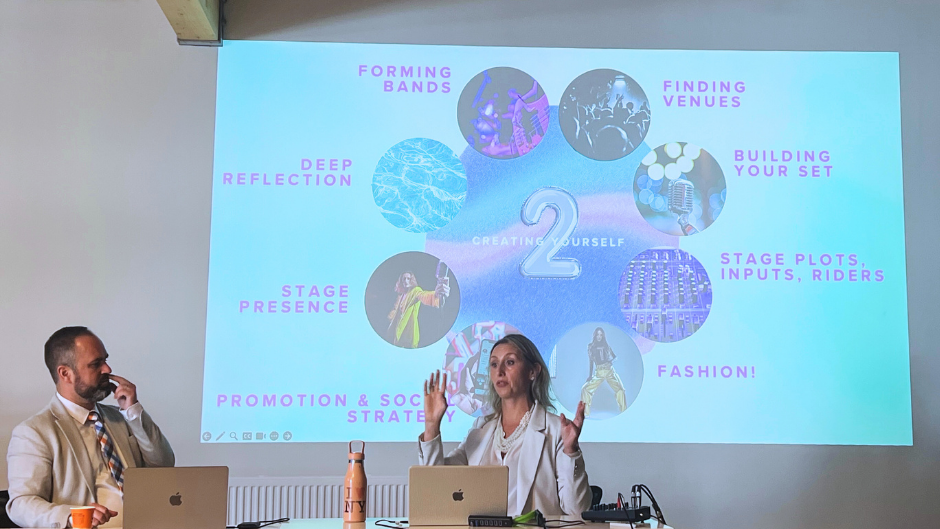
Murnak, an assistant professor with M.A.D.E. who directs popular music pedagogy and contemporary voice programs, described the week as a combination of teacher training and hands-on workshops to help the IUA faculty understand M.A.D.E.’s collaborative student-centered method.
“They have kids with a lot of training and kids with no training,” said Murnak. “Their biggest question was how do you live with both of those in one class? A lot of what we did was show them how that created an ecosystem of peer-to-peer instruction. It’s a different form of teaching.”
The Icelandic connection is due to Doyle, who studied in the Frost School’s jazz program from 2000 to 2003, and returned in 2014 to get a doctorate in jazz studies. Later Doyle began teaching in Iceland, and in 2022 he invited Sanchez to teach masterclasses there, when Sanchez met Thora Einarsdottir, then the dean of performing arts at the IUA, and other Icelandic education leaders. Einarsdottir and some IUA music faculty visited the Frost School in late 2023, observing classes and attending the opening of the Knight Center for Music Innovation. Doyle spearheaded the creation of the new MIT program, which he will direct.
“We really dialed in to the spirit of the experiential process,” said Doyle of the long-awaited visit. “Over the years I’ve had many opportunities to discuss this with Rey, but it was entirely different for us all to experience what it was about.”
The Frost School teachers were energized by a place so different from Miami that Strange and Murnak both joked that Iceland, with its stark, volcanic landscape and chilly weather, was like another planet.
“It was like being on Mars,” said Murnak. “Dan and I couldn’t get over the purity of the air—it felt like you were breathing for the first time. The whole thing was super cool.”
The Miami visitors bonded with their Icelandic counterparts. Now Doyle said he and IUA leaders are working to formalize an exchange program with the Frost School, for which they’ve already received funding.Jónasson says they aim to become leaders in this new style of music education. “My plan is for us to place ourselves in the front line of the field within the next five years,” he said.
The inspiration went both ways. “We learned a lot from them,” said Sanchez. “They respect all kinds of music. That’s a Frost School value we’re trying to model everywhere.”
Which is something Doyle is glad to help with. “I am so honored to be a part of the UM family, with its dedication to forward-thinking leadership and pedagogy,” he said. “I am endlessly proud to be an alum of the Frost School.”
