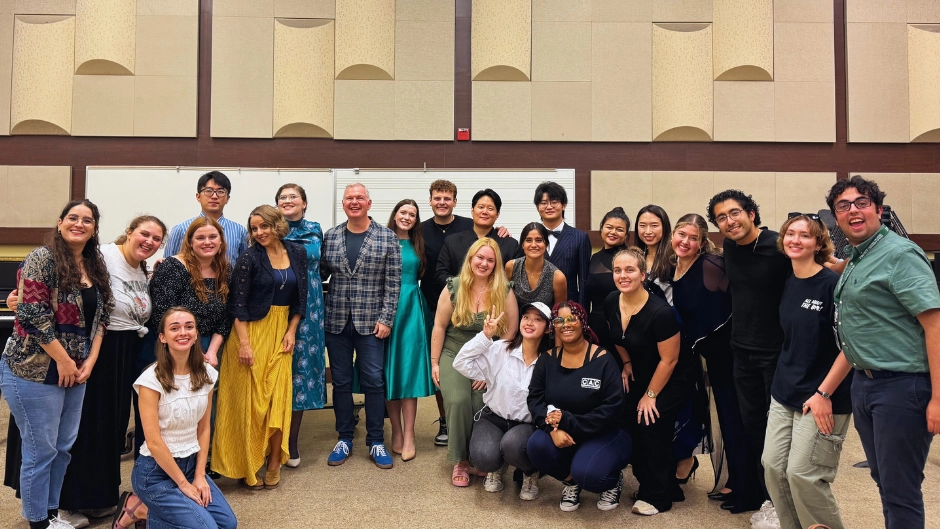
Craig Terry is a pianist and a coach, a simple term that could mean many things. He explains it this way.
“It’s about helping people find the next steps to elevate their art, musicmaking, and singing,” said Terry. “To bring them closer to where they’ll want to be in order to be a professional at the highest level.”
Terry, a resident guest artist in the classical voice program at the Frost School of Music’s Department of Vocal Performance this year, has long worked at the heights of the opera world. He is the music director of the Ryan Opera Center at the Lyric Opera of Chicago, one of the country’s foremost opera troupes, and has been an assistant conductor there and at the Metropolitan Opera, where he was also part of their Lindemann Young Artist Development Program. He has worked with a who’s who of classical vocalists, including Joyce DiDonato, with whom he won a GRAMMY for “Songplay” in 2020.
As he coached four Frost School singers in audition arias at a recent masterclass for graduate and undergraduate students, Terry showed why he is one of the most admired and in-demand coaches in the opera world. He gave each student a rigorously detailed analysis of their aria and their singing, from pronunciation to style, while simultaneously pushing them to take risks and discover the emotional motivation to make the aria their own.
“I want you to show me a lot more,” he told senior Brandon Flores, who had just given an accomplished rendition of “No Puede Ser” from the zarzuela “La Taberna del Puerto,” where the character Leandro agonizes disbelievingly at being betrayed by the woman he loves. “I want the audience to believe you are completely blinded by love.” Standing next to Flores, Terry urged him to soar more strongly in the song’s climax, then pull back to a quiet but intense vulnerability. “Wait, wait,” Terry said, as Flores held a climactic note. “Use your tenor superpowers. You have all the power to stop time.”
“It’s a new way to look at the music,” Flores said. “He showed me that once you have brought the song to a certain level with your preparation, you can take liberties in the music. There’s lots more to take advantage of.”
Terry’s coaching will help these young singers distinguish themselves not just as talented and well-trained but as artists capable of captivating an audience and making their own mark on an opera. His help can potentially make a life-changing difference as they prepare to audition for graduate school, professional work, or the young artist programs that can be a crucial interim stage between training and the opera world.
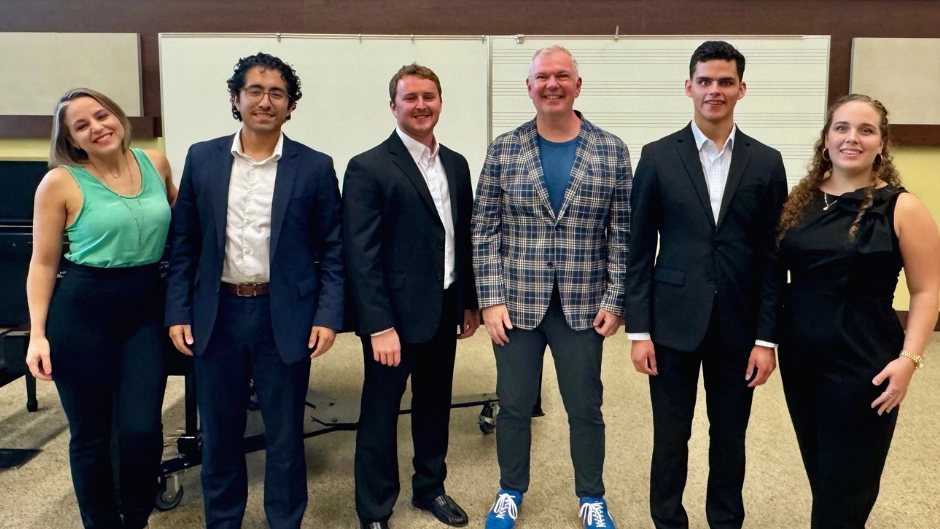
“His breadth of knowledge enables him to prepare students for the next step in their development,” said Frank Ragsdale, chair of the vocal performance department, who said Terry’s residency will bring him back to the Frost School in November, January, and March. “It brings cachet to the program and an advanced opportunity for the students.”
In the masterclass, Terry was relentlessly precise and demanding as he coached Naysa Marrero on the lively “In uomini, in soldati” from Mozart’s comic “Cosi fan tutte” (which the Frost Opera Theater will present this spring). He stopped her several times to correct the timing of her first breath, before she had made a sound. “If the first thing I hear is wrong, it tells me something,” he said. But he also talked about her character, the sassy, cynical maidservant Despina, in a down-to-earth way that drew frequent laughter from the approximately 40 masterclass students, even as they hung on his every word.
“You’re not just a character chirping around onstage, you’re a real person,” he said. “Has anyone here ever worked in a restaurant? I was always the pianist in the bar. I met lots of Despinas doing that.” By the time they finished, both he and the students were applauding Marrero.
Terry’s empathy and artistic understanding lift his coaching far beyond the technical. “For many singers, it’s a matter of getting them to feel comfortable enough to put themselves at the center of the stories they’re telling,” he said. “I always tell the artist, ‘I will never ask you about your life. But I have to know you’re putting your life into the stories you’re telling. Because if you don’t, the audience will not receive it.”
Zaryah Gourgel, a second-year master’s student whom Terry has been coaching in “Despuis le jour” from Gustave Charpentier’s “Louise,” said his combination of demanding detail and artistry was both practical and inspiring. “If I am in an audition and only have 10 or 15 minutes to show off everything I can do, I need to have that precision,” said Gourgel, who also got her undergraduate degree at the Frost School. “I need to know what he is listening for, because these are the things that judges and other maestros are listening for.”
“At first it was very intimidating, because he knows everything about opera in North America,” Gourgel said. “But although he has this incredible history, he’s also a person and a musician who loves what he does. I look up to that. I remind myself that I’m a student, but at the end of the day, I am a musician, and I think that is what has built a rapport between him and us.”
