
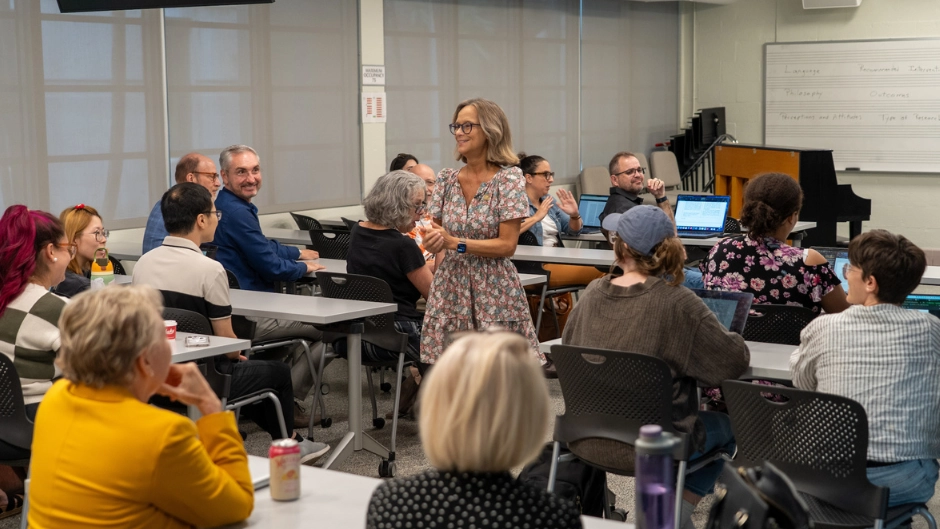
The assignment that visiting scholar Alice Hammel gave for last Friday’s forum for music education and music therapy graduate students seemed simple: bring in the oldest and the newest journal articles they could find on music education for students with disabilities.
But the resulting discussion was anything but simple. Hammel led the students in analyzing how the articles illustrated the profound changes in this expanding area of music education since the mid-20th century. One of the most notable changes was in the language used, from the use of pejorative terms like “retardation,” “handicapped,” and “deficiencies” in the 1950s and 1970s, to recent articles discussing how to enhance the learning experience for everyone.
Hammel, a music educator, researcher, clinician, and author of multiple textbooks, has been key to shaping that transformation, from a mindset of ‘there’s something wrong with you and I’m going to fix it’ to ‘music for every child and every child for music.’ It is an inclusive model that seeks to create the best possible music learning experience for each student, tailored to fit their abilities and background.
“Every student should learn every day,” said Hammel, whose warm, animated manner mirrors her welcoming ethos. “I want to know all the things so that I can teach all the students. If you only know one way of teaching or only teach one type of music, you can only reach one type of kid.”
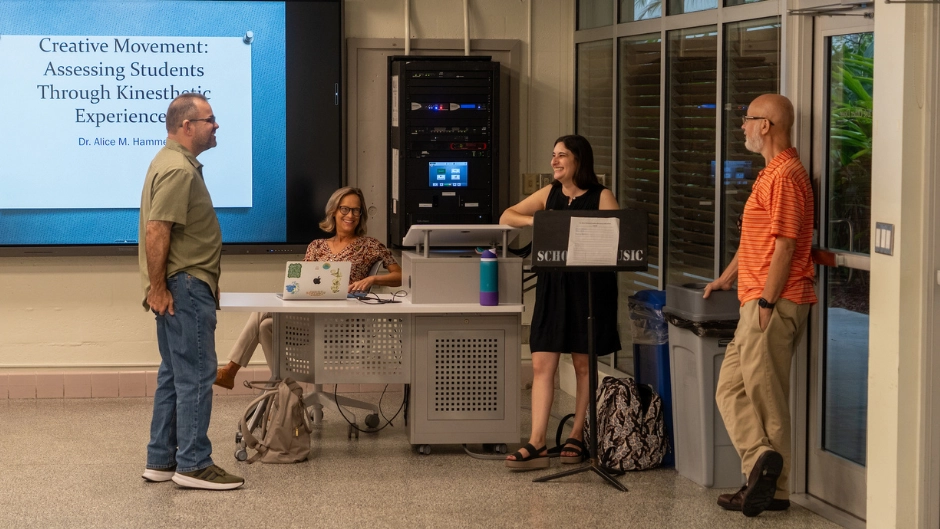
Hammel was brought to the Frost School through a Visiting Scholar Grant from the Florida Collegiate Music Education Association, which doctoral student Nerissa Rebagay applied for with the support of music education professor Dr. Stephen Zdzinski. Carlos Abril, a fellow music education professor and Associate Dean for Research, helped secure additional funding from the Frost School. Hammel’s visit, from September 4 to 5, also included a forum for undergraduates, a creative movement workshop, a guest lecture, and a networking dinner for graduate students.
Raised in rural Sebring, Florida, Hammel said she has always been fascinated by human variety. “I loved everything different,” she said. “I loved everything musical. In my community, the only music education was what they got in public schools. That made me very motivated that when I became a teacher, I would include everyone.” In graduate school at Florida State University in the late 1980s and 1990s, she began to develop her own method to do so. “I decided that my career path had not been invented yet, and that it was in the crack between music education and special education. I wanted to combine them.”
“She’s an amazing teacher,” said Rebagay, who has been inspired by Hammel since reading her work in Zdzinski’s undergraduate class, “Teaching Students with Differences and Disabilities” (recently re-named for one of Hammel’s textbooks), which Zdzinski has taught since coming to the Frost School in 2002. Previously an elective, the class became mandatory this year to align with new degree requirements in Florida.
Rebagay, a double major in music therapy and music education as an undergraduate, was fascinated. “Her work really resonated with me,” said Rebagay, who took Hammel’s summer teacher training program from 2021 to 2023, and also runs Miami Jam Sessions, a free music therapy socialization group and mentoring program for neurodiverse teens and young adults.
Hammel’s visit affirmed a growing interest in the field of teaching students of varying abilities in the Frost School’s music education department, said Zdzinski. He, Abril, and fellow music education professor Don Coffman, along with the three music therapy faculty members, attended Hammel’s graduate forum.
“She is the best conference presenter I have ever seen,” Zdzinski said of Hammel, whom he says is one of the two most influential and important music education pedagogues for teaching special learners.
Zdzinski said Rebagay is one of several outstanding current and recent music education graduate students focused on working with students with different abilities. They include doctoral student Edward Ercilla, who is deaf, and has become known for his expertise in teaching hard-of-hearing and deaf students in 20 years of teaching music in Miami-Dade; and Giulia Ripani, who went on to a tenure-track position at Columbia University after receiving her doctorate in music education from the Frost School last spring.
Hammel hopes that young scholars like Rebagay will create even better and more inclusive ways of teaching music to everyone. “Because change takes so much time, I won’t see it in my lifetime,” she said. “But I hope that Nerissa will.”
