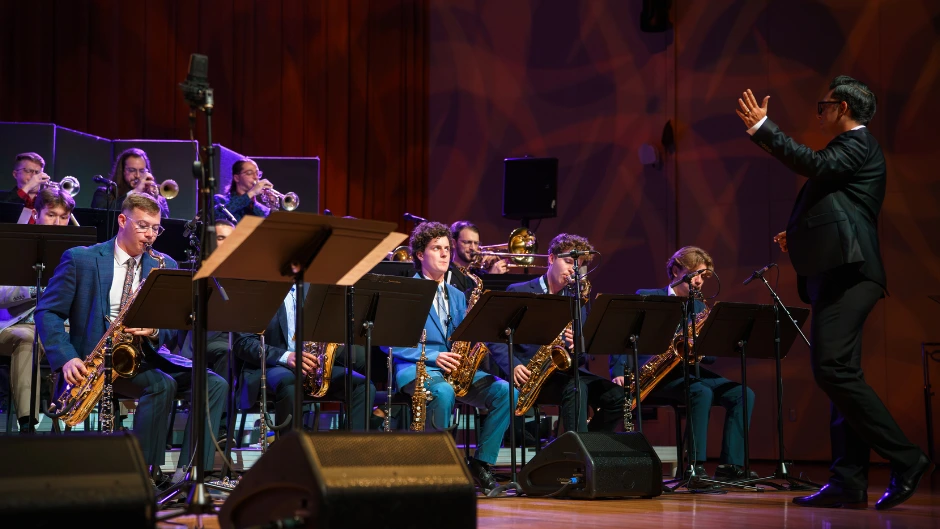
As director of the Frost School of Music’s Studio Jazz Writing Program, assistant professor Stephen Guerra spends much of his time teaching students how to be music’s crucial but largely unsung architects: the arrangers of orchestral and other large-scale music that audiences hear in television, films, concerts, and beyond.
“We’re the invisible artists,” said Guerra, who is also creative director of the Henry Mancini Institute. He notes that arrangers are key to the work of famous film composers like Hans Zimmer and John Williams, artists like Ben Folds, and popular shows like “American Idol” and “The Voice.”
“An arranger or orchestrator’s job is realizing the artistic vision of the composer or framing the music you’re arranging to highlight the artist you’re working for,” Guerra said. “We get a lot of creative input, but it’s really about realizing other people’s visions.”
And so Guerra is particularly proud that two former and two current students were recently honored for their talent in arranging and composing. His program, which offers a master’s in studio jazz writing and a doctorate in jazz composition, teaches composition, arranging, and essential production and technical skills for a music world in which composers must be able to record their work.
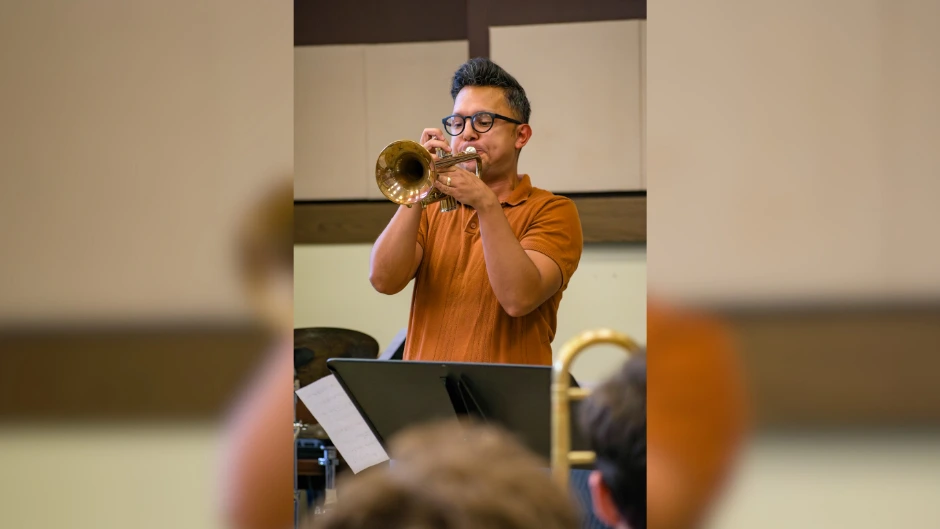
This fall, composer and musician Michael R. Dudley, a rising young composer and musician who earned doctoral and master’s degrees in jazz trumpet performance at the Frost School and took multiple classes in Guerra’s program, received the inaugural ASCAP Foundation Johnny Mandel Prize for Early-Career Arrangers. At the same time, Eli Feingold, who got a bachelor’s in jazz trombone in 2019 and a master’s from the Studio Jazz Writing Program in 2021, won the ASCAP Foundation Herb Alpert Young Jazz Composer Award for his piece “1210.” (Mandel was a renowned film and television composer who was a National Endowment for the Arts Jazz Master and Songwriters Hall of Fame inductee.)
Feingold said Guerra and the program were key to his development. “Steve was one of the most important influences for me in developing my confidence as a writer,” he said. “In my private lessons and throughout my time in the Studio Jazz Writing Program with both Gary Lindsay and Steve, they encouraged me to write as much as possible and to get lost in the process of doing so. Being able to write for incredibly skilled peers provided invaluable experience as a young composer looking to try out ideas.”
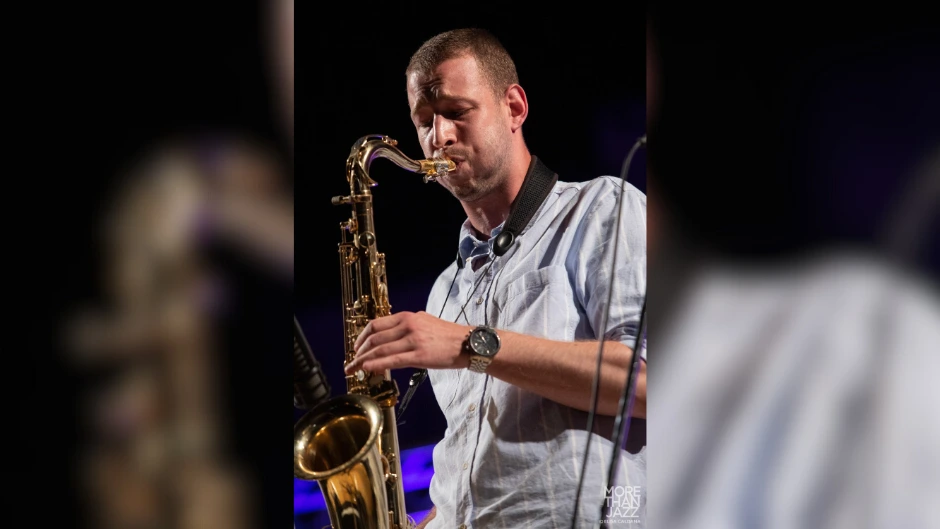
Also this fall, current jazz writing master’s student Gergő Kormányos won the first prize in the American Society of Music Arrangers and Composers (ASMAC)’s 2025 Student Competition’s Bill Conti Big Band Arranging contest, with doctoral student Jorge Machain, who has won a number of composition accolades, winning second place. The two men, who are also roommates, were up against contestants from across the country and the world.
Kormányos won for his arrangement of his own composition “Motion Picture,” which was inspired by a Duke Ellington quote about music’s capacity to inspire people and was on the Frost Jazz Orchestra’s annual live concert recording. “I aimed to write something powerful and forward-moving, a piece that can offer strength and momentum through challenging times,” Kormányos said. “Winning this competition means a great deal to me. It is both an honor and a moment of encouragement. I am deeply grateful for the performers, mentors, and community at the Frost School of Music.”
Guerra said that for Dudley and Feingold, being honored by the foundation for ASCAP—a leading performance rights group and major player in the music world—can be a psychological and professional boost. “To have that on their resume validates what they’re doing and thrusts them into the spotlight,” said Guerra. For Kormányos and Machain, the ASMAC prizes encourage them amidst the relentless demands of school. “What we do isn’t easy, and it’s a lot of work,” said Guerra. “To get that validation is so important. They spend every day in school with us telling them how to do things better. It’s nice when someone says, ‘This is great.’”