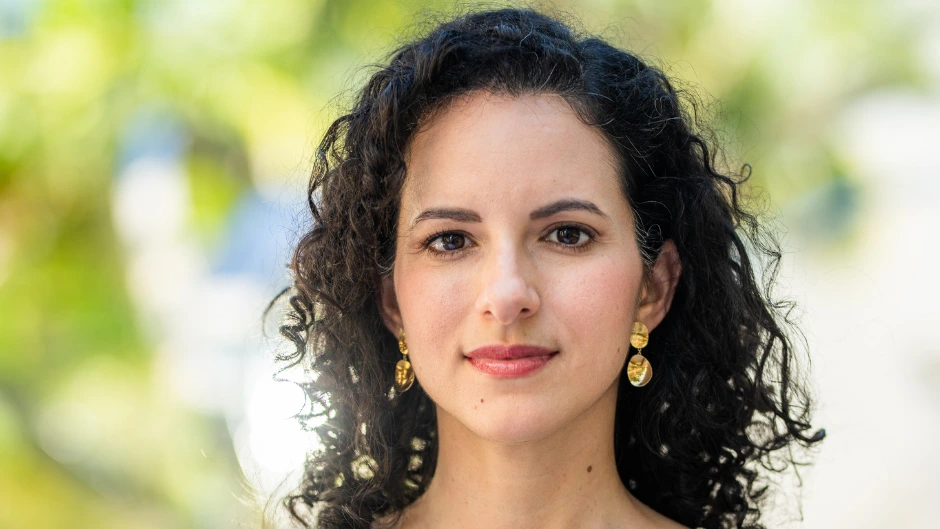
The "Benito Bowl," Puerto Rican superstar Bad Bunny’s Super Bowl halftime show, sparked a global reaction across popular culture. Seen by an estimated 128 million viewers, the performance was a love letter to all things Puerto Rican. Few people in the mainland United States were as well-prepared to take it all in as students in Marysol Quevedo’s Music of Latin America class at the Frost School of Music.
“I completely reorganized the course to get into some Cuban and Puerto Rican genres at the beginning of the semester,” said Quevedo. “I wanted to give students what they needed to understand musically what would happen.”
An associate professor in the musicology department, Quevedo is uniquely qualified to guide students on such a journey. She grew up playing classical flute and cello in her native Puerto Rico, then became immersed in Latin music while pursuing a doctoral degree at Indiana University. There, she worked with the school’s Latin American Music Center and began teaching a Music of Latin America class. Her expertise is well-suited for the Frost School, which has a long history of alumni working successfully in Latin music.
One of Quevedo’s recurring class subjects is Puerto Rican star Ricky Martin’s crossover breakthrough at the 1999 Grammy Awards, which triggered a wave of Latin American artists rising to fame in the United States, dubbed the “Latin Explosion.” Fittingly, Martin was one of Bad Bunny’s featured guests, singing the anti-gentrification anthem “Lo Que Le Pasó a Hawaii.”
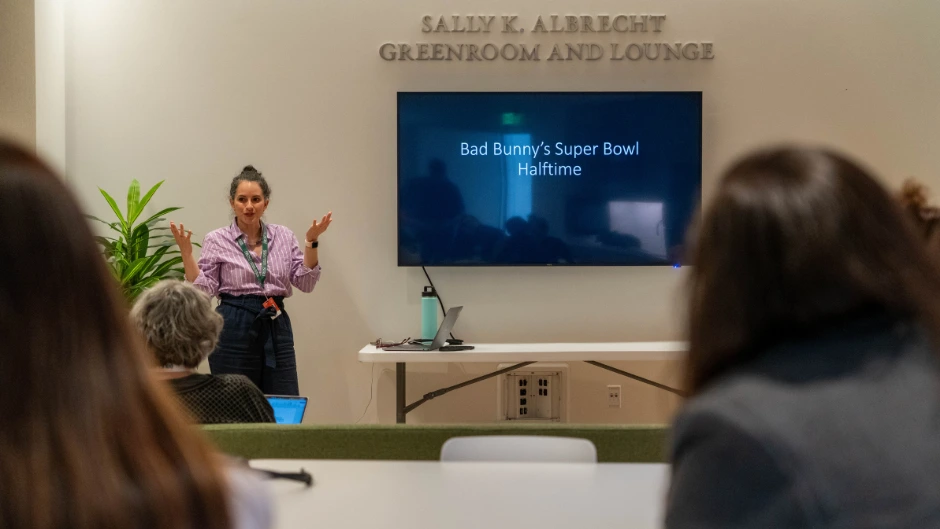
Marysol Quevedo giving a talk on Bad Bunny's Super Bowl performance at the Frost School. Photo by Gonzalo Mejia/Frost School of Music.
“Ricky Martin had to sing in English in 1999 to break through to the mainstream pop market, and 25-plus years later, Bad Bunny had him on the world’s biggest stage singing in Spanish,” said Quevedo, who gave a talk on the event for Frost School faculty and staff and was interviewed about the Super Bowl by NBC 6, the South Florida network affiliate. “That’s such a full-circle moment. I can teach a bunch of different genres through this halftime show because it engaged so many different musical styles. There are so many different angles through which to examine it—racial representation, music, lyrics, visual symbolism, fashion. It will be generating discussion for a long, long time.”
Martin was part of a cast of hundreds recreating the experience of Bad Bunny’s 2025 stadium tour (which didn’t play the U.S. mainland) and his "No Me Quiero Ir de Aquí" (I Don’t Want to Leave Here) Puerto Rican residency. He took viewers on a journey through shared places and experiences familiar to Puerto Ricans, with a dizzying array of symbols, styles, and icons, from the original Puerto Rican flag to legendary Nuyorican matriarch Toñita (María Antonia Cay) of Brooklyn’s Caribbean Social Club fame to a parade of musicians (including Frost School alumnus Danny Flores) playing traditional Puerto Rican plena. Bad Bunny presented his Album of the Year Grammy to a boy playing a young Benito and even served as a witness to a real-life wedding that happened as part of the show.
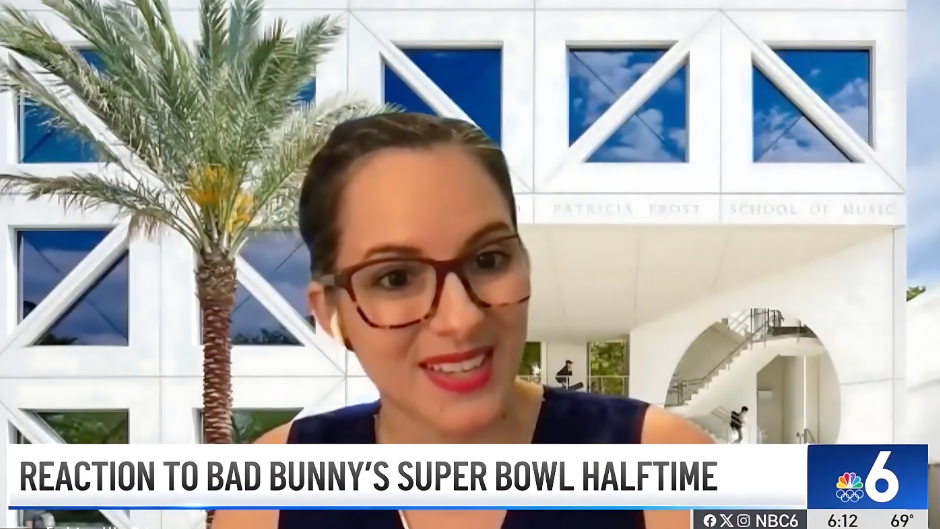
Marysol Quevedo was interviewed about the Super Bowl by NBC 6.
“There were so many tiny little things in it, all well-chosen and so meaningful,” said Quevedo. “The whole thing was a brilliant master class in live video production, and the fact that nothing went wrong was amazing. Changing my class to fit it just felt like the obvious thing to do, like it would have been weird not to. Our responsibility as faculty is to work to make the classroom relevant to what is happening in the world right here and right now.”
