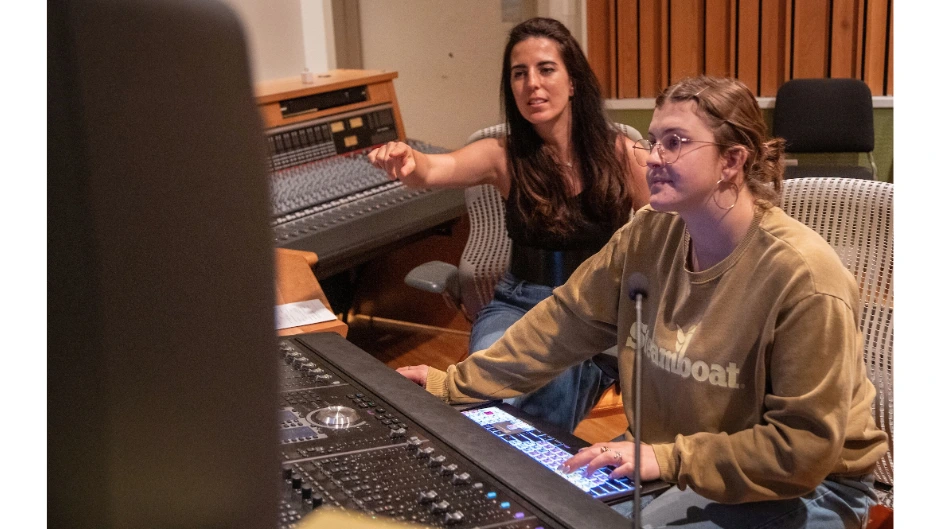
An old sports adage says that you miss 100 percent of the shots you don’t take, a mindset that prevails at the Music Engineering Technology program at the Frost School of Music. Already established as the first program of its kind at a college or conservatory, the Frost School’s engineering program has had an impressive run in recent years, with its students winning numerous scholarships, awards and competitions.
“We’ve had a lot more intentionality about encouraging students to apply for things,” said Christopher L. Bennett, associate professor and chair of the program since 2022. “We’ve been at this level a long time, almost an industry secret with a lot of the employers that have pipelines set up with us. But it’s become something we emphasize.”
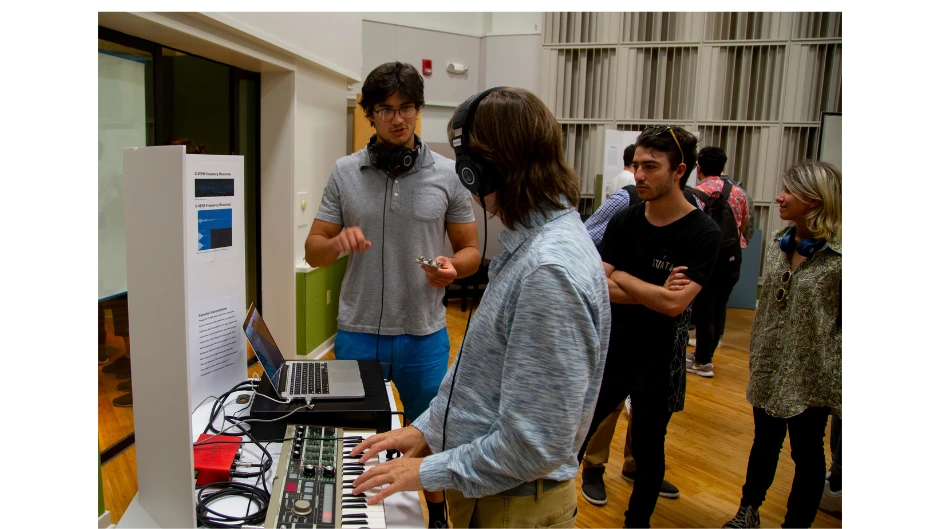
Highlights from the summer of 2026 include awards to two Frost School engineering students from the Audio Engineering Society (AES). Graduate student Samuel Courtney won a prestigious Garry Margolis Scholarship from the AES Educational Foundation, while recent master's graduate Anish Ghosh earned a Bronze Award in the AES Student Design Competition.
“We’ve had an AES Gold, Silver or Bronze winner every year since I took over the program,” said Bennett. “And Samuel Courtney is a really fantastic student. It’s rare to find a student who will dive so deeply into projects and make a lot more out of them than you even intended.”

Over the past five years, Frost School engineering students have received 17 scholarships and awards from a broad range of professional organizations. Along with AES, they’ve scored with the Fulbright Association, National Association of Music Merchants (NAMM), Audiovisual and Integrated Experience Association (AVIXA), and the University of Miami’s University Student Startup Accelerator (USTAAR).
One thing that sets music engineering apart from other programs at the Frost School is that it’s a science rather than a music or liberal arts degree. At the same time, students are expected to be musicians as well as engineers.
“There’s no lower standard by virtue of applying to this program,” Bennett said. “You have to audition and cut it as a legit performer, too, which makes our students special. Usually, software developers are one pool and musicians with a critical ear for what sounds good are another. The overlap between the two is small, and we take advantage of that. Our students can read a schematic and debug hardware, and they’re also highly trained and can sit in with the band.”