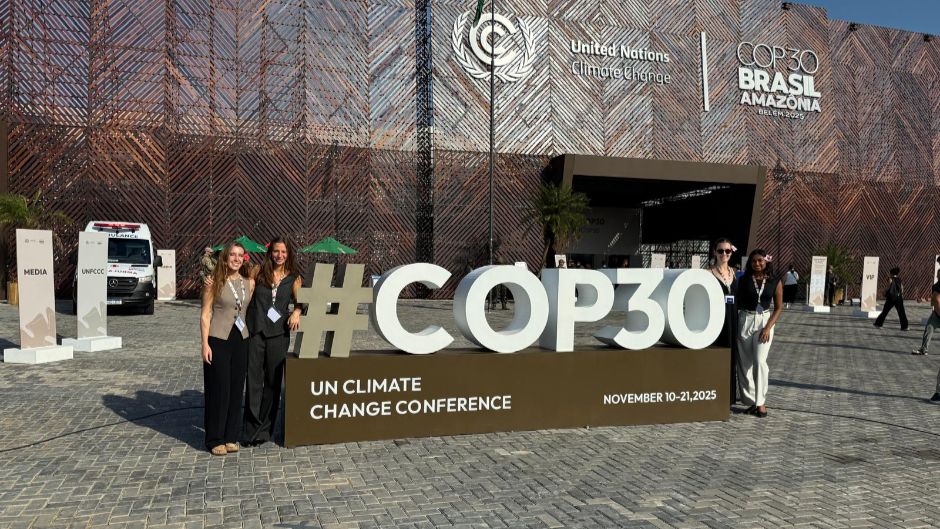
In the sweltering humidity of Belém, Brazil, where the Amazon River pushes its massive weight into the Atlantic, the air inside the conference center offered no respite. It was an ecosystem of 56,000 badge-wearing diplomats, activists, and observers. Amid this global village, a team from the University of Miami School of Law was taking meetings and notes.
In the weeks leading up to Thanksgiving, while their peers were outlining for finals, this delegation of 12 students and four faculty members, led by professor Jessica Owley, descended upon COP30, the 2025 United Nations Climate Change Conference. Their mission was not to spectate, but to serve as the legal backbone for some of the world's most vulnerable populations: the Small Island Developing States.
The Environmental Law Program at Miami Law offers students the unique opportunity to work with countries and global organizations and engage in the annual negotiations for the United Nations Framework Convention on Climate Change (UNFCCC).
"To see our students sitting shoulder-to-shoulder with world leaders, navigating the future of the planet with such poise, is nothing short of transformative," said Owley, director of the Environmental Law Program. "They aren't just learning the law here; they are supporting the people shaping it, for the communities that need it most."
David and Goliath in the jungle
The stakes at the 30th session of the climate change treaty negotiations could not be higher, particularly for the nations the UM team supported: Samoa, Palau, Tuvalu, and the Federated States of Micronesia. These countries are often the moral compass of the conference, yet they arrive with some of the smallest delegations to fight battles that will determine their physical survival.
A mosaic of minds
The cohort accompanying Owley was a cross-pollination of disciplines perfect for tackling a planetary crisis. The roster ranged from seasoned 3Ls like Andrew Tonioli and Nicolas Vincenty to Lydia Gargano, who is getting their M.S. in Marine Science and Policy. It included dual-threat scholars like Alex Carbaugh-Rutland, who is balancing a law degree with a Ph.D. at the Rosenstiel School, and Grace Hussain, a doctoral candidate in Environmental Science and Policy. The team even bridged continents and specialties, drawing in international perspectives from Spanish exchange student Lucia Niño Junyent and maritime law expertise from LL.M. student Clara Tomé.
Under the strategic guidance of Climate Law Fellow Valerie Fajardo and visiting professor Tracy Bach, the Miami Law contingent was embedded directly into these negotiation teams. They tracked dizzying agendas, polished national statements, and acted as intermediaries in rooms where a single word choice could dictate millions in funding.
For Brittany Findley, a 3L J.D./International Law LL.M., the work struck a personal chord. Rooted in her own Caribbean heritage, Findley understands the precariousness of island life.
“My most significant takeaway from attending COP30 is that decision-making, especially at an international scale, is incredibly deliberate,” Findley said. “It was powerful being able to witness how climate arguments from different countries and groups intersected, and sometimes clashed, with the political stance of others.”
Findley’s assignment focused on the labyrinthine world of climate finance—tracking the money promised versus the money delivered.
“I would hear from small island states about how they are losing land to rising sea levels, and in the same room hear from developed countries' resistance toward taking accountability for historically producing an abundance of greenhouse gas emissions,” she said. “This juxtaposition highlighted the ethical dimension of climate negotiations and how the outcome of these negotiations are truly the pinnacle of survival for many countries.”
From theory to the thick of it
The road to Belém began long before the flights touched down. In a specialized short course, students spent weeks dissecting the jargon of international diplomacy—a language as dense as the rainforest surrounding them.
“After the short course leading up to COP30, I felt very prepared in understanding what exactly I was tasked with tracking,” Findley said. “In class, we also learned about various terms and acronyms that were actually used during the Conference, so it was nice to be able to quickly pivot given our overall preparation.”
That pivot was essential. With 145 agenda items to monitor, the team logged marathon hours and serious step counts. For 3L Olivia Clausen, president of the Environmental Law Society, the immersion was total.
“The School of Law paired us directly with delegations, allowing us to observe negotiations as parties rather than observers,” Clausen said. “While many other students attended in a spectator role, we were lucky to have a more active experience and directly support Small Island Developing States.”
The urgency of now
The setting itself—the gateway to the Amazon—served as a stark reminder of the ticking clock. Outside the venue, Indigenous leaders and protestors amplified the call for climate justice, grounding the high-minded legal arguments in the soil and water of the region.
“Attending the conference in Belém helped create a sense of increased urgency to address climate change impacts affecting the Amazon region and its communities,” Clausen observed. “The presence of Indigenous leaders and advocates, both at the COP and in protests outside of the COP, emphasized the social context of the negotiations and the need for climate justice.”
This year marked UM’s fifth foray into the COP negotiations, a tradition that has evolved from observation to essential participation. In the past, students attended COP negotiations in Egypt in 2022, in Dubai, United Arab Emirates, in 2023, in Baku, Azerbaijan, and in Madrid, Spain. With faculty experts like Antonio Nanni and Daniel Suman lending interdisciplinary weight to this year’s delegation, the university has cemented its status not just as an observer of history, but as an active participant in the fight to salvage a future.
As the conference wrapped and the students traded the humidity of Brazil for the humidity of Miami, they brought back more than souvenirs. They returned with the heavy, exhilarating knowledge that in the quiet, freezing rooms where treaties are hammered out, their voices—and the voices they amplified—mattered.
Read more about Miami Law’s environmental law area of study.
