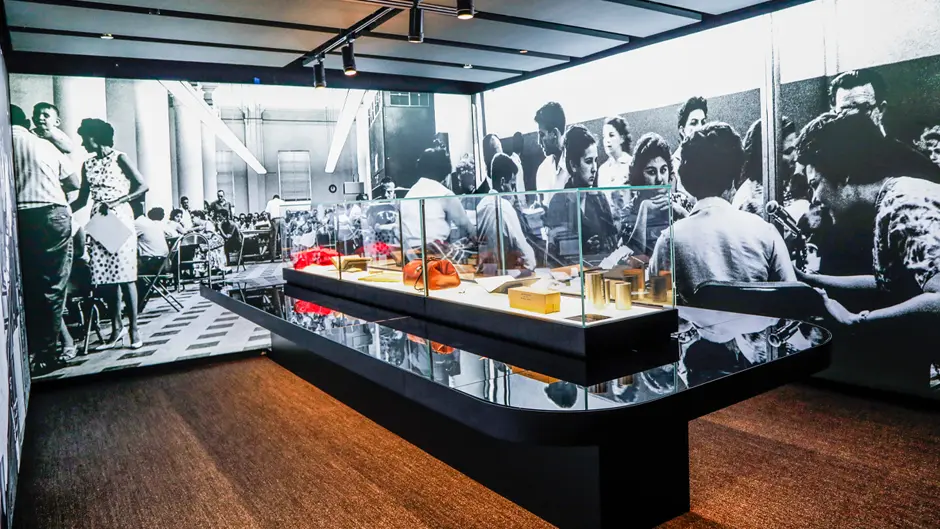
Following two-plus years of a collaborative restoration initiative, Miami Dade College’s Freedom Tower—at one time the tallest skyscraper in all the South—celebrated its 100th anniversary this month with fanfare, a ribbon-cutting ceremony, and crowds that strolled through the reopened downtown National Historic Landmark to better learn its extraordinary story.
And what a story is preserved within its fabled walls.
Built in 1925, the 17-story tower served for many years as the headquarters and printing facility for The Miami News, then, with the exodus of Cubans fleeing the regime change in Cuba, the federal government leased the building and repurposed it in 1962 to become the Cuban Refugee Center—famously known as “el refugio.” For decades, the building towered over the Miami downtown skyline as a symbol of liberty and beacon of hope for the tens of thousands of refugees who were processed, trained, and facilitated to begin new lives in America.
“The Freedom Tower has had a great impact on the Cuban diaspora community. It’s a beacon of the refugee experience, and many who came here in the 1960s and 1970s passed through the tower, so it has a lot of emotional significance for our community,” said Amanda Moreno-Schroeder, director of the University of Miami Libraries’ Cuban Heritage Collection (CHC) and the Esperanza Bravo de Varona Chair.
“It’s been so exciting to see the work that Miami Dade College (MDC) is doing to protect and preserve that history, and we’re happy to contribute a small part to that project,” added Moreno-Schroeder, whose CHC team provided a wealth of artifacts to be used in the interactive and detailed re-creations for the two floors of exhibition space and rooms in the tower.
Moreno-Schroeder explained that MDC reached out several years ago seeking a collaboration that would showcase materials from CHC, home to the largest repository of materials on Cuba outside of the island and the most comprehensive collection of resources about Cuban exile history and the global Cuban diaspora experience.
“They came and researched the collection for a few months, visiting us weekly leading up to the exhibition. They did a really beautiful job,” said Moreno-Schroeder. “A lot of content from our Cuban Refugee Center records is utilized in the re-creations of the Freedom Tower they now have inside the building—in images, video, and interactive pieces. It’s very exciting for us to have content there.”
MDC asked for recommendations, and because much of the Cuban Refugee Center records at the CHC are digitalized, the process was much easier.
“Starting in the 1960s, we have the records of the refugee center here at CHC, so we have the content they needed,” said Moreno-Schroeder. “They told us they couldn’t have done it without us, which was nice to hear. A lot of the content was integral for them to do the historical piece of the exhibition.”
She and Michael Bustamante—the Emilio Bacardí Moreau Chair in Cuban and Cuban-American Studies, director of the College of Arts and Sciences’ Cuban Studies program, and director of academic programs at the CHC—were interviewed for the reopening, talking about the importance of the Freedom Tower restoration.
Barbara Gutierrez, a writer and director with University Communications, is included in the Freedom Tower exhibit of Cuban exiles, which captures the stories of a diverse group in the Cuban diaspora. Though Gutierrez and her family never passed through the Freedom Tower, her testimonial is similar to that of thousands who fled the island at the onset of the Communist regime. As a 12-year-old, Gutierrez left Cuba with her parents—a teacher and an engineer—and her brother. The family traveled first to Madrid, Spain, where they lived in hostels for months, then to New York. Gutierrez first arrived in Miami in 1980 as a young journalist.
While the University partnership associated with the restoration effort is recent, Gladys Gómez-Rossié, community relations coordinator with the CHC, highlighted that the University played a critical role in the 1960s and following decades supporting the refugees.
“Many of the refugees were professionals—doctors, engineers, lawyers, architects, and nurses—and there was a shortage at the time in the U.S., especially for doctors,” Gómez-Rossié explained. “Dr. [Henry King] Stanford was University president at the time, and he really opened the doors to help.”
Under Stanford’s leadership, the University created programs and offered classes to teach English, train lawyers to take the bar, and facilitate the newcomers’ entrance into society. Student loan programs were created, professionals were hired, and facilities such as the North-South Center were created for research.
“There was a lot going on between the University and the community. A lot of people say that if it wasn’t for the University of Miami, they never would have made the progress they did,” said Gómez-Rossié.
In comments at the reopening as reported by the Miami Herald, Madeline Pumariega, MDC president, noted that the U.S. cultural climate was different in 2022 when this most recent refurbishment effort was launched.
“I think the timing is perfect to show the amazing contributions of people that come here looking for opportunity and looking for hope,” said Pumariega. “When we first started, it probably wasn’t the national conversation, but I hope that this does remind us all of the caring and compassionate country that we are in—the country that opened the doors for my parents and for so many wonderful generations who call the United States home and who have made enormous contributions to this county.”
“We’re so happy to have been able to collaborate,” said Moreno-Schroeder. “Our MDC friends were amazing colleagues, and I love to see the collection materials used in new and exciting ways. This was really a great partnership for us.”
