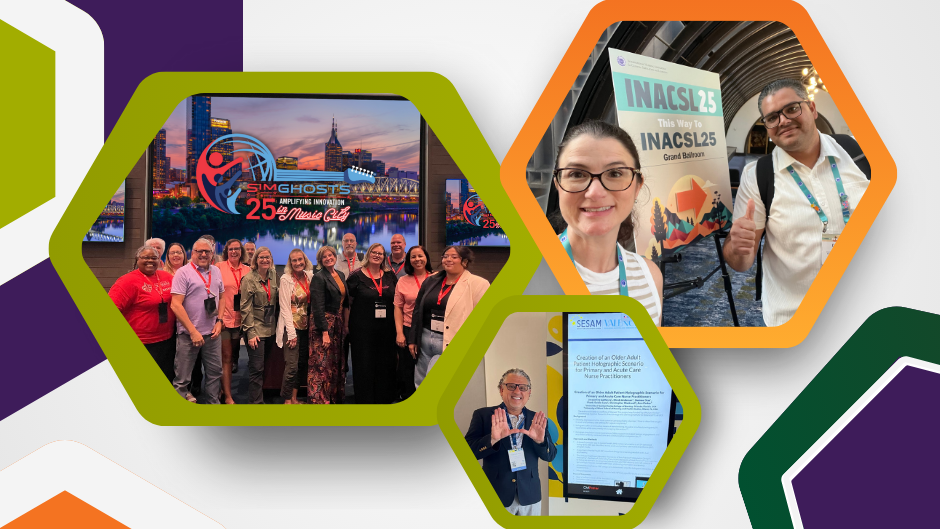
Collaboration is the lifeblood of science and innovation, and this summer proved the perfect time to expand networks near and far. From May to July, staff from the S.H.A.R.E. Simulation Hospital Advancing Research & Education® (S.H.A.R.E.) took part in several prominent simulation in health care conferences. “The continued success of simulation education in health care at the University of Miami School of Nursing and Health Studies relies on our team members having their fingers on the pulse of what is happening around the nation and the world,” said Zuzer Calero, Executive Director of Business Operations at S.H.A.R.E.
Didier Torres, simulation technologist, and Michelle Gobel Osso, simulation educator, represented both the school and S.H.A.R.E. at the International Nursing Association of Clinical Simulation and Learning (INACSL) conference, held in Denver, Colorado, in June. Both described their first experience attending this conference as overwhelmingly positive, noting the value of networking with so many like-minded professionals in one place.
Torres was particularly interested in the immersive Virtual Reality (VR) presentations, and the potential for incorporating VR throughout clinical spaces at S.H.A.R.E. “The idea behind integrating VR is that students can work up their confidence in virtual scenarios and prepare to work with simulation manikins and real patients,” explained Torres. Although doctoral students in the school’s Nurse Anesthesia Program already use VR technology in surgical preparation simulations, VR will ultimately become more fully integrated into simulations for undergraduate nursing programs as well, noted Torres.
His colleague Michelle Osso also homed in on the use of new strategies and ideas to implement at S.H.A.R.E. while learning about the latest technology from 80-plus vendors in the exhibit hall. “Creative approaches to education, like escape-room strategies and rapid-cycle deliberation practices for resuscitation, stood out to me,” she said. One of Osso’s biggest takeaways was realizing just how many potential uses there are for artificial intelligence (AI) within simulation, from design to integration. “We need to continue embracing AI and using this new technology purposefully to supplement our curricula,” she said.
A large volume of research on the use of AI in simulation education was presented at the conference, particularly its capacity to help create simulation scenarios. “These systems can be used for individual student practice, with instructors pre-setting objectives and the AI system guiding the students toward their desired outcome,” noted Torres.
“We have started to integrate AI into many of our daily processes and have observed its benefits already,” Calero said of S.H.A.R.E. “The combination of these AI technologies coupled with our accrediting body standards will significantly enhance our simulation capabilities by improving learner engagement, streamlining operations, and supporting data-driven decision making.”
Calero was among a group of S.H.A.R.E. staffers who traveled to Nashville, Tennessee, this July, for the SimGHOSTS conference, where the use of AI in health care education was also a hot topic to explore. Among the research presentations the S.H.A.R.E. team attended explored the opportunities and risks associated with integrating AI in simulation education, emphasizing the importance of ethical, safe, and effective implementation. “As the use of technology and artificial intelligence continues to grow and be implemented in education, the importance of human collaboration is more important than ever,” she advised.
Camila Venegas, a S.H.A.R.E. simulation technologist, was invited to present a workshop at SimGHOSTS on cost-effective moulage for human trafficking simulation scenarios. Venegas demonstrated creation of three injuries commonly associated with human trafficking victims, then had participants re-create them. She emphasized how in-house moulage production can reduce costs while maintaining high levels of immersion. By re-creating these wounds participants also gained a more in-depth, trauma-informed awareness of the injuries. Human trafficking is a prevalent problem, and Venegas hopes her research on this topic will foster greater awareness and response among health care workers.
While some members of the S.H.A.R.E. team explored AI in Tennessee, Dr. Frank Guido-Sanz, the school’s Associate Dean for Simulation Education and Research, was in Valencia, Spain, at the three-day Society for Simulation in Europe (SESAM) conference, themed “Developing, Adopting, and Embedding Innovative Simulation.” There he presented on simulation innovation in health care for nurse practitioners and addressed some of the challenges that go along with these innovative efforts, such as physical space limitations.
This was not Dr. Guido-Sanz’s first experience engaging with international simulation educators. Last year he was a keynote speaker at the Chilean Society of Clinical Simulation conference. And in May he represented S.H.A.R.E. at the National Teaching Institute & Critical Care Exposition (NTI) in New Orleans, presenting on HIV epidemiology in the United States in conjunction with former University of Central Florida colleagues, with whom he has collaborated for over a decade.
“While the topics of my presentations this year differed, they all showcased the diverse scholarly work of nurse educators and how their contributions further education and close knowledge gaps,” said Dr. Guido-Sanz. He added that when it comes to simulation in health care, collaboration and progress go hand in hand. “We all share the impetus of health care innovation in simulation and technology,” he said. “Fortunately, most simulation education centers share similar affiliations, thanks to international organizations like INACSL, SimGHOSTS, SESAM, and more, making education and practice standards common internationally.”