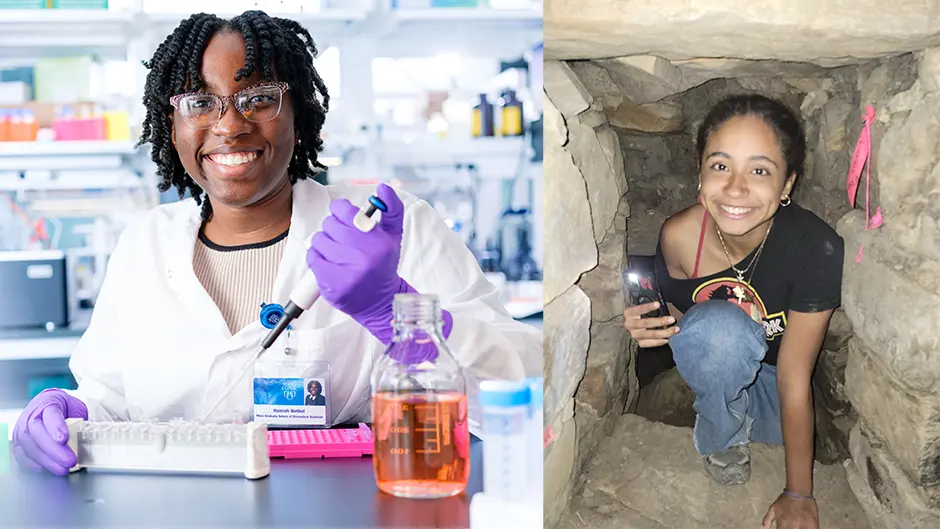
The University of Miami College of Arts and Sciences offers summer research funding for undergraduates through the Beyond the Book scholarship program. This summer, six students received scholarships to pursue research projects in fields ranging from bioarchaeology to quantitative finance. Two additional students received scholarships supported by alumni Dr. Leslie Goldsmith and Connie Goldsmith to help cover the costs of completing veterinary medicine internships.
Here are two examples of the summer research projects supported by the Beyond the Book scholarship program.
Researching links between bacteria and cancer
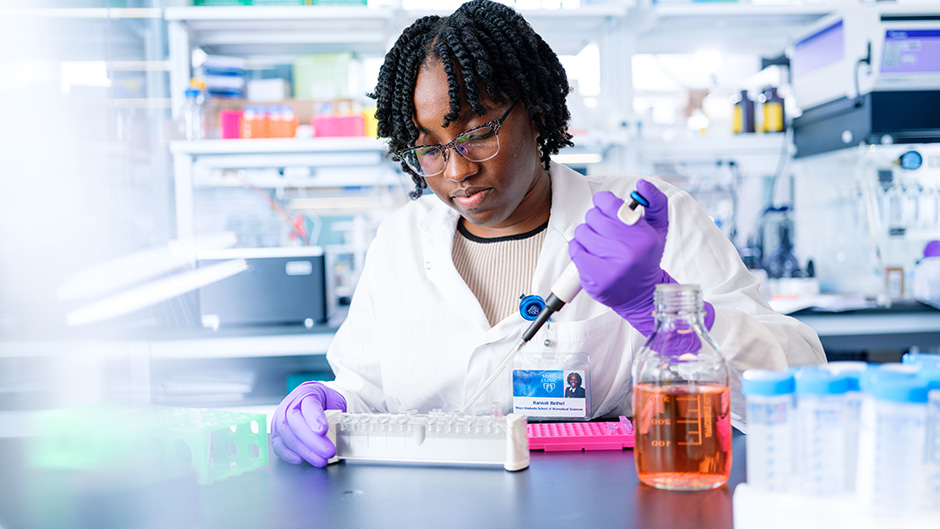
Hannah Bethel, a senior at the College of Arts and Sciences, got a crash course in biomedical research this summer.
As a research assistant at the Mayo Clinic Graduate School of Biomedical Sciences in Rochester, Minnesota, she contributed to cutting-edge research on gynecological cancers, exploring the role of bacteria in modulating cancer risk and progression.
“I’m very interested in infectious disease and oncology,” said Bethel, who is double majoring in neuroscience and medical anthropology and minoring in public health and microbiology and immunology. “My goal is to understand how microbial communities, like Porphyromonas and HPV, can influence cancer development and progression. Infectious disease and oncology are deeply intertwined, and I want to explore those links to improve prevention and treatment strategies.”
Bethel’s research at the Mayo Clinic focused on a genus of bacteria called Porphyromonas and its links to cancer and other diseases. Under the guidance of a clinical epidemiologist, Bethel worked on a systematic literature review of research on how this type of bacteria is connected to chronic diseases. Then, she worked in a lab under the guidance of a microbiologist to study two genera of bacteria, Porphyromonas and Lactobacillus, and how they impact a woman’s risk of developing endometrial cancer.
This was Bethel’s second summer at the Mayo Clinic. Last summer, she conducted research there as part of the clinic’s Summer Undergraduate Research Fellowship program. This summer, the Beyond the Book scholarship program helped cover Bethel’s travel and living expenses.
“Beyond the Book was the reason why I was able to come here,” she said. “There weren’t that many opportunities in Miami to do exactly what I wanted to do.”
Bethel has been selected for a competitive postbaccalaureate researcher position at the Mayo Clinic, where she will continue investigating microbiome-cancer interactions. Her long-term goal is to complete an M.D.-Ph.D. program and either work in Miami, where she grew up, or in Latin America to pursue her passion for international research collaboration.
Excavating tombs in Peru
Gabriella Sánchez Torres, who is also a senior at the College of Arts and Sciences, traveled to Peru this summer to attend a bioarchaeology field school.
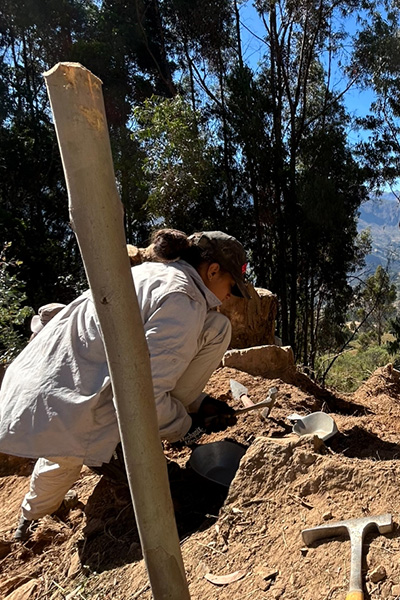
She spent three weeks at the Huari-Ancash Bio-Archaeological Research Project field school learning archaeological methods and putting that knowledge into practice by excavating a series of tombs in the mountains of Áncash, Peru.
“We found a lot of really cool artifacts,” said Sánchez Torres, who is majoring in medical anthropology and minoring in history, Portuguese, and criminology. “They had a lot of cool ceramics.”
Sánchez Torres and the other students spent their final week at the field school analyzing the artifacts and human remains they had unearthed from the tombs. The program also included lectures on the archeology and anthropology of the region, as well as opportunities to work closely with the researchers who were guiding the excavations.
The work was often physically difficult, in part because the excavations took place at sites between 9,000 to 12,000 feet above sea level. Sánchez Torres also had to bend upside down into some of the tombs to excavate them.
The benefits of the program far outweighed the physical discomfort, however. In addition to the opportunity to learn more about bioarchaeology, Sánchez Torres, who speaks Spanish, enjoyed talking to local residents and even picked up some words in Quechua, an Indigenous language.
“I think the best part for me was the cultural exchange with the locals,” she said. “People would come up to us, and they would say, ‘Oh, do you know about this site?’ and ‘I have this in my house, and it looks like this,’ and they would just casually have archaeological vases in their homes.”
Sánchez Torres, who grew up in West Palm Beach, was awarded a Beyond the Book scholarship and a grant from the Department of Anthropology to help cover the costs of participating in the program.
After she graduates from the University, Sánchez Torres plans to either complete law school, a Ph.D. in medical anthropology, or a joint J.D./Ph.D. program. If she decides to pursue law school, her plan is to become an international human rights lawyer.
